
Free Pre-Start Checklist (Leaf Vacuum) Template
Download our free Pre-Start Checklist (Leaf Vacuum) Template in DOCX and PDF.
Free Pre-Start Checklist (Leaf Vacuum) Template
DOCX • 125 KB + PDF
Updated Oct 2026
No signup required
Purpose of the Free Pre-Start Checklist (Leaf Vacuum) Template
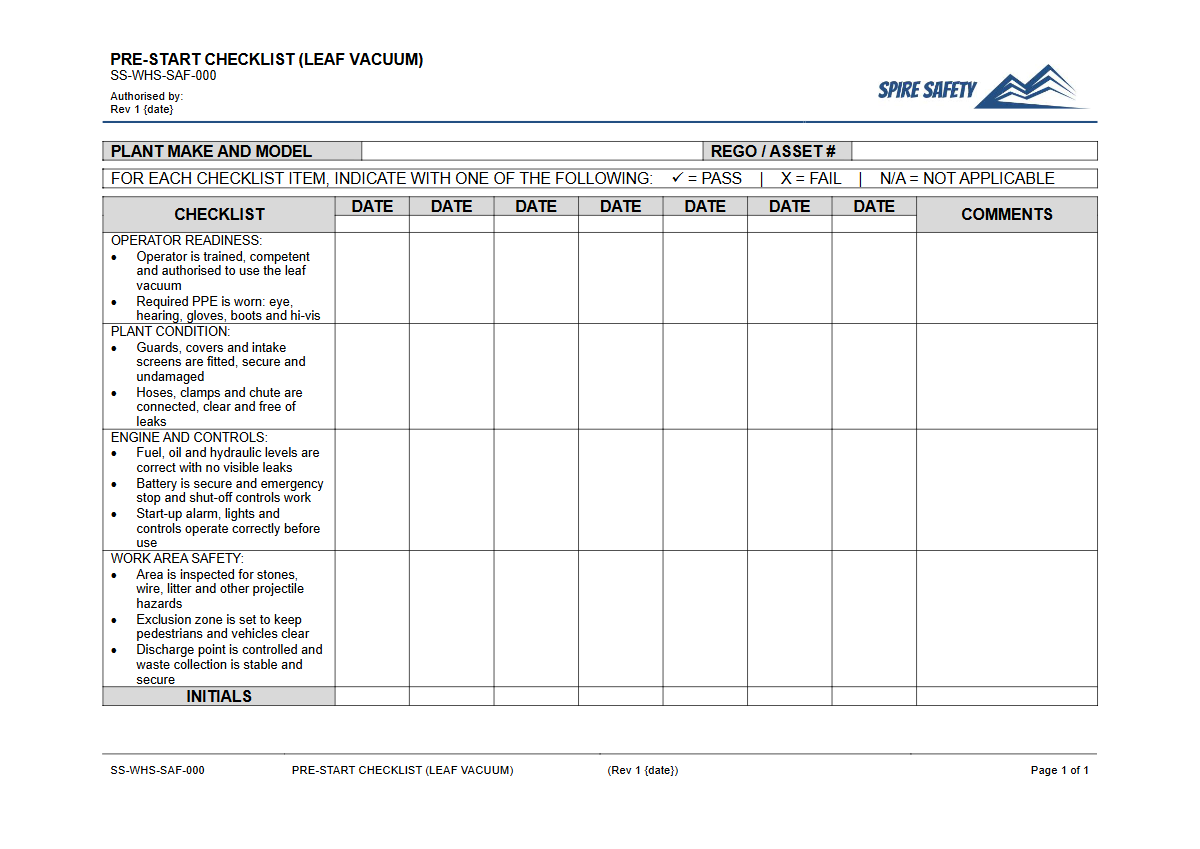
Ensuring outdoor power equipment is safe and ready for use is a critical part of workplace safety. Our Free Pre-Start Checklist (Leaf Vacuum) Template provides a structured starting point for formalising your daily equipment inspections.
This downloadable DOCX and PDF document helps operators quickly and effectively identify potential hazards, mechanical issues, or damage before starting work, reducing the risk of incidents and equipment downtime.
The primary purpose of this Pre-Start Checklist is to systematise the inspection process for leaf vacuums. By using this template, your organisation can promote a consistent safety standard for all operators.
It serves as a practical tool to help meet your duty of care under WHS legislation by identifying foreseeable hazards and taking steps to control them. Documenting these checks also creates a valuable record of your safety activities.
For broader team engagement on equipment safety, consider using our Pre-Start Checks and Plant Maintenance Toolbox Talk to reinforce good practices.
Video walkthrough
How to use the Free Pre-Start Checklist (Leaf Vacuum) Template
Simply download the template in your preferred format (DOCX for easy editing or PDF for immediate printing). The document is designed as a foundational guide for you to build upon.
Important: This is a generic template that must be customised for your specific needs. We recommend you review and adapt the checklist to include the unique makes and models of leaf vacuums used at your workplace, the specific tasks they are used for, and your company’s internal safety procedures. Integrating this checklist is a key component of effective WHS management systems.
When to use a Leaf Vacuum Pre-Start Checklist
A pre-start check should be completed by the operator before every use of the leaf vacuum. This includes the first time it is used on a shift and after any significant break.
Making this a non-negotiable part of the daily routine ensures that the equipment's condition is assessed consistently, preventing the use of unsafe or faulty machinery. This discipline is particularly important in high-use environments like council works, commercial landscaping, and property maintenance.
Who should use the Pre-Start Checklist
The checklist should be completed by the person who will be operating the leaf vacuum. They are in the best position to assess the equipment they are about to use.
Supervisors also have a role in ensuring these checks are being completed correctly and that any reported issues are addressed promptly. Verifying that an operator is competent to both use the equipment and perform the check is also crucial; for related equipment, you might use a document like our Verification of Competency (Hydrovac or Vacuum Excavator) Template as a reference for structuring your competency assessments.
What to Inspect on a Leaf Vacuum
A thorough pre-start inspection should cover several key areas. While your customised list will be more specific, key checks typically include:
- General Condition: Check for any visible damage, loose parts, or fluid leaks.
- Guards and Shields: Ensure all safety guards, particularly around the intake, impeller, and exhaust, are securely in place and undamaged.
- Fuel and Oil (for petrol models): Check levels and look for any leaks in fuel lines or caps.
- Controls: Verify that the throttle, choke, and on/off switch function correctly and are easy to operate.
- Intake/Nozzle: Ensure the vacuum tube and nozzle are free from blockages or damage.
- Collection Bag/Container: Inspect for tears, holes, or faulty zippers/latches that could allow dust and debris to escape.
- Personal Protective Equipment (PPE): Confirm that the required PPE, such as eye protection, hearing protection, gloves, and respiratory protection, is available and in good condition.
These checks should be part of a broader documented safety procedure. For similar high-risk equipment, a Safe Work Method Statement (Vacuum Truck Operation) Template can provide a useful framework for developing comprehensive risk controls.
Regular documentation of these processes is also vital for demonstrating safety compliance, a process often reviewed during a WHS compliance auditing program.
By integrating this checklist into your operations, you contribute to a safer work environment for everyone. Explore our complete free WHS resources library for more templates to support your safety management system.
Common mistakes
Common mistakes to avoid
- Skipping checks for 'quick jobs', leading to unforeseen equipment failures.
- Failing to check the condition of the collection bag or container for tears or damage.
- Ignoring manufacturer's specific inspection points outlined in the operator's manual.
- Not documenting the checks, leaving no record of due diligence.
Legal references
Legal considerations
The following legal requirements may be relevant to this type of work.
- Work Health and Safety Act (Harmonised) — Provides the primary duties for protecting workers and other people from work health and safety risks.
- Work Health and Safety Regulations (Harmonised) — Sets out requirements supporting the management of workplace hazards and risks.
The following codes may be relevant to this type of work.
- Managing WHS Risks Code of Practice — Provides practical guidance on identifying hazards, assessing risks and applying effective controls.
- Work Health and Safety Consultation, Cooperation and Coordination Code of Practice — Provides practical guidance on consulting workers and coordinating with other duty holders.
- Managing the Work Environment and Facilities Code of Practice — Provides practical guidance on safe work environments, workplace facilities and related controls.
Did you know
Noise Hazard
The noise from a commercial leaf vacuum can exceed 100 decibels, well above the 85 dBA exposure limit where hearing protection is mandatory in Australian workplaces.
Projectile Risk
Leaf vacuums can unintentionally pick up and eject small, hard objects like stones or twigs at high speeds, creating a significant risk of eye injuries to the operator and bystanders.
FAQ
Frequently asked questions
01Why are pre-start checks for leaf vacuums important?
02What should happen if a fault is found during the check?
03Is this checklist template enough for WHS compliance?
04How often should a leaf vacuum be inspected?
Share this resource
Free Pre-Start Checklist (Leaf Vacuum) Template
Browse Categories
How To Use It
- 1Download and open in Word or PDF.
- 2Replace the placeholders with your business details.
- 3Get it reviewed by a WHS specialist before rollout.
Need it customised?
Our WHS consultants can adapt this template to your site, run a gap analysis, or audit what you already have in place.
Book a Free Consultation WHS consulting servicesor call 1300 156 382