
Free Pre-Start Checklist (Lifting Beam) Template
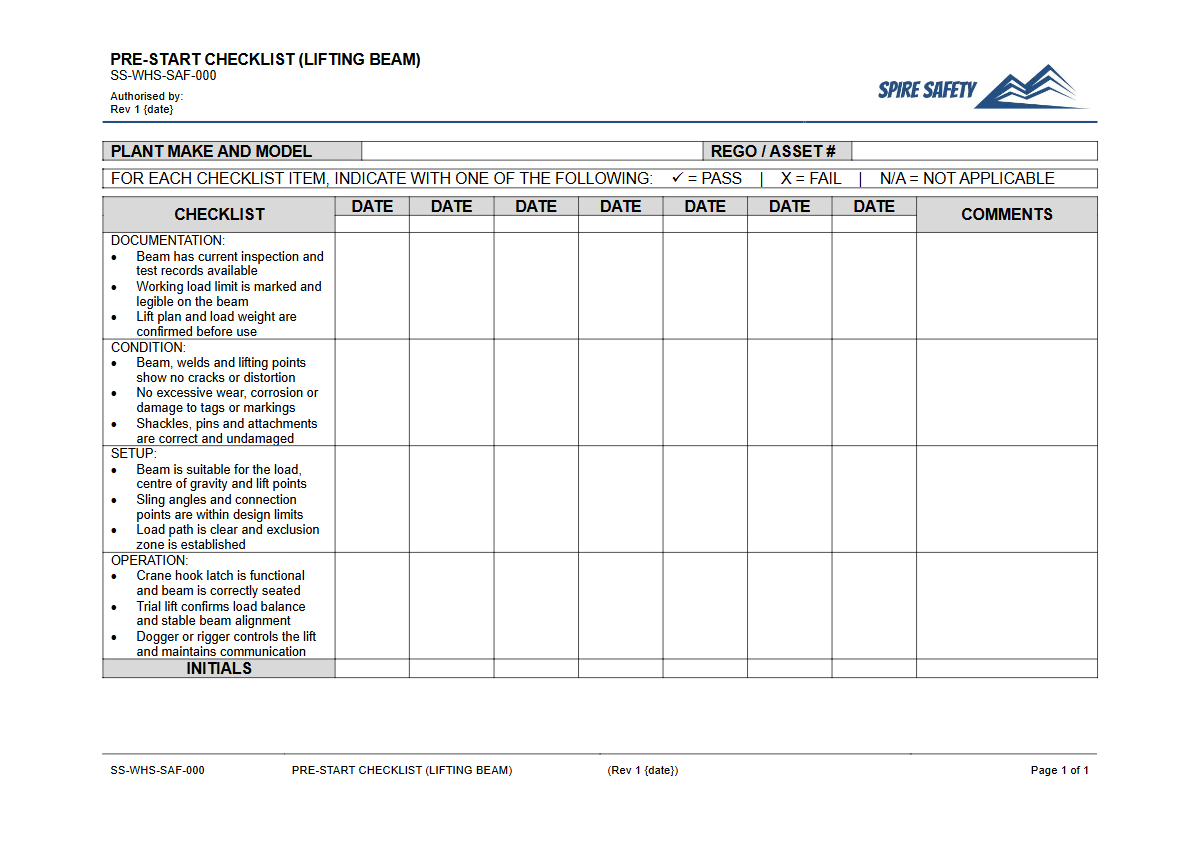
Download our free Pre-Start Checklist (Lifting Beam) Template. This structured document helps operators formalise safety checks before use. Get your DOCX & PDF.
Free Pre-Start Checklist (Lifting Beam) Template
DOCX • 125 KB + PDF
Updated Oct 2026
No signup required
Purpose of the Free Pre-Start Checklist (Lifting Beam) Template
A lifting beam is a critical piece of equipment used to handle heavy and often awkward loads. Failure of this equipment can have catastrophic consequences for workers and property.
This free Pre-Start Checklist (Lifting Beam) Template provides a structured framework for operators to conduct thorough, consistent inspections before each use. Implementing a formal pre-start process helps identify potential defects, damage, or wear and tear that could compromise the beam's integrity.
It's a fundamental part of managing risks associated with lifting operations, helping your organisation meet its duties under WHS law and maintain a safe working environment.
By documenting these checks, you create a clear record of equipment condition and demonstrate due diligence in your safety procedures. Regular pre-start inspections are a proactive measure to prevent incidents, reduce downtime from unexpected equipment failure, and protect your most valuable asset—your people. To further bolster safety culture around lifting, consider running a session with our Crane and Lifting Operations Safety Toolbox Talk.
What is a Lifting Beam?
A lifting beam is an engineered device used with cranes or hoists to provide multiple lifting points or to handle loads that need to be supported over a specific span. Unlike a spreader beam, which primarily handles compressive forces, a lifting beam is subjected to bending forces.
They are common in manufacturing, construction, and workshop environments for lifting materials like steel plates, frames, and machinery. This template is designed to cover the common inspection points for such devices.
Video walkthrough
How to use the Free Pre-Start Checklist (Lifting Beam) Template
Using this template effectively is straightforward. After downloading the DOCX or PDF file, it should be integrated into your daily operational procedures.
The operator responsible for the lift should complete the checklist at the beginning of their shift or immediately before the first use of the lifting beam for the day. They should physically verify each item on the list, noting the condition and ticking it off only after a satisfactory inspection.
Any identified faults, damage, or concerns must be recorded in the comments section, and the beam must be immediately quarantined from service until assessed by a competent person.
Completed checklists should be filed as part of your operational records. These records can be invaluable during safety audits or incident investigations.
A well-maintained archive demonstrates a consistent approach to safety and can help identify recurring issues with specific equipment. This process should be a core component of your broader WHS management systems.
Please note: This document is a template and must be customised to suit the specific make, model, and operational context of the lifting beams used in your workplace. We provide it as a starting point, not a finished, document.
You should add or remove checklist items based on the manufacturer's recommendations and a workplace-specific risk assessment.
When to use it
The Pre-Start Checklist for a lifting beam should be completed before its first use on any given day or shift. It is not a substitute for the comprehensive, periodic inspections that must be carried out by a competent person at intervals defined by Australian Standards and manufacturer guidelines.
Rather, it is a crucial daily check to catch any damage or defects that may have occurred since the last use. Reinforcing the importance of these daily checks can be achieved by using resources like our Pre-Start Checks and Plant Maintenance Toolbox Talk.
Who should use it
This checklist should be completed by a worker who is trained, competent, and authorised to operate the lifting equipment it will be attached to. The person performing the check must understand what they are looking for, including signs of stress, wear, distortion, and damage to welds, attachment points, and markings.
Their training should empower them to make a clear 'fit-for-use' or 'not-fit-for-use' decision. Using engineered lifting equipment like beams is a key strategy to avoid manual handling risks; a topic covered in our Healthy Backs - Posture and Lifting Toolbox Talk. If any doubt exists about the beam's condition, the operator must have the authority and responsibility to escalate the issue and prevent its use.
For complex situations, engaging external WHS consulting can provide expert guidance on your lifting procedures.
Common mistakes
Common mistakes to avoid
- Using a generic checklist without customising it for the specific lifting beam model and its application.
- "Pencil-whipping" the checklist by ticking boxes without physically and thoroughly inspecting each item.
- Ignoring minor defects like worn identification tags or slight surface corrosion, which can hide or lead to bigger problems.
- Failing to immediately quarantine a faulty lifting beam after a defect is found, leaving it in a state where it could be used accidentally.
Legal references
Legal considerations
The following legal requirements may be relevant to this type of work.
- Work Health and Safety Act (Harmonised) — Provides the primary duties for protecting workers and other people from work health and safety risks.
- Work Health and Safety Regulations (Harmonised) — Sets out requirements supporting the management of workplace hazards and risks.
The following codes may be relevant to this type of work.
- Managing WHS Risks Code of Practice — Provides practical guidance on identifying hazards, assessing risks and applying effective controls.
- Work Health and Safety Consultation, Cooperation and Coordination Code of Practice — Provides practical guidance on consulting workers and coordinating with other duty holders.
- Managing the Work Environment and Facilities Code of Practice — Provides practical guidance on safe work environments, workplace facilities and related controls.
Did you know
Load Capacity
The rated capacity of a lifting beam assumes a perfectly vertical lift. Angled lifts can dramatically increase the stresses on the beam and its components, potentially leading to failure even if the load is under the rated limit.
Hidden Damage
Hairline cracks, often invisible to the naked eye, can develop in welds or high-stress areas of a lifting beam. These can propagate suddenly under load, which is why non-destructive testing is often part of detailed periodic inspections.
FAQ
Frequently asked questions
01What items should be on a lifting beam pre-start checklist?
02How often should a lifting beam be inspected?
03Who is considered a competent person for inspecting lifting equipment?
04What happens if a defect is found during a pre-start check?
Share this resource
Free Pre-Start Checklist (Lifting Beam) Template
Browse Categories
How To Use It
- 1Download and open in Word or PDF.
- 2Replace the placeholders with your business details.
- 3Get it reviewed by a WHS specialist before rollout.
Need it customised?
Our WHS consultants can adapt this template to your site, run a gap analysis, or audit what you already have in place.
Book a Free Consultation WHS consulting servicesor call 1300 156 382