
Free Pre-Start Checklist (Linisher) Template
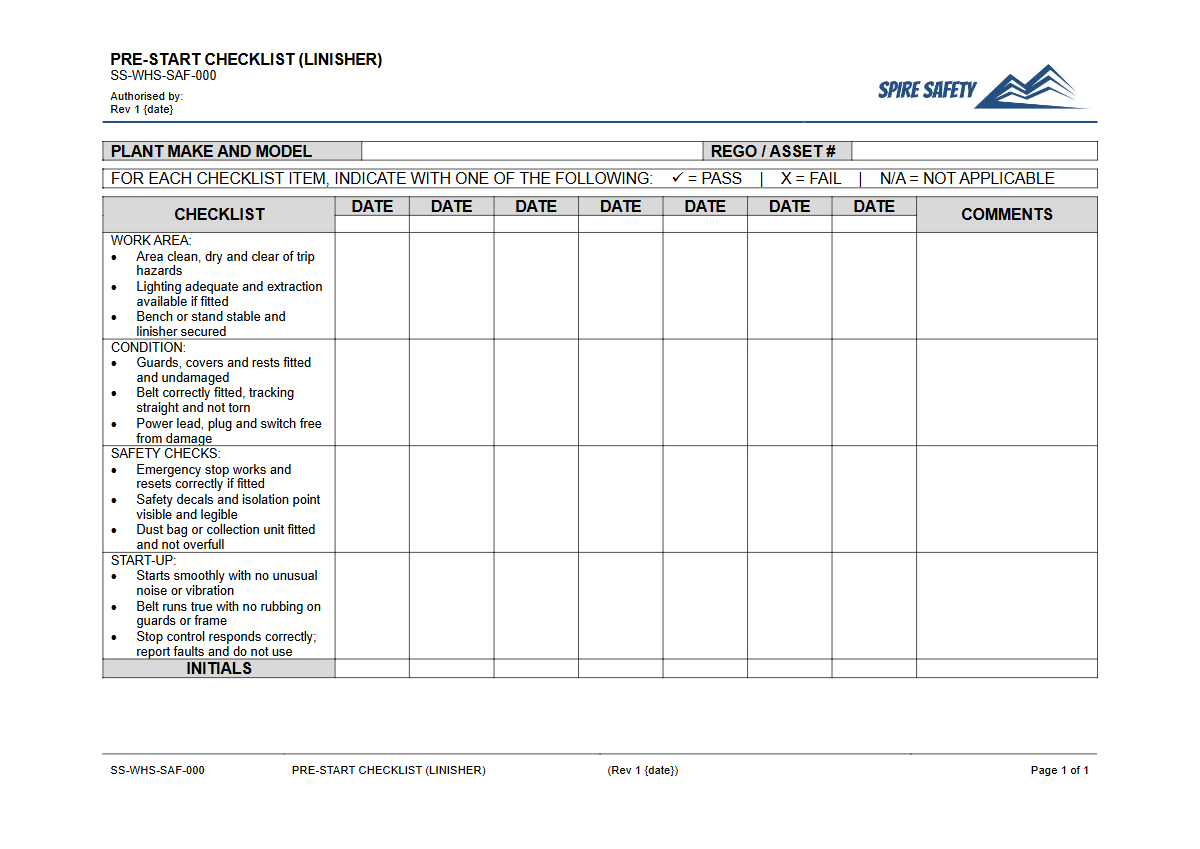
Download our Free Pre-Start Checklist (Linisher) Template (DOCX & PDF). Formalise daily equipment inspections to manage WHS risks in your workshop.
Free Pre-Start Checklist (Linisher) Template
DOCX • 125 KB + PDF
Updated Oct 2026
No signup required
Purpose of the Free Pre-Start Checklist (Linisher) Template
A linisher, also known as a belt sander or grinder, is a powerful abrasive tool common in workshops across Australia. Its operation presents significant hazards, including entanglement, abrasion, flying debris, noise, and hazardous dust.
This Free Pre-Start Checklist (Linisher) Template provides a structured framework for operators to conduct consistent, documented safety inspections before using the equipment. Systematically checking key components like guards, belts, and emergency stops helps identify potential faults that could lead to injury, ensuring the machine is fit for use at the start of every shift.
Integrating this checklist into your daily routine is a practical step towards fulfilling your PCBU (Person Conducting a Business or Undertaking) duties. It serves as a tangible record of risk management activities and promotes a proactive safety culture where operators take ownership of their equipment's condition.
These documented checks form a critical component of a comprehensive WHS management system, demonstrating a clear commitment to workplace safety and operational diligence.
Video walkthrough
How to use the Free Pre-Start Checklist (Linisher) Template
This resource is provided in both DOCX and PDF formats for your convenience. The DOCX file is fully editable, allowing you to tailor the checklist to the specific requirements of your workplace.
Download the template and adapt it to include the unique features, controls, and hazards associated with the linishers your team operates.
Note: It is crucial to remember that this is a template. We recommend you customise it to reflect the specific make, model, and configuration of the linishers in your workplace, as well as your specific operational environment and risk profile.
You may need to add or remove checks to ensure it is fully relevant.
Once customised, operators should be trained on how to complete the checklist correctly. This process is similar for other fixed plant, and you may find our free Pre-Start Checklist (Bench Grinder) Template a useful complementary resource for your workshop.
A completed check should confirm the machine is safe or clearly identify any faults that require it to be tagged out of service for repair.
When to use it
A pre-start checklist should be completed before the linisher is used for the first time on any given day or shift. This ensures a baseline of safety is established before work commences.
It is also best practice to conduct a check after any maintenance or repair work has been carried out to verify that the equipment has been returned to a safe operational state.
If an operator changes during a shift, the incoming operator should review the initial check or perform their own to ensure they are satisfied with the equipment's condition. Consistency is key; using the checklist every single time fosters a habit of safety and prevents complacency from setting in. This principle also applies to other high-risk equipment, such as that covered in our free Pre-Start Checklist for Floor Saws.
Who should use it
The primary person responsible for completing the Pre-Start Checklist (Linisher) is the machine's operator. They are in the best position to physically inspect the equipment and assess its immediate safety.
By signing off on the check, they are confirming they have inspected the linisher and found it safe to operate.
Supervisors and managers also have a role. They are responsible for ensuring the checks are being completed correctly and consistently.
They should periodically review completed checklists to identify recurring faults, which may indicate a need for scheduled maintenance or further operator training. Our WHS consulting services can assist in developing effective training and implementation programs.
WHS Officers or Safety Managers may also use the records generated by these checklists as part of broader WHS compliance auditing activities. The data can help track the safety performance of plant and equipment over time and inform risk assessments.
Depending on the materials being processed, effective dust control is also a critical consideration, and our free Pre-Start Checklist (Fume Cabinet) Template may also be relevant. For more templates and safety documents, you can explore our complete free WHS resources library.
Common mistakes
Common mistakes to avoid
- Failing to check the condition, tracking, and tension of the abrasive belt before starting.
- Ignoring the condition of machine guards, tool rests, and spark arrestors.
- Not ensuring the dust extraction system is turned on and functioning correctly before grinding.
- Treating the checklist as a 'tick-and-flick' exercise without conducting a genuine physical inspection.
Legal references
Legal considerations
The following legal requirements may be relevant to this type of work.
- Work Health and Safety Act (Harmonised) — Provides the primary duties for protecting workers and other people from work health and safety risks.
- Work Health and Safety Regulations (Harmonised) — Sets out requirements supporting the management of workplace hazards and risks.
The following codes may be relevant to this type of work.
- Managing WHS Risks Code of Practice — Provides practical guidance on identifying hazards, assessing risks and applying effective controls.
- Work Health and Safety Consultation, Cooperation and Coordination Code of Practice — Provides practical guidance on consulting workers and coordinating with other duty holders.
- Managing the Work Environment and Facilities Code of Practice — Provides practical guidance on safe work environments, workplace facilities and related controls.
Did you know
Guarding is Key
Abrasive belts on linishers can travel at speeds exceeding 20 metres per second. Unguarded or improperly guarded belts and wheels are a leading cause of serious entanglement and abrasion injuries in workshops.
Dust Dangers
Dust generated from grinding certain materials, such as metals, composites, or treated woods, can be a significant respiratory hazard. Effective dust extraction and appropriate respiratory protective equipment (RPE) are critical controls.
FAQ
Frequently asked questions
01What is the difference between a linisher and a bench grinder?
02Is using a linisher pre-start checklist a legal requirement?
03How often should a linisher pre-start check be performed?
04What should happen if a fault is found during a pre-start check?
Share this resource
Free Pre-Start Checklist (Linisher) Template
Browse Categories
How To Use It
- 1Download and open in Word or PDF.
- 2Replace the placeholders with your business details.
- 3Get it reviewed by a WHS specialist before rollout.
Need it customised?
Our WHS consultants can adapt this template to your site, run a gap analysis, or audit what you already have in place.
Book a Free Consultation WHS consulting servicesor call 1300 156 382