
Free Pre-Start Checklist (Log Splitter) Template
Download our free Pre-Start Checklist (Log Splitter) Template in DOCX & PDF. This resource helps formalise equipment checks and manage WHS risks.
Free Pre-Start Checklist (Log Splitter) Template
DOCX • 125 KB + PDF
Updated Oct 2026
No signup required
Purpose of the Free Pre-Start Checklist (Log Splitter) Template
Operating a log splitter involves significant risks, from crushing and amputation hazards to high-pressure hydraulic fluid injection. A consistent inspection routine is non-negotiable for safety.
This free Pre-Start Checklist (Log Splitter) Template provides a structured starting point for your organisation to formalise equipment safety checks before each use. By documenting inspections, you create a clear record of due diligence and help operators systematically identify potential faults before they can cause an incident.
This template is designed to align with Australian WHS principles for plant and equipment management.
Implementing documented checks helps integrate safety into daily operations, reinforcing a positive safety culture. It serves as a practical tool within broader WHS management systems, demonstrating a commitment to proactively managing workplace hazards.
Regularly completing this checklist ensures the machine's critical safety features are functional and that operators are actively thinking about safety before they begin work.
Video walkthrough
How to use the Free Pre-Start Checklist (Log Splitter) Template
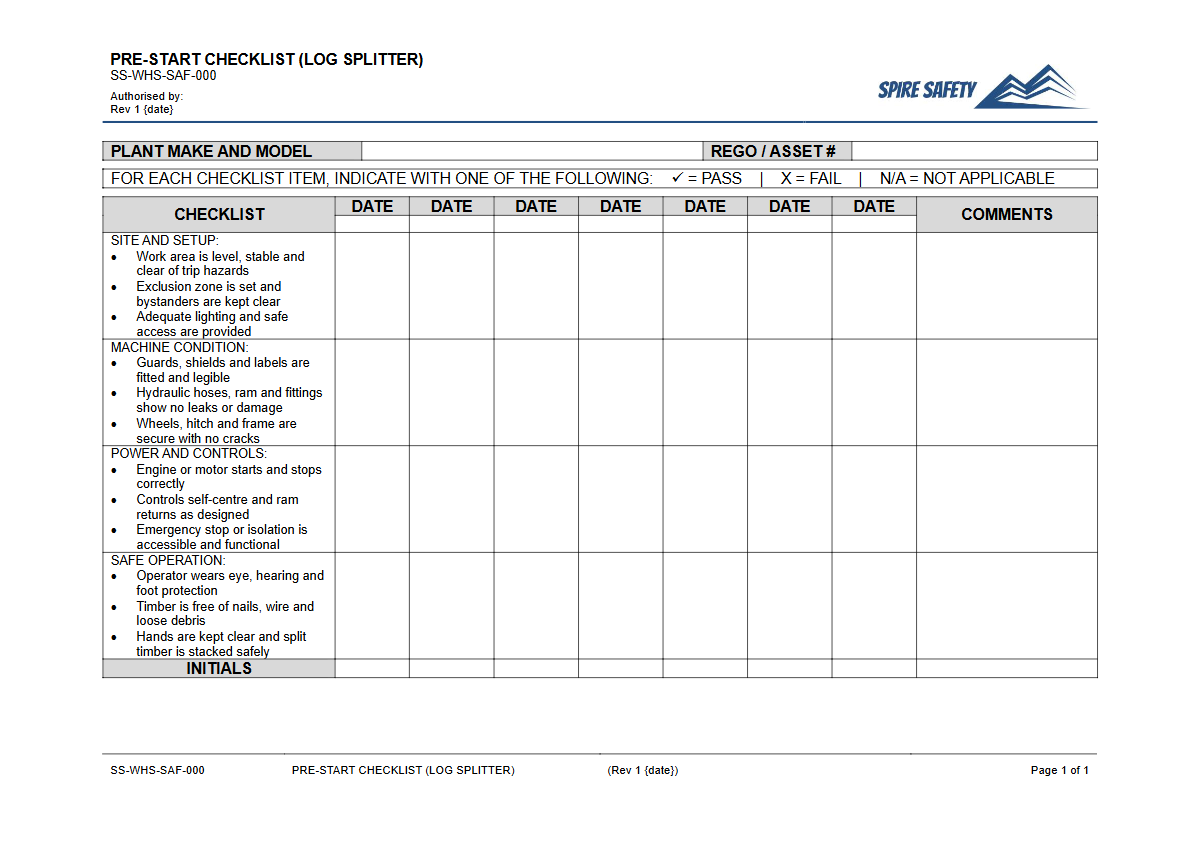
This resource is available as a DOCX file for easy editing and a PDF for straightforward printing. The checklist format guides the operator through a logical inspection sequence, covering key mechanical, hydraulic, and safety components specific to log splitters.
Items are typically checked off as 'OK', 'Fault', or 'N/A', with space for comments to detail any issues found.
Important: This is a template, not a finished document. Every workplace and piece of equipment is different.
You must customise this checklist to suit the specific make and model of your log splitter, your operational environment, and your organisation's specific safety procedures. We are not responsible for any incidents that may arise from the use of this template.
It is your responsibility to ensure the final document is fit for purpose. For other equipment-specific examples, you can review our Free Pre-Start Checklist (CNC Router) Template.
Key Inspection Areas to Include
Your customised checklist should cover critical components, including:
- Guards and Shields: Ensure all guards are in place, secure, and undamaged.
- Controls: Check that operating levers, switches, and emergency stops are functional and clearly labelled.
- Hydraulic System: Inspect hoses, fittings, and cylinders for leaks, cracks, or damage. Check hydraulic fluid levels.
- Splitting Wedge and Ram: Look for signs of damage, cracking, or excessive wear.
- Frame and Structure: Check the overall stability of the machine, including wheels and support legs.
- Work Area: Ensure the surrounding area is clear of obstructions, trip hazards, and unauthorised personnel.
When to use it
A pre-start check should be completed before every use of the log splitter or, for continuous operations, at the beginning of each shift. This frequency ensures that any damage or faults that may have occurred during previous use, transport, or overnight are identified before the machine is put under load again. Consistent checks are a cornerstone of effective equipment safety, as discussed in our Pre-Start Checks and Plant Maintenance Toolbox Talk.
Who should use it
The pre-start checklist must be completed by a person who is trained, competent, and authorised to operate the specific log splitter. The operator should have a thorough understanding of the machine's functions, potential hazards, and the safety procedures to follow.
Assessing and documenting operator skill is crucial, and a process similar to our Verification of Competency (Pipe Threader) Template can be adapted for this purpose.
Supervisors or managers should periodically review completed checklists to identify recurring faults, confirm checks are being done correctly, and ensure any required maintenance is actioned. These reviews can be a key input for internal WHS compliance auditing to verify that safety procedures are being followed effectively on the ground.
If a fault is identified during the check, the log splitter must be immediately taken out of service, tagged with a "Do Not Operate" or similar tag, and reported to a supervisor for repair. The machine should not be used until it has been repaired by a qualified person and cleared for return to service. This process should be clearly defined in your operational procedures, much like the steps outlined in a Safe Work Method Statement (SWMS) for Concrete Truck Operations.
This document is just one of many tools available to help you build a safer workplace. For a wider range of checklists, forms, and talk templates, browse our complete free WHS resources library.
Common mistakes
Common mistakes to avoid
- Using the template without customising it for the specific machine.
- The operator completing the checklist from memory without physically inspecting each item.
- Ignoring 'minor' faults like small hydraulic leaks or missing guard bolts.
- Failing to formally tag out and remove a faulty machine from service.
Legal references
Legal considerations
The following legal requirements may be relevant to this type of work.
- Work Health and Safety Act (Harmonised) — Provides the primary duties for protecting workers and other people from work health and safety risks.
- Work Health and Safety Regulations (Harmonised) — Sets out requirements supporting the management of workplace hazards and risks.
The following codes may be relevant to this type of work.
- Managing WHS Risks Code of Practice — Provides practical guidance on identifying hazards, assessing risks and applying effective controls.
- Work Health and Safety Consultation, Cooperation and Coordination Code of Practice — Provides practical guidance on consulting workers and coordinating with other duty holders.
- Managing the Work Environment and Facilities Code of Practice — Provides practical guidance on safe work environments, workplace facilities and related controls.
Did you know
Incredible Force
Consumer-grade log splitters can generate between 10 to 30 tons of force, easily splitting hardwood logs but also capable of causing severe crushing injuries in an instant.
The Silent Danger
A pinhole leak in a high-pressure hydraulic hose can inject fluid into the skin at over 400 km/h. This injury may look minor but can cause severe tissue damage and requires immediate, specialised medical treatment.
FAQ
Frequently asked questions
01What are the main hazards of using a log splitter?
02How often should a log splitter be inspected?
03Is a pre-start checklist a legal requirement in Australia?
04Can I use this template for any brand or model of log splitter?
Share this resource
Free Pre-Start Checklist (Log Splitter) Template
Browse Categories
How To Use It
- 1Download and open in Word or PDF.
- 2Replace the placeholders with your business details.
- 3Get it reviewed by a WHS specialist before rollout.
Need it customised?
Our WHS consultants can adapt this template to your site, run a gap analysis, or audit what you already have in place.
Book a Free Consultation WHS consulting servicesor call 1300 156 382