
Free Pre-Start Checklist (Marine Hoist) Template
Download our free Pre-Start Checklist (Marine Hoist) Template. This structured Word & PDF document helps formalise daily safety checks and identify hazards.
Free Pre-Start Checklist (Marine Hoist) Template
DOCX • 125 KB + PDF
Updated Oct 2026
No signup required
Purpose of the Free Pre-Start Checklist (Marine Hoist) Template
Operating a marine hoist involves significant risks, from structural failure to dropped loads. This Free Pre-Start Checklist (Marine Hoist) Template provides a structured framework for operators to conduct thorough, systematic inspections before each use.
Its primary purpose is to identify any damage, wear, malfunction, or environmental hazards that could compromise the safe operation of the equipment. Using this checklist helps create a consistent safety routine, reduces the likelihood of incidents, and supports preventative maintenance efforts by catching minor issues before they become critical failures.
A well-documented inspection process is a key component of your safety management system. The completed checklists serve as important records, demonstrating due diligence and providing valuable data for maintenance scheduling and regular WHS compliance auditing. Formalising this process moves your organisation beyond informal checks and towards a more robust approach to managing plant safety.
What this Pre-Start Checklist covers
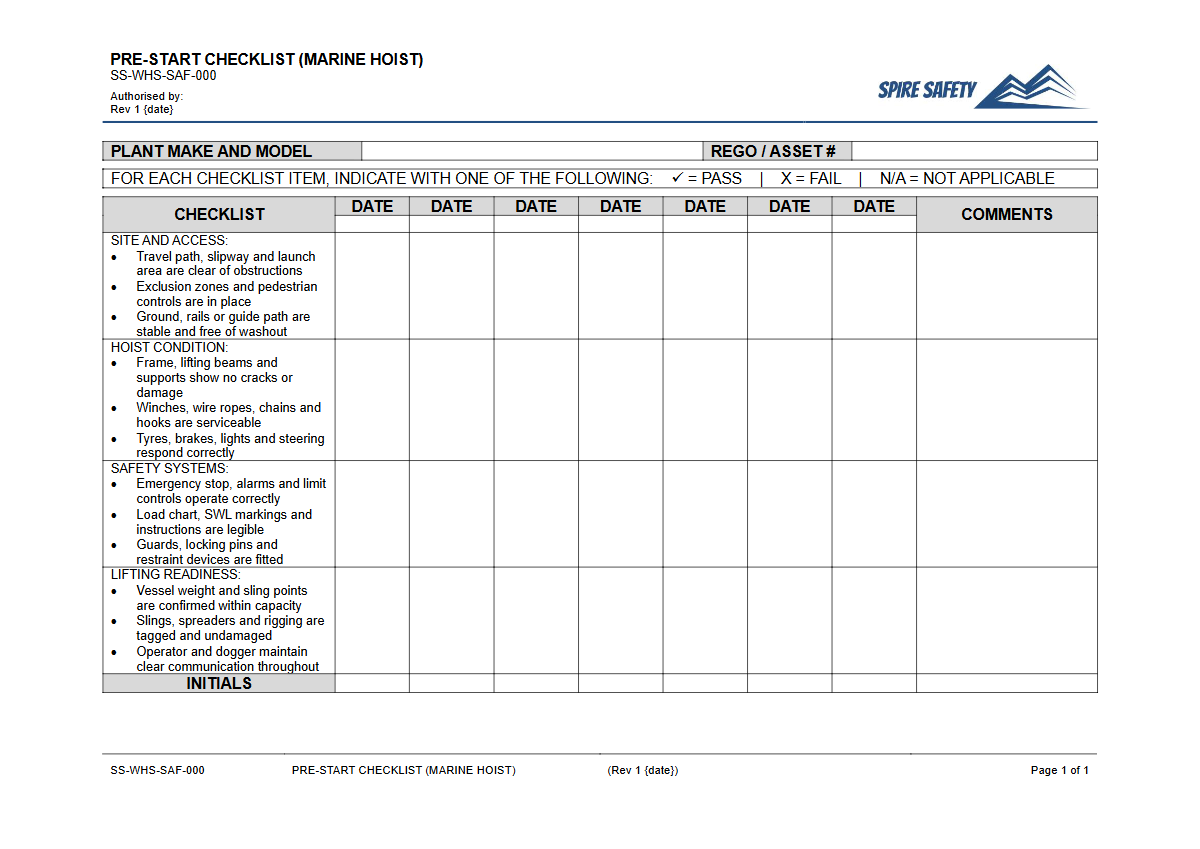
This template prompts checks across key areas of a typical marine hoist, including:
- Structural Components: Frame, beams, columns, and fasteners for signs of corrosion, cracks, or deformation.
- Lifting Mechanisms: Wire ropes, chains, slings, hooks, and safety latches for wear, fraying, or damage.
- Mechanical Systems: Wheels, brakes, gearboxes, and hydraulic systems for leaks, proper lubrication, and function.
- Controls and Electrics: Emergency stops, control pendants, limit switches, and warning devices for correct operation.
- Work Area: Checks for clear travel paths, stable ground conditions, and exclusion zones.
These daily inspections are a cornerstone of equipment safety and are an excellent topic to reinforce with your teams. You can use our Pre-Start Checks and Plant Maintenance Toolbox Talk Template to facilitate these important discussions.
Video walkthrough
How to use the Free Pre-Start Checklist (Marine Hoist) Template
This checklist is available for download in both DOCX and PDF formats. The DOCX file is fully editable, allowing you to tailor it to your specific operational needs. To use it effectively, follow these steps:
- Download the template and open the DOCX version.
- Review the checklist items against the manufacturer’s operating manual for your specific marine hoist.
- Add, remove, or modify checks to reflect the unique features and risks of your equipment and work environment (e.g., specific checks for a hydraulic boat trailer versus a fixed boat lift).
- Save the customised document as your organisation's official pre-start checklist and distribute it to all authorised operators.
Important: This document is a template, not a finished safety tool. We provide it as a starting point.
You must customise this checklist to address the specific hazards present in your workplace and the unique characteristics of your machinery. It's crucial that operators are not only trained on how to fill out the checklist but also deemed competent in operating the equipment.
For related machinery, our Verification of Competency (Electric Hoist or Chain Block) Template provides a useful structure for assessing operator skills.
When to use it
A pre-start checklist for a marine hoist should be completed before the first use on every shift or every day the equipment is operated. If the hoist is used intermittently throughout the day, a single check at the start of the day may be sufficient, provided no incidents or changes in condition have occurred.
The goal is to ensure the equipment is in a safe condition at the moment of use. Integrating this check into your daily operational rhythm is a fundamental part of a proactive safety culture and a well-functioning WHS management systems.
Who should use it
The pre-start checklist must be completed by a person who is trained, authorised, and competent to operate the specific marine hoist. This is typically the operator assigned to the equipment for the shift.
Supervisors or managers also have a responsibility to ensure these checks are being completed correctly and to review the completed forms. They must take prompt action on any reported faults or deficiencies, which includes removing the hoist from service until it can be inspected and repaired by a qualified person. Communicating these findings and any changes in equipment status can be effectively managed during daily team briefings, which can be documented using a Free Pre-Start Meeting Template.
By implementing a rigorous pre-start inspection process, you actively manage risks and uphold your duty of care. This template is one of many tools available in our free WHS resources library, designed to help Australian businesses build safer workplaces.
Common mistakes
Common mistakes to avoid
- Using a generic checklist not customised for the specific hoist model.
- "Pencil-whipping" the form without physically inspecting each item.
- Failing to immediately tag out and report faulty or damaged equipment.
- Poor record-keeping of completed checklists and identified defects.
Legal references
Legal considerations
The following legal requirements may be relevant to this type of work.
- Work Health and Safety Act (Harmonised) — Provides the primary duties for protecting workers and other people from work health and safety risks.
- Work Health and Safety Regulations (Harmonised) — Sets out requirements supporting the management of workplace hazards and risks.
The following codes may be relevant to this type of work.
- Managing WHS Risks Code of Practice — Provides practical guidance on identifying hazards, assessing risks and applying effective controls.
- Work Health and Safety Consultation, Cooperation and Coordination Code of Practice — Provides practical guidance on consulting workers and coordinating with other duty holders.
- Managing the Work Environment and Facilities Code of Practice — Provides practical guidance on safe work environments, workplace facilities and related controls.
Did you know
Corrosion Risk
Marine environments accelerate corrosion. Regular, thorough checks of wire ropes, chains, and structural steel are critical as saltwater and salty air can significantly reduce their structural integrity and load capacity much faster than in other environments.
FAQ
Frequently asked questions
01What's the difference between a pre-start check and regular maintenance?
02Is this marine hoist checklist compliant with Australian WHS laws?
03Who is responsible for ensuring marine hoist pre-start checks are done?
04What should I do if I find a fault during a pre-start check?
Share this resource
Free Pre-Start Checklist (Marine Hoist) Template
Browse Categories
How To Use It
- 1Download and open in Word or PDF.
- 2Replace the placeholders with your business details.
- 3Get it reviewed by a WHS specialist before rollout.
Need it customised?
Our WHS consultants can adapt this template to your site, run a gap analysis, or audit what you already have in place.
Book a Free Consultation WHS consulting servicesor call 1300 156 382