
Free Pre-Start Checklist (Mast Lift) Template
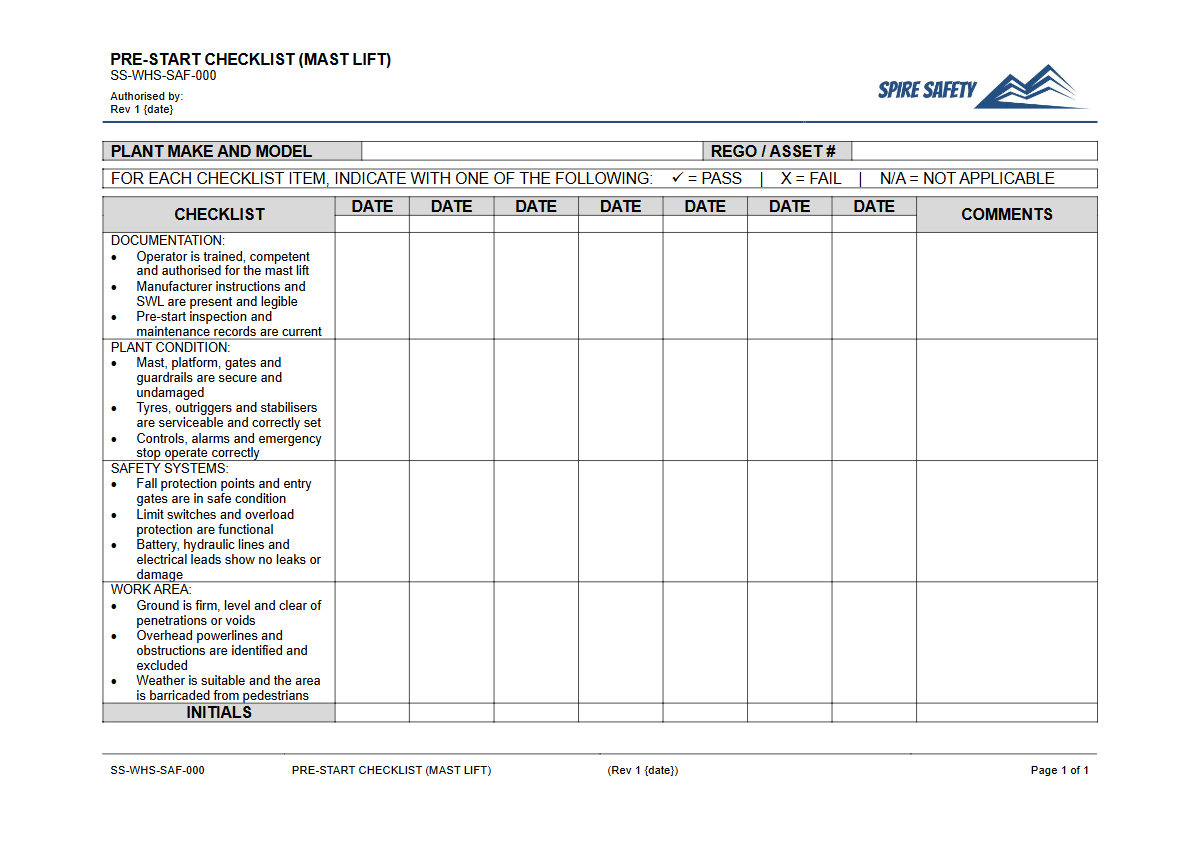
Download our free Pre-Start Checklist (Mast Lift) Template. This structured DOCX & PDF document helps formalise daily equipment inspections and WHS processes.
Free Pre-Start Checklist (Mast Lift) Template
DOCX • 125 KB + PDF
Updated Oct 2026
No signup required
Purpose of the Free Pre-Start Checklist (Mast Lift) Template
Using a vertical mast lift requires rigorous safety checks before every shift. Our Free Pre-Start Checklist (Mast Lift) Template provides a structured starting point for operators to conduct these essential inspections, helping to identify potential faults or hazards before they lead to an incident.
A documented pre-start process is a fundamental part of a PCBU's primary duty of care to provide and maintain safe plant and equipment. Formalising this process helps create a consistent safety standard across all operators and shifts.
This checklist guides operators through a systematic inspection of critical components, from controls and emergency systems to structural integrity and stability. By identifying and reporting issues early, businesses can prevent equipment failures, avoid costly unplanned downtime, and most importantly, reduce the risk of accidents and injuries.
Integrating this check into daily routines reinforces a proactive safety culture, where every worker understands their role in maintaining a safe work environment. To further embed these practices, consider using our Pre-Start Checks and Plant Maintenance Toolbox Talk to brief your team.
Video walkthrough
How to use the Free Pre-Start Checklist (Mast Lift) Template
This resource is available for immediate download as both a DOCX file for easy editing and a PDF for straightforward printing. To implement it effectively, start by customising the checklist to suit your specific operational needs.
The provided template is a comprehensive starting point aligned with Australian WHS principles, but it is not a one-size-fits-all solution.
Important: It is crucial to adapt this template to the specific make and model of your mast lift, your site conditions, and your operational risks. We have provided a solid foundation, but you must ensure it aligns perfectly with your workplace's unique requirements.
Add or remove checks as necessary, consult the manufacturer’s instructions, and reference relevant risk assessments. This customisation is a key step in ensuring the checklist is a practical and effective tool for your workers. A pre-start check is just one part of a safe system of work, which is often detailed in a Safe Work Method Statement (Scissor Lift Operation) Template.
When to use a Mast Lift Pre-Start Checklist
A pre-start checklist should be completed by a competent operator before the first use of the mast lift on every shift. This ensures that the equipment's condition has not changed overnight or between operators.
The check should also be performed if the mast lift is relocated to a different area of the worksite, as new environmental hazards may be present. Furthermore, a thorough inspection is necessary after the equipment has undergone maintenance or repairs to verify that it has been returned to a safe operational state.
Consistent use of the checklist provides a clear, documented history of the equipment's condition.
Who should use this Pre-Start Checklist
This checklist should be used by any person tasked with operating a mast lift. It is essential that these individuals are not only licensed (where required) but are also deemed competent to operate the specific model of equipment.
Part of this competence includes the ability to conduct a thorough pre-start inspection and recognise potential defects. You can formalise this process using a resource like our Scissor Lift VOC (Verification of Competency) Template, adapting it for your mast lifts.
Supervisors and safety officers also have a role in reviewing completed checklists to ensure the process is being followed correctly and that any reported faults are actioned in a timely manner.
Beyond the Operator
While the operator is the primary user, the information gathered on these checklists is valuable for the entire organisation. Maintenance personnel can use the records to track recurring issues and schedule preventative maintenance.
Management can use the data as part of their overall review of the organisation's WHS management systems, demonstrating active monitoring of plant safety. This documentation also serves as critical evidence of due diligence during safety audits or in the event of an incident.
Integrating with Risk Management
The pre-start checklist is a direct outcome of a thorough risk assessment process. It acts as a final, practical check to manage risks identified for that piece of plant.
When conducting your initial assessment, you identify hazards like hydraulic failure, control malfunction, or instability. The pre-start check then becomes the operational control measure to verify that safeguards for those hazards are in place and working. For a related example of this process, see our Free Scissor Lift Risk Assessment Template.
Regularly reviewing completed checklists can also inform future risk assessments. If operators frequently report minor issues with a particular component, it may indicate a systemic problem that requires a higher-level control measure.
This continuous improvement loop is the cornerstone of an effective safety management system. To ensure your processes remain effective, consider periodic, independent WHS compliance auditing to identify any gaps or opportunities for improvement.
Common mistakes
Common mistakes to avoid
- Treating the check as a "tick and flick" exercise without physically verifying each item.
- Failing to customise the generic checklist for the specific make and model of the mast lift.
- Not immediately removing the equipment from service when a fault is found and reported.
- Poor record-keeping or failing to have supervisors review completed checklists for actioning.
Legal references
Legal considerations
The following legal requirements may be relevant to this type of work.
- Work Health and Safety Act (Harmonised) — Provides the primary duties for protecting workers and other people from work health and safety risks.
- Work Health and Safety Regulations (Harmonised) — Sets out requirements supporting the management of workplace hazards and risks.
The following codes may be relevant to this type of work.
- Managing WHS Risks Code of Practice — Provides practical guidance on identifying hazards, assessing risks and applying effective controls.
- Work Health and Safety Consultation, Cooperation and Coordination Code of Practice — Provides practical guidance on consulting workers and coordinating with other duty holders.
- Managing the Work Environment and Facilities Code of Practice — Provides practical guidance on safe work environments, workplace facilities and related controls.
Did you know
A Leading Cause of Fatalities
Falls from height remain a leading cause of fatalities in the Australian construction industry. Rigorous pre-start checks on elevating work platforms (EWPs) like mast lifts are a critical control measure to prevent equipment failure.
Duty of Care
Under model WHS laws, a PCBU must ensure plant is safe to use. Documented pre-start checks provide tangible evidence of the process used to fulfil this duty, so far as is reasonably practicable.
FAQ
Frequently asked questions
01What is the purpose of a mast lift pre-start checklist?
02How often should a mast lift pre-start check be completed?
03Who is responsible for completing the mast lift pre-start?
04Can I use this template for any type of mast lift?
Share this resource
Free Pre-Start Checklist (Mast Lift) Template
Browse Categories
How To Use It
- 1Download and open in Word or PDF.
- 2Replace the placeholders with your business details.
- 3Get it reviewed by a WHS specialist before rollout.
Need it customised?
Our WHS consultants can adapt this template to your site, run a gap analysis, or audit what you already have in place.
Book a Free Consultation WHS consulting servicesor call 1300 156 382