
Free Pre-Start Checklist (Meat Tender) Template
Formalise safety checks in your butchery or food processing facility with our free Pre-Start Checklist (Meat Tender) Template. Download now in DOCX & PDF.
Free Pre-Start Checklist (Meat Tender) Template
DOCX • 125 KB + PDF
Updated Oct 2026
No signup required
Purpose of the Free Pre-Start Checklist (Meat Tender) Template
A meat tenderiser is a powerful piece of equipment that presents significant risks, including severe cuts from blades, entanglement in moving parts, and electrical hazards. Using a structured checklist before operation is a fundamental safety practice.
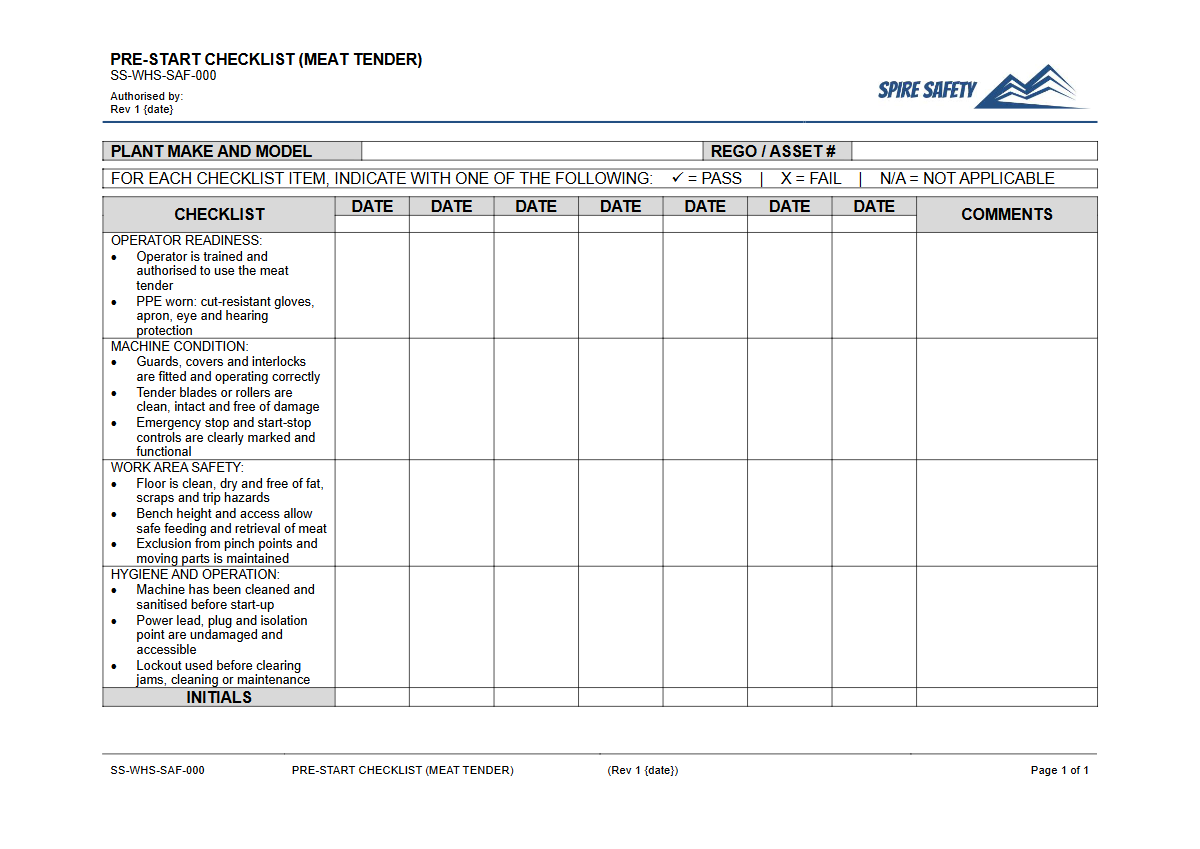
This free Pre-Start Checklist (Meat Tender) Template provides a formal method for operators to inspect the equipment before use, ensuring it is in safe working order. Implementing this check helps your organisation identify potential faults early, prevent incidents, and maintain a documented record of safety inspections, which is a key component of a robust safety management system.
Regularly completing these checks demonstrates a commitment to workplace safety and helps meet duties under WHS legislation. It encourages a proactive safety culture where potential hazards are identified and controlled before they can cause harm.
The process also plays a vital role in food safety by including checks for cleanliness and sanitation, preventing cross-contamination. For a broader view on integrating checks into your daily safety routines, consider using a free pre-start meeting template to brief your team on daily hazards and tasks.
Video walkthrough
How to use the Free Pre-Start Checklist (Meat Tender) Template
This resource is available as a user-friendly DOCX file for easy editing in Microsoft Word or other word processors, and also as a PDF for universal access and printing. After downloading, you can adapt the checklist to suit your specific operational needs.
Important: This document is a template and must be customised for your workplace. We recommend a competent person, such as a supervisor or WHS representative, adapts the checklist to align with the specific make and model of your meat tenderiser, its unique hazards, your organisation's safe work procedures, and the relevant Australian standards.
Integrating this customised checklist into your overall WHS management system ensures it aligns with your broader safety framework and objectives.
What to include in your inspection
Your customised checklist should cover critical safety components. Key areas to inspect before starting a meat tenderiser include:
- Guards and Covers: Ensure all physical guards are in place, secure, and undamaged. Check that interlock systems on guards are functioning correctly, meaning the machine cannot operate if a guard is open.
- Emergency Stops: Test all emergency stop buttons and switches to confirm they immediately halt the machine's operation.
- Blades and Cutting Components: Visually inspect blades for sharpness, damage, or missing parts. Ensure they are correctly seated and secured.
- Electrical Safety: Check that power cords, plugs, and switches are free from damage, fraying, or exposed wires. The machine should be properly earthed.
- Cleanliness and Sanitation: Verify that the machine and its components have been properly cleaned and sanitised from the previous use, with no food residue or foreign matter present.
- Operating Controls: Test that all start, stop, and operational controls are working as intended and are clearly labelled.
- Work Area: Ensure the area around the tenderiser is clear of obstructions, slip hazards like water or grease, and has adequate lighting.
These checks help form a comprehensive safety procedure. Reinforcing these principles can be effectively achieved through regular training sessions, such as a pre-start checks and plant maintenance toolbox talk, to keep safety at the forefront of every operator's mind.
When to use it
The pre-start checklist should be completed by the operator before the first use of the meat tenderiser on every shift. It should also be performed after any extended break, following cleaning or maintenance activities, or if the machine has been moved.
This routine ensures a consistent safety standard and catches any issues that may have developed between uses.
Periodic WHS compliance audits can help verify that procedures like pre-start checks are being consistently followed and remain effective. This level of oversight helps maintain high safety standards across the entire operation.
While this resource is specific to meat tenderisers, the principles apply to many types of machinery. For example, similar pre-start diligence is required for complex equipment covered in resources like our free Pre-Start Checklist (CNC Router) Template.
Who should use it
This checklist is designed for several key personnel within a food processing, butchery, or commercial kitchen environment:
- Machine Operators: As the primary users of the equipment, operators are responsible for conducting the pre-start check to ensure their own safety and the safety of those around them.
- Supervisors and Line Managers: They are responsible for ensuring operators are trained and competent to perform the checks, and for reviewing completed checklists to monitor compliance and address any reported issues promptly.
- WHS and Maintenance Personnel: WHS managers can use the completed checklists as data for safety audits and risk assessments. Maintenance staff rely on the reports to schedule repairs and preventative maintenance, preventing equipment failure.
For more complex safety challenges or assistance in developing comprehensive safety documentation, organisations can benefit from specialist WHS consulting to ensure their systems are robust and effective. You can also explore our entire catalogue of checklists, toolbox talks, and templates in our free WHS resources library.
Common mistakes
Common mistakes to avoid
- Using a generic checklist without customising it for the specific machine model and its unique guards or controls.
- Skipping the check under the assumption that the machine was 'working fine yesterday'.
- Failing to immediately report, tag out, and remove faulty equipment from service.
- Treating the checklist as a 'tick and flick' paperwork exercise instead of a genuine safety inspection.
Legal references
Legal considerations
The following legal requirements may be relevant to this type of work.
- Work Health and Safety Act (Harmonised) — Provides the primary duties for protecting workers and other people from work health and safety risks.
- Work Health and Safety Regulations (Harmonised) — Sets out requirements supporting the management of workplace hazards and risks.
The following codes may be relevant to this type of work.
- Managing WHS Risks Code of Practice — Provides practical guidance on identifying hazards, assessing risks and applying effective controls.
- Work Health and Safety Consultation, Cooperation and Coordination Code of Practice — Provides practical guidance on consulting workers and coordinating with other duty holders.
- Managing the Work Environment and Facilities Code of Practice — Provides practical guidance on safe work environments, workplace facilities and related controls.
Did you know
Laceration Risk
The sharp, fast-moving blades in commercial meat tenderisers can cause severe lacerations and amputations, making functioning guards and emergency stops the most critical safety controls.
Food Safety Link
For food processing equipment, pre-start checks are a crucial step in a site's HACCP or food safety plan, helping to prevent physical, chemical, and biological contamination.
FAQ
Frequently asked questions
01What key items should be on a meat tenderiser pre-start inspection checklist?
02Is a digital pre-start checklist better than a paper one?
03How often should completed meat tenderiser pre-start checklists be reviewed?
04Why is checking for cleanliness so important on a meat tenderiser pre-start?
Share this resource
Free Pre-Start Checklist (Meat Tender) Template
Browse Categories
How To Use It
- 1Download and open in Word or PDF.
- 2Replace the placeholders with your business details.
- 3Get it reviewed by a WHS specialist before rollout.
Need it customised?
Our WHS consultants can adapt this template to your site, run a gap analysis, or audit what you already have in place.
Book a Free Consultation WHS consulting servicesor call 1300 156 382