
Free Pre-Start Checklist (Metal Detector) Template
Download our free Pre-Start Checklist (Metal Detector) Template to formalise equipment inspections and improve safety.
Free Pre-Start Checklist (Metal Detector) Template
DOCX • 125 KB + PDF
Updated Oct 2026
No signup required
Purpose of the Free Pre-Start Checklist (Metal Detector) Template
A metal detector is a critical control point in many industries, from food manufacturing to recycling and quarrying. Its reliable operation is essential for product safety, quality control, and preventing damage to downstream equipment.
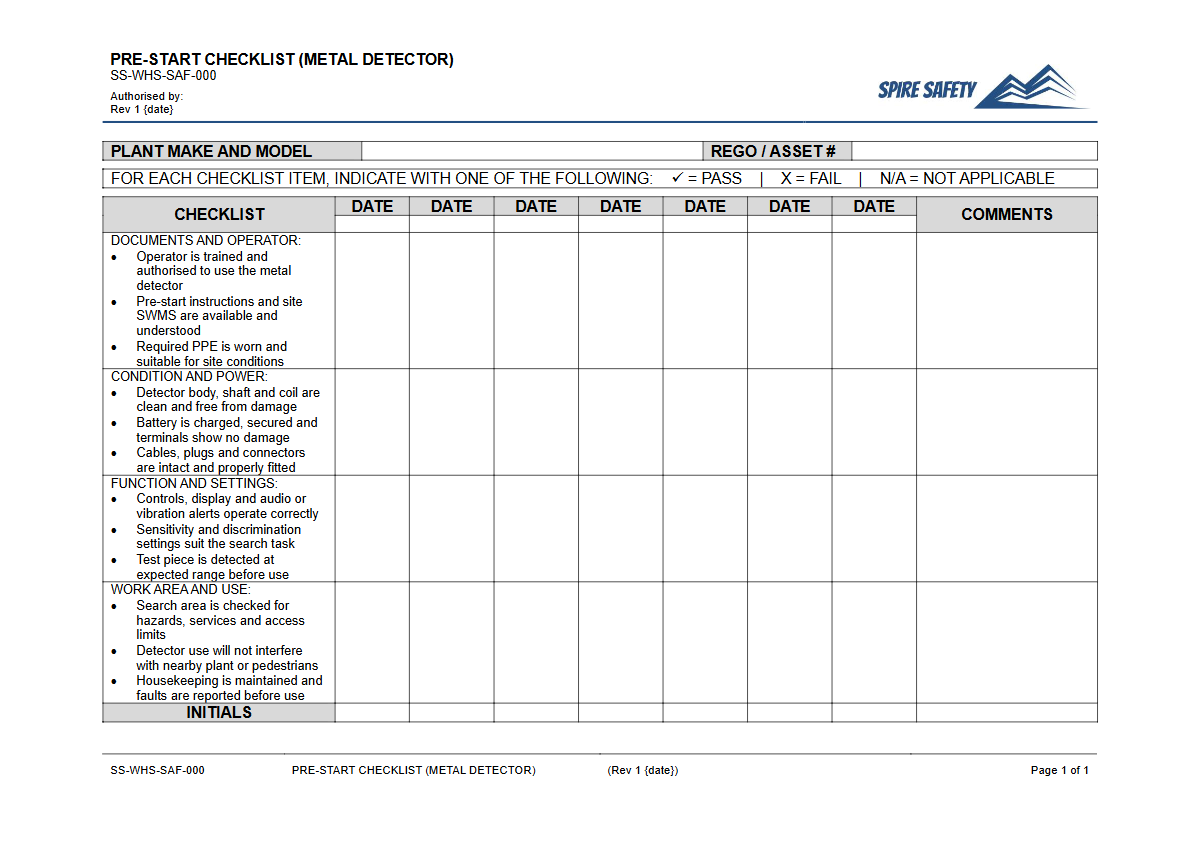
This free Pre-Start Checklist (Metal Detector) Template provides a structured framework for operators to conduct consistent, thorough inspections before use. Regularly completing these checks helps identify potential faults, electrical hazards, or calibration issues before they cause incidents, equipment failure, or product contamination.
Formalising this process is a key part of an organisation's duty of care and proactive safety culture.
Integrating pre-start checks into daily operations demonstrates a commitment to operational safety and helps meet legal obligations for plant maintenance. For a broader overview of this crucial safety habit, consider using our Pre-Start Checks and Plant Maintenance Toolbox Talk to reinforce the topic with your team.
Video walkthrough
How to use the Free Pre-Start Checklist (Metal Detector) Template
This template is a foundational document designed for adaptation. To implement it effectively in your workplace, follow these steps:
- Download: Choose either the DOCX or PDF format. The DOCX file is fully editable.
- Customise: Modify the checklist to reflect the specific make and model of your metal detector(s), the operating environment, and the unique risks present in your workplace. Add or remove items to ensure the check is relevant and comprehensive.
- Train: Ensure all operators are trained on how to properly conduct each check, what the acceptance criteria are, and how to report any identified faults or deviations.
- Implement: Integrate the checklist into your daily start-up procedures. Establish a system for filing and reviewing completed checklists to track equipment condition over time.
Note: This document is a template only. We are not WHS experts for your specific business.
You must customise this checklist to suit the specific equipment, tasks, and risks in your workplace. Integrating this process into your broader WHS management system ensures it becomes a documented and repeatable part of your safety procedures.
When to use it
A Pre-Start Checklist for a metal detector should be completed before the equipment is used for the first time each day or at the beginning of every shift. In environments with high usage or critical control requirements, it may be necessary to perform checks more frequently, such as after product changeovers or maintenance activities.
This routine ensures the machine's safety features and detection capabilities are functioning correctly before production begins, minimising risk. Documenting these checks can be a key agenda item in daily safety discussions, which can be formalised using a free Pre-Start Meeting Template.
Who should use it
The checklist should be completed by a worker who is trained, competent, and authorised to operate the specific metal detector. They must have the knowledge to recognise a fault or a potential hazard related to the equipment's condition.
Supervisors or team leaders also have a role in verifying that the checks are being completed correctly and in taking prompt action to address any reported issues, such as organising repairs or withdrawing the equipment from service until it is safe to use. Ensuring operators are deemed competent is a critical step; our Verification of Competency (Metal Cut-Off Saw) Template provides a framework for assessing competency on similar industrial plant.
Benefits of Regular Pre-Start Checks
Consistently using a pre-start checklist offers numerous benefits beyond basic compliance. These include:
- Enhanced Safety: Proactively identifies and addresses mechanical or electrical hazards before they can harm an operator.
- Improved Reliability: Early detection of minor faults prevents them from escalating into major breakdowns, reducing costly downtime.
- Assured Quality: Regular verification of the detector's sensitivity and rejection mechanism ensures contaminated products do not reach consumers.
- Clear Records: Creates a documented history of the equipment's condition, which is invaluable for maintenance planning and demonstrating due diligence.
These records provide tangible evidence of your safety processes, which is a key focus during any formal WHS compliance auditing activities. By formalising these checks, you create a powerful tool for continuous improvement and risk management across your operations.
Common mistakes
Common mistakes to avoid
- Using a generic, non-customised checklist that doesn't match the specific equipment.
- Performing a 'tick and flick' exercise without actually inspecting the items.
- Failing to properly test the detector's sensitivity and reject mechanism with certified test pieces.
- Not immediately reporting and taking corrective action when a fault or failed test is discovered.
Legal references
Legal considerations
The following legal requirements may be relevant to this type of work.
- Work Health and Safety Act (Harmonised) — Provides the primary duties for protecting workers and other people from work health and safety risks.
- Work Health and Safety Regulations (Harmonised) — Sets out requirements supporting the management of workplace hazards and risks.
The following codes may be relevant to this type of work.
- Managing WHS Risks Code of Practice — Provides practical guidance on identifying hazards, assessing risks and applying effective controls.
- Work Health and Safety Consultation, Cooperation and Coordination Code of Practice — Provides practical guidance on consulting workers and coordinating with other duty holders.
- Managing the Work Environment and Facilities Code of Practice — Provides practical guidance on safe work environments, workplace facilities and related controls.
Did you know
Sensitivity Testing
Metal detectors are tested using standardised test pieces (spheres) of different metal types (ferrous, non-ferrous, stainless steel). The size of the sphere determines the sensitivity level, which is a critical parameter in food safety and other quality control applications.
Product Effect
The product being inspected can have its own conductive properties (e.g., high salt or moisture content), which can affect the metal detector's signal. Modern detectors use multi-frequency technology to compensate for this "product effect" and prevent false rejections.
FAQ
Frequently asked questions
01What key items should be on a metal detector pre-start checklist?
02How often should metal detector pre-start checks be performed?
03Who is responsible for ensuring metal detector pre-starts are completed?
04Can this checklist be used for any brand of metal detector?
Share this resource
Free Pre-Start Checklist (Metal Detector) Template
Browse Categories
How To Use It
- 1Download and open in Word or PDF.
- 2Replace the placeholders with your business details.
- 3Get it reviewed by a WHS specialist before rollout.
Need it customised?
Our WHS consultants can adapt this template to your site, run a gap analysis, or audit what you already have in place.
Book a Free Consultation WHS consulting servicesor call 1300 156 382