
Free Pre-Start Checklist (MIG Welder) Template
Download our Free Pre-Start Checklist (MIG Welder) Template in DOCX & PDF. Formalise daily safety inspections and manage WHS risks for MIG welding tasks.
Free Pre-Start Checklist (MIG Welder) Template
DOCX • 125 KB + PDF
Updated Oct 2026
No signup required
Purpose of the Free Pre-Start Checklist (MIG Welder) Template
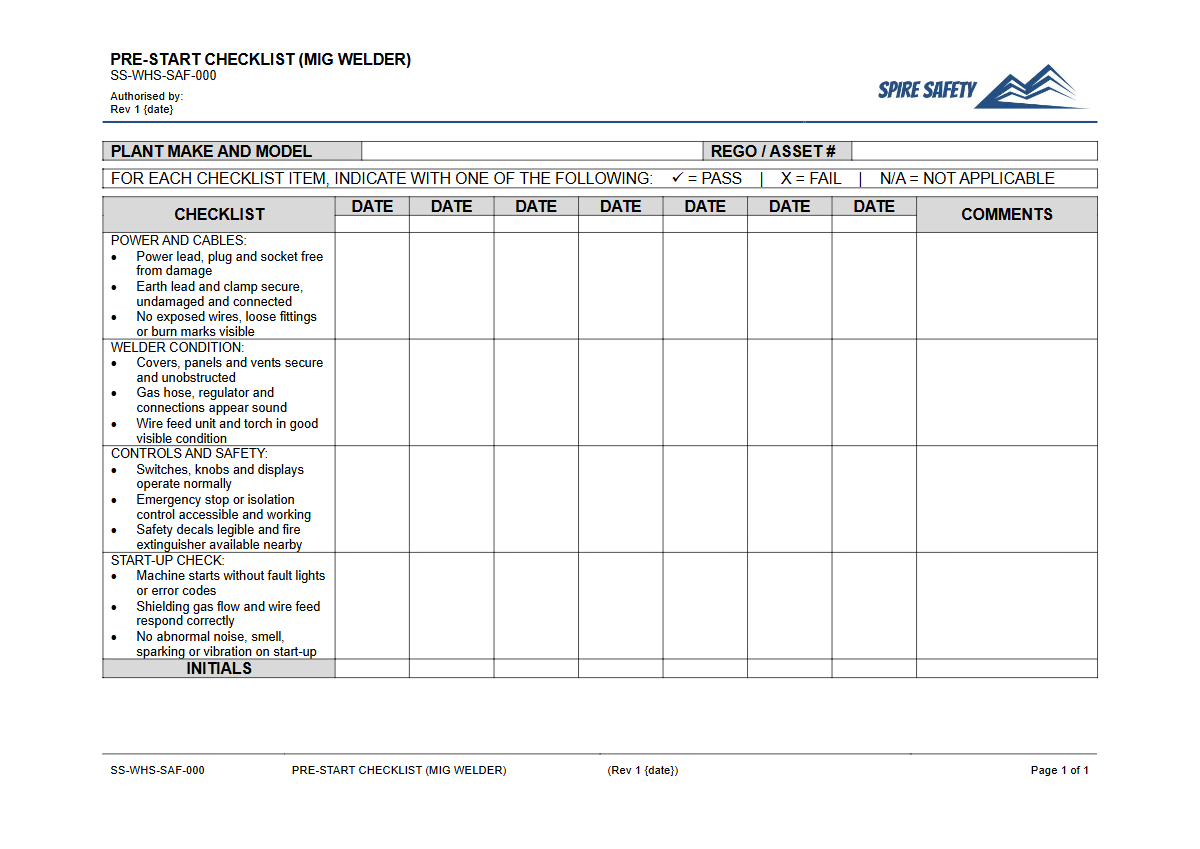
Operating welding equipment carries significant risks if machines are not properly maintained and inspected. This Free Pre-Start Checklist (MIG Welder) Template provides a structured framework for operators to conduct systematic safety checks before starting work.
Using a checklist helps formalise the inspection process, ensuring that key safety components—such as electrical leads, gas regulators, safety guards, and personal protective equipment (PPE)—are assessed for damage or faults. The primary goal is to identify and control hazards before they can cause injury or damage, promoting a safer working environment for everyone.
Implementing this process is a key step in fulfilling a PCBU's duty of care under Australian WHS legislation.
A consistent pre-start inspection routine helps prevent incidents related to electric shock, fire, exposure to harmful fumes, and equipment malfunction. It creates a documented record that the welder was in safe working order at the beginning of a shift.
Similar to using a bench grinder pre-start checklist for workshop tools, this document standardises the safety verification process for a specific piece of high-risk plant.
Video walkthrough
How to use the Free Pre-Start Checklist (MIG Welder) Template
This resource is available as a fully editable DOCX file and a print-ready PDF. To begin, simply download the format that best suits your needs.
The checklist is designed as a starting point, aligned with general Australian WHS principles for plant and equipment safety. It provides a logical sequence for inspecting a standard MIG welder, from the power source and gas supply to the wire feeder and gun assembly.
Please note: This template is a starting point. We strongly recommend you customise it to reflect the specific MIG welder models, work environment, and unique risks present in your workplace.
Add or remove items to ensure the checklist is entirely relevant to your operations. Once customised, integrate the document into your daily procedures, train all operators on its correct use, and establish a clear process for reporting and rectifying any faults found during the inspection. This proactive approach is fundamental to building comprehensive WHS management systems.
When to use it
A MIG welder pre-start check should be conducted at the beginning of every shift or before the equipment is used for the first time each day. If multiple operators use the same machine during a single shift, it is good practice for each new operator to perform their own check before commencing work.
This ensures accountability and prevents assumptions about the equipment's condition. The checklist should also be used after any maintenance or repair work to verify that the welder has been returned to a safe operational state.
Welding often generates significant fumes, making good ventilation critical. In some settings, this might involve using specific equipment covered by a checklist for fume cabinets or other extraction systems.
Who should use it
This checklist should be completed by personnel who are trained, competent, and authorised to operate a MIG welder. This typically includes boilermakers, welders, fabricators, and maintenance staff.
The person performing the check must have sufficient knowledge to recognise potential hazards, such as frayed cables, incorrect gas pressure settings, or a malfunctioning wire feed system. Supervisors should also be familiar with the checklist to ensure their teams are completing inspections correctly and to follow up on any reported defects.
The documented checks provide supervisors with clear oversight of equipment condition and operator behaviour.
Key Inspection Points for a MIG Welder
While your customised checklist will be more detailed, a thorough pre-start inspection generally covers these critical areas:
- Work Area: Check for clear, dry footing. Ensure no flammable materials are nearby and that fire-fighting equipment (e.g., extinguisher) is accessible. Verify adequate ventilation is in place.
- Cables & Connections: Inspect the primary power lead, welding lead, and earth clamp lead for any cuts, abrasions, or exposed wires. Ensure the earth clamp is clean and makes a firm connection to the workpiece.
- Gas Cylinder & Regulator: Confirm the gas cylinder is upright and securely chained to a wall or trolley. Check the regulator and flowmeter for damage and ensure gas hoses have no leaks or cracks.
- Wire Feeder & Gun: Inspect the gun, trigger, and liner for signs of wear or damage. Ensure the wire feed mechanism operates smoothly and that the correct drive rollers are installed for the wire size.
- General Machine Condition: Check that the welder's casing is intact, all safety guards are in place, and controls are clearly labelled and functional.
- Personal Protective Equipment (PPE): Confirm the operator has and is using the correct PPE, including a welding helmet with the correct shade lens, flame-retardant clothing, welding gloves, and safety boots.
These checks are not just procedural; they are a critical defence against serious workplace incidents. Verifying that these systems work as intended through regular WHS compliance auditing helps confirm the effectiveness of your overall safety program. While this document is for a welder, the same principles apply to other plant, such as when using a pre-start checklist for a bin lifter.
Integrating Checklists into Your Safety Culture
A pre-start checklist is most effective when it is part of a broader, positive safety culture. It should not be a 'tick-and-flick' exercise but a mindful inspection that empowers operators to take ownership of their safety.
Encourage workers to stop and report issues without fear of reprisal. The data gathered from these checklists can also be a valuable resource for identifying recurring equipment faults, informing maintenance schedules, and justifying investment in newer, safer equipment.
For organisations looking to formalise these processes further, engaging with professional WHS consulting services can provide expert guidance on building a robust and practical safety system.
Common mistakes
Common mistakes to avoid
- Neglecting to check the condition and firm connection of the earth clamp.
- Failing to secure gas cylinders upright with a chain or strap, creating a tipping hazard.
- Using the checklist as a paper exercise without genuinely inspecting each item.
- Forgetting to inspect the immediate work area for flammable or combustible materials.
Legal references
Legal considerations
The following legal requirements may be relevant to this type of work.
- Work Health and Safety Act (Harmonised) — Provides the primary duties for protecting workers and other people from work health and safety risks.
- Work Health and Safety Regulations (Harmonised) — Sets out requirements supporting the management of workplace hazards and risks.
The following codes may be relevant to this type of work.
- Managing WHS Risks Code of Practice — Provides practical guidance on identifying hazards, assessing risks and applying effective controls.
- Work Health and Safety Consultation, Cooperation and Coordination Code of Practice — Provides practical guidance on consulting workers and coordinating with other duty holders.
- Managing the Work Environment and Facilities Code of Practice — Provides practical guidance on safe work environments, workplace facilities and related controls.
Did you know
Welding Fume Classification
In 2017, the International Agency for Research on Cancer (IARC) reclassified welding fumes as a Group 1 carcinogen, meaning they are carcinogenic to humans. This highlights the critical importance of proper ventilation and respiratory protection.
UV Radiation Hazard
The electric arc in MIG welding produces intense ultraviolet (UV) radiation, which can cause severe skin burns (like sunburn) and eye damage known as 'arc eye' or 'welder's flash' in a very short time.
FAQ
Frequently asked questions
01What is the purpose of a MIG welder pre-start checklist?
02How often should a MIG welder pre-start check be done?
03Who is responsible for completing the MIG welder checklist?
04Is this template enough for WHS compliance?
Share this resource
Free Pre-Start Checklist (MIG Welder) Template
Browse Categories
How To Use It
- 1Download and open in Word or PDF.
- 2Replace the placeholders with your business details.
- 3Get it reviewed by a WHS specialist before rollout.
Need it customised?
Our WHS consultants can adapt this template to your site, run a gap analysis, or audit what you already have in place.
Book a Free Consultation WHS consulting servicesor call 1300 156 382