
Free Pre-Start Checklist (Mini Crane) Template
Download our free Pre-Start Checklist (Mini Crane) Template to formalise equipment inspections and improve safety. Get your customisable DOCX and PDF now.
Free Pre-Start Checklist (Mini Crane) Template
DOCX • 125 KB + PDF
Updated Oct 2026
No signup required
Purpose of the Free Pre-Start Checklist (Mini Crane) Template
Operating a mini crane involves significant risks, making pre-operational safety checks essential. This Free Pre-Start Checklist (Mini Crane) Template provides a structured framework for operators to conduct thorough inspections before each use.
Its primary purpose is to systematically identify potential hazards, defects, or mechanical faults that could lead to an incident. By formalising this process, organisations can proactively manage risks, ensure the equipment is safe for operation, and maintain a clear record of safety diligence.
Integrating these checks is a fundamental part of a robust safety management system, helping to prevent equipment failure, property damage, and serious injury.
Consistent use of a pre-start checklist promotes a culture of safety-consciousness among workers. It reinforces the importance of diligence and empowers operators to take ownership of their equipment's condition.
For a broader discussion on lifting safety, our Crane and Lifting Operations Safety Toolbox Talk provides valuable material for team safety meetings.
Video walkthrough
How to use the Free Pre-Start Checklist (Mini Crane) Template
This resource is available for immediate download in both DOCX (Microsoft Word) and PDF formats. The DOCX file is fully editable, allowing you to tailor the checklist to your specific operational needs.
The PDF version is ready for printing and immediate use if it suits your current requirements. To effectively implement the checklist, operators should be trained on each inspection point, understanding what to look for and the standards for pass or fail.
Important: It is crucial to customise this template for your specific workplace. We have provided a comprehensive starting point, but you must add, modify, or remove items to reflect the exact make and model of your mini crane, your site conditions, unique attachments, and internal procedures. Effective customisation ensures the checklist is a practical and relevant tool within your broader WHS management systems.
Key Areas Covered in the Checklist
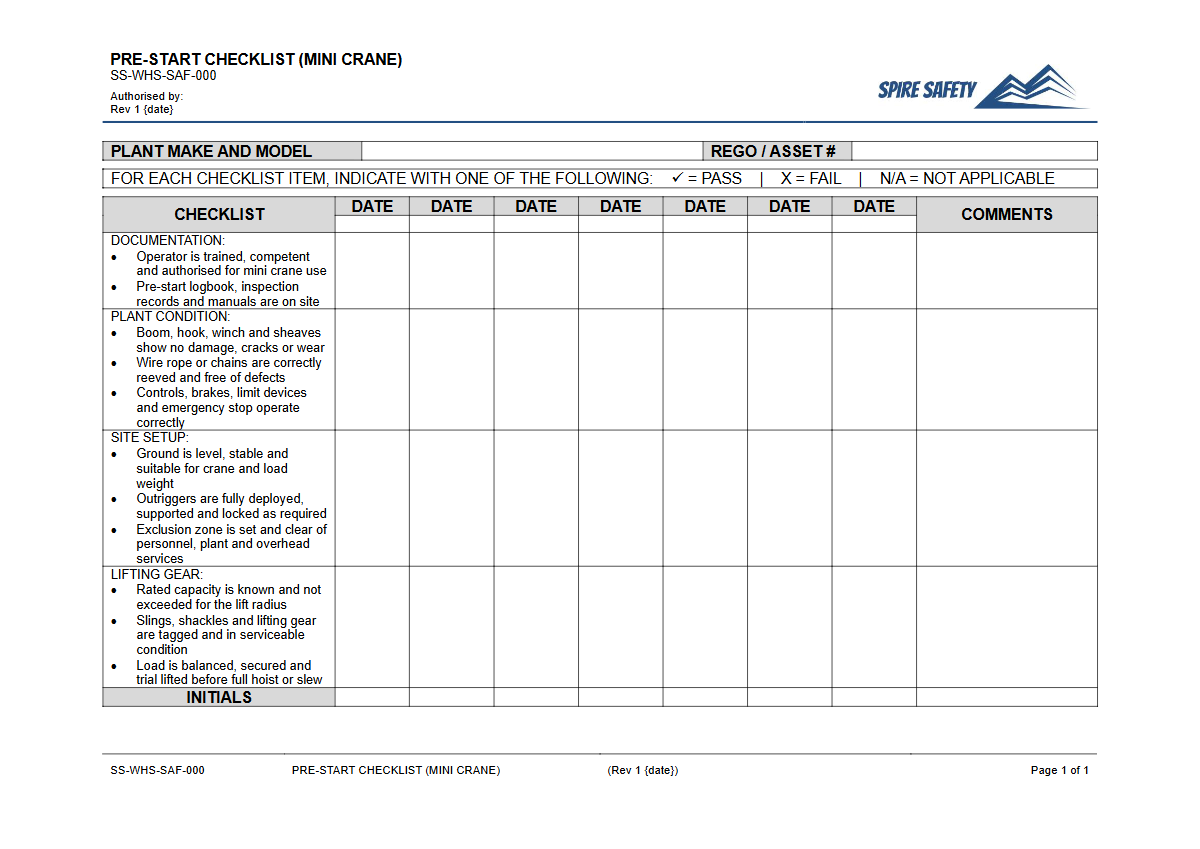
Our template prompts the user to inspect critical components and safety features of a typical mini crane. The sections are designed to be logical and follow a natural inspection flow, covering areas such as:
- General Condition: Checking for fluid leaks, structural damage, and overall cleanliness.
- Safety Devices: Verifying the function of horns, alarms, emergency stops, and load moment indicators (LMI).
- Controls and Instruments: Ensuring all levers, buttons, and gauges are functional and clearly labelled.
- Lifting Components: Inspecting hooks, latches, wire ropes, and sheaves for wear, damage, or corrosion.
- Hydraulics and Outriggers: Checking hydraulic hoses for leaks or damage and ensuring outriggers extend, set, and lock correctly.
- Tyres/Tracks: Assessing condition and correct inflation or tension.
Regularly reviewing the effectiveness of your checklist is a key activity that can be assessed during a WHS compliance auditing process, ensuring it remains fit for purpose as equipment ages or operational contexts change.
When to use it
The pre-start checklist should be completed by the operator before the start of every shift or prior to the first use of the mini crane each day. It should also be used if a new operator takes over the equipment mid-shift.
This routine ensures that the crane's condition is verified before any load is lifted, catching potential issues that may have developed overnight or during previous use. The checklist is the first step in a safe operating procedure, often preceding the completion of a task-specific risk assessment or Safe Work Method Statement. For certain high-risk tasks, a pre-start check is a prerequisite for a compliant Safe Work Method Statement for vehicle loading crane operation.
Who should use it
This pre-start checklist is designed to be used by trained and competent mini crane operators. The person responsible for operating the equipment is best placed to assess its condition, as they have the practical knowledge to recognise when something is not right.
Supervisors and safety managers should also use the completed checklists to monitor compliance, track equipment faults, and ensure that maintenance actions are being completed. In many Australian jurisdictions, crane operation requires a specific high-risk work licence, and operators must be deemed competent on the specific make and model of crane.
Assessing this can be formalised using a document like a Verification of Competency for tower cranes, adapted for the relevant equipment type.
By ensuring that only authorised and competent personnel conduct these checks, organisations uphold their duty of care and maintain the integrity of their safety procedures. The completed forms serve as important legal records, demonstrating that safety checks are a routine part of your operations. Find more templates to support your safety processes in our free WHS resources library.
Common mistakes
Common mistakes to avoid
- Completing the checklist from memory without physically inspecting the crane ('pencil-whipping').
- Using a generic checklist that doesn't match the specific make and model of the mini crane.
- Ignoring seemingly minor issues like weeping hydraulic fluid or worn labels, which can indicate larger problems.
- Failing to properly file and retain completed checklists for auditing and maintenance tracking.
Legal references
Legal considerations
The following legal requirements may be relevant to this type of work.
- Work Health and Safety Act (Harmonised) — Provides the primary duties for protecting workers and other people from work health and safety risks.
- Work Health and Safety Regulations (Harmonised) — Sets out requirements supporting the management of workplace hazards and risks.
The following codes may be relevant to this type of work.
- Managing WHS Risks Code of Practice — Provides practical guidance on identifying hazards, assessing risks and applying effective controls.
- Work Health and Safety Consultation, Cooperation and Coordination Code of Practice — Provides practical guidance on consulting workers and coordinating with other duty holders.
- Managing the Work Environment and Facilities Code of Practice — Provides practical guidance on safe work environments, workplace facilities and related controls.
Did you know
Crane Stability
Incorrectly set up outriggers are a leading cause of mobile crane incidents. A pre-start check that verifies stable and level ground conditions and proper outrigger deployment is critical to preventing tipping.
High Risk Work Licence
In Australia, operating most types of mobile cranes, including certain mini cranes depending on their capacity, requires the operator to hold a specific High Risk Work Licence (HRWL).
FAQ
Frequently asked questions
01What is the difference between a pre-start checklist and regular maintenance?
02What should an operator do if a fault is found during a pre-start check?
03Is a digital pre-start checklist better than a paper one?
04How long should a mini crane pre-start inspection take?
Share this resource
Free Pre-Start Checklist (Mini Crane) Template
Browse Categories
How To Use It
- 1Download and open in Word or PDF.
- 2Replace the placeholders with your business details.
- 3Get it reviewed by a WHS specialist before rollout.
Need it customised?
Our WHS consultants can adapt this template to your site, run a gap analysis, or audit what you already have in place.
Book a Free Consultation WHS consulting servicesor call 1300 156 382