
Free Pre-Start Checklist (Monorail Hoist) Template
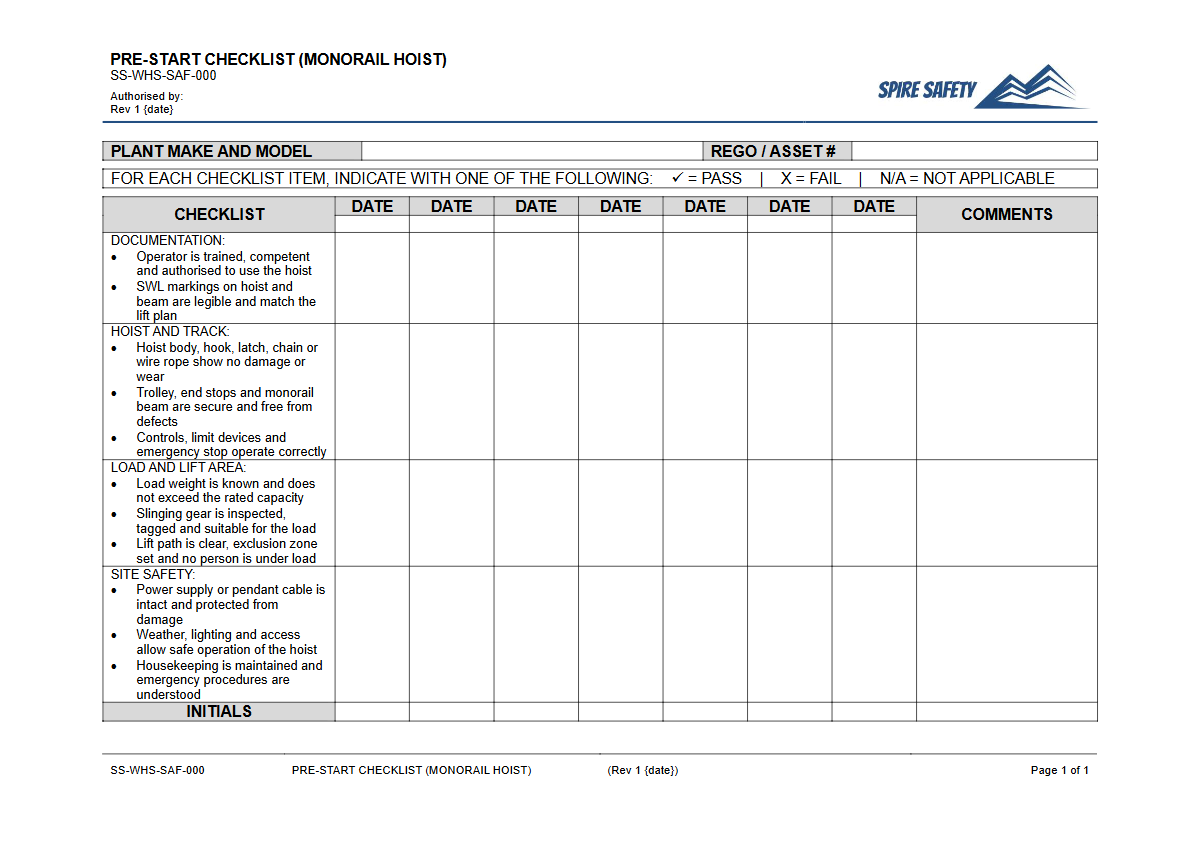
Download our free Pre-Start Checklist (Monorail Hoist) Template. This structured Word & PDF document helps formalise equipment safety checks and manage risks.
Free Pre-Start Checklist (Monorail Hoist) Template
DOCX • 125 KB + PDF
Updated Oct 2026
No signup required
Purpose of the Free Pre-Start Checklist (Monorail Hoist) Template
This free Pre-Start Checklist (Monorail Hoist) Template provides a structured starting point for conducting daily equipment inspections. Regular pre-start checks are a fundamental component of managing the risks associated with high-risk plant like monorail hoists.
By formalising this process, you can systematically identify and address potential hazards such as worn components, damaged controls, or safety feature malfunctions before they lead to an incident, equipment failure, or costly downtime. It creates a documented record of inspection, demonstrates due diligence, and supports a proactive maintenance schedule.
Integrating this checklist into your daily operational procedures helps ensure that the hoist is safe for use at the beginning of every shift. It also reinforces safety-conscious behaviour among operators.
A consistent inspection routine can be effectively communicated through regular safety meetings, such as those guided by a Pre-Start Checks and Plant Maintenance Toolbox Talk, ensuring all workers understand their responsibilities.
Video walkthrough
How to use the Free Pre-Start Checklist (Monorail Hoist) Template
Using this template is straightforward. First, download the document in your preferred format—DOCX for easy customisation or PDF for immediate printing.
The next step is critical for ensuring the checklist is effective and relevant to your operations.
IMPORTANT: This template is a guide only. You must customise it to reflect the specific make, model, configuration, and operating environment of your monorail hoist.
We recommend a competent person reviews and adapts the checklist to address your site-specific hazards, manufacturer's requirements, and any unique lifting attachments used. A generic checklist will not capture all potential risks.
Once tailored, the checklist should be integrated into your comprehensive WHS management systems. Train all authorised operators on how to properly complete the inspection, what to look for, and the procedure for reporting any identified faults or defects. The completed checklists should be retained as a record of compliance and maintenance history.
When to use it
The pre-start checklist for a monorail hoist should be completed at the following times:
- Before the first use of each shift: This is the most critical time, ensuring the equipment is safe before work commences.
- After any significant idle period: If the hoist has not been used for an extended time, a thorough check is necessary.
- Following maintenance or repairs: A check must be conducted to verify that the equipment has been returned to a safe operating condition.
Regular use builds a strong safety culture and ensures operators are not only competent in using the equipment but also in verifying its safety. This can be complemented by confirming worker skills using a Verification of Competency for an electric hoist or chain block.
Who should use it
This checklist is designed for use by several key personnel within an organisation:
- Competent Hoist Operators: The primary user is the person operating the monorail hoist. They are in the best position to conduct a thorough visual and functional inspection before their shift begins.
- Supervisors and Team Leaders: Managers responsible for overseeing lifting operations should use the checklist to verify that safety procedures are being followed and to address any reported issues promptly.
- WHS Advisors and Safety Officers: WHS personnel can use the template as a foundation for developing standardised safety procedures across the workplace.
The effectiveness of your pre-start process relies on clear communication. Discussing checklist findings and any new hazards can be incorporated into daily workgroup meetings, which can be structured using a pre-start meeting template.
Periodically reviewing completed checklists helps identify recurring issues or trends that may require more significant intervention. The overall effectiveness of your safety controls can be validated through independent WHS compliance audits.
If you're looking for other documents to support your safety management system, you can explore our complete free WHS resources library for a wide range of templates and guides.
Common mistakes
Common mistakes to avoid
- Pencil-whipping the form without performing a physical inspection.
- Using a generic checklist that doesn't match the specific hoist model or work environment.
- Failing to immediately tag out and report faulty equipment.
- Neglecting to check the condition of the lifting chain or wire rope for kinks, corrosion, or broken strands.
Legal references
Legal considerations
The following legal requirements may be relevant to this type of work.
- Work Health and Safety Act (Harmonised) — Provides the primary duties for protecting workers and other people from work health and safety risks.
- Work Health and Safety Regulations (Harmonised) — Sets out requirements supporting the management of workplace hazards and risks.
The following codes may be relevant to this type of work.
- Managing WHS Risks Code of Practice — Provides practical guidance on identifying hazards, assessing risks and applying effective controls.
- Work Health and Safety Consultation, Cooperation and Coordination Code of Practice — Provides practical guidance on consulting workers and coordinating with other duty holders.
- Managing the Work Environment and Facilities Code of Practice — Provides practical guidance on safe work environments, workplace facilities and related controls.
Did you know
Chain vs. Wire Rope
Monorail hoists use either chain or wire rope. While chain hoists are generally more durable for rugged environments, wire rope hoists can offer faster lifting speeds and higher capacities, making the choice dependent on the specific application.
The Critical Safety Latch
The small safety latch on a hoist hook is a critical safety device designed to prevent the sling or load from accidentally slipping off. A missing, bent, or faulty latch is a common defect that immediately renders the hoist unsafe for use.
FAQ
Frequently asked questions
01What should be included in a monorail hoist pre-start check?
02How often should monorail hoist pre-start checks be conducted?
03Is a pre-start checklist a legal requirement for monorail hoists in Australia?
04Who is responsible for completing the hoist pre-start checklist?
Share this resource
Free Pre-Start Checklist (Monorail Hoist) Template
Browse Categories
How To Use It
- 1Download and open in Word or PDF.
- 2Replace the placeholders with your business details.
- 3Get it reviewed by a WHS specialist before rollout.
Need it customised?
Our WHS consultants can adapt this template to your site, run a gap analysis, or audit what you already have in place.
Book a Free Consultation WHS consulting servicesor call 1300 156 382