
Free Pre-Start Checklist (Mortiser) Template
Download our free Pre-Start Checklist (Mortiser) Template. This user-friendly DOCX & PDF resource helps formalise equipment safety checks. Get started now.
Free Pre-Start Checklist (Mortiser) Template
DOCX • 125 KB + PDF
Updated Oct 2026
No signup required
Purpose of the Free Pre-Start Checklist (Mortiser) Template
Operating a mortiser, whether a hollow chisel or chain type, involves significant risks including entanglement, cuts from sharp components, and exposure to hazardous wood dust. This free Pre-Start Checklist (Mortiser) Template provides a structured framework for operators to conduct thorough safety inspections before commencing work.
Formalising this process helps identify and control hazards, ensuring the machine is fit for purpose and operating correctly. Systematically documenting these checks creates a valuable record, demonstrating proactive risk management and supporting the PCBU's primary duty of care under Australian WHS legislation.
Integrating regular checks like this one is a fundamental component of effective WHS management systems. It transforms safety from an abstract policy into a practical, daily activity, fostering a stronger safety culture and reducing the likelihood of incidents. These records are vital for tracking equipment condition over time and identifying trends that may require preventative maintenance.
Video walkthrough
How to use the Free Pre-Start Checklist (Mortiser) Template
This resource is a downloadable DOCX file that you can easily edit in Microsoft Word or a compatible program, as well as a print-ready PDF. The checklist format is designed for efficiency, allowing operators to quickly verify the condition of key safety features and operational components.
After downloading, the first step is to customise the document to reflect the specific make and model of the mortiser used in your workplace. Add or remove items to ensure the checklist is comprehensive and relevant to your unique environment and tasks.
Training your team on how to complete the checklist properly is just as important as having the document itself. A great way to introduce the new procedure is through a focused safety session, which can be structured using a pre-start checks and plant maintenance toolbox talk. This ensures everyone understands the purpose of each check and the correct procedure for reporting faults.
Important: This is a template, not a finished document. To be effective, you must customise it to your specific equipment, operational context, and WHS management system.
We assume no liability for incidents arising from the use of this template, as its implementation and customisation are your responsibility.
When to use it
A mortiser pre-start checklist should be completed before the first use of the machine on any given day or shift. Establishing this as a non-negotiable routine is crucial for its effectiveness.
If the machine is used by multiple operators throughout a day, it is good practice for each new operator to conduct their own pre-start check to verify its condition before they begin. This creates clear accountability and ensures that any damage or faults that occur during a shift are identified promptly.
These daily checks should be part of a broader safety schedule. While a pre-start checklist is for routine operational safety, it does not replace the need for scheduled preventative maintenance or more detailed inspections carried out by competent persons.
Integrating these checks into the start of a shift can be seamlessly done during a team briefing, which can be documented using a pre-start meeting template to ensure all safety matters are covered.
Who should use it
The primary user of this checklist is the machine operator. They have the most direct interaction with the equipment and are best placed to notice subtle changes in its performance or condition.
Supervisors also have a key role in reviewing the completed checklists to ensure they are being filled out correctly and to follow up on any reported defects. This review process closes the loop, ensuring that identified hazards are either rectified immediately or the equipment is locked out and tagged until it can be repaired by a qualified maintenance person.
Completed checklists also serve as critical evidence during internal reviews or formal WHS compliance audits. They demonstrate that the organisation has a system in place for regularly inspecting plant and equipment. It's also important to remember that machine safety is only one part of the equation; operator competency is the other.
While this checklist verifies the machine, operator skill should be separately assessed using tools such as a Verification of Competency (Pipe Threader) template, adapted for the relevant machinery.
What's covered in the checklist?
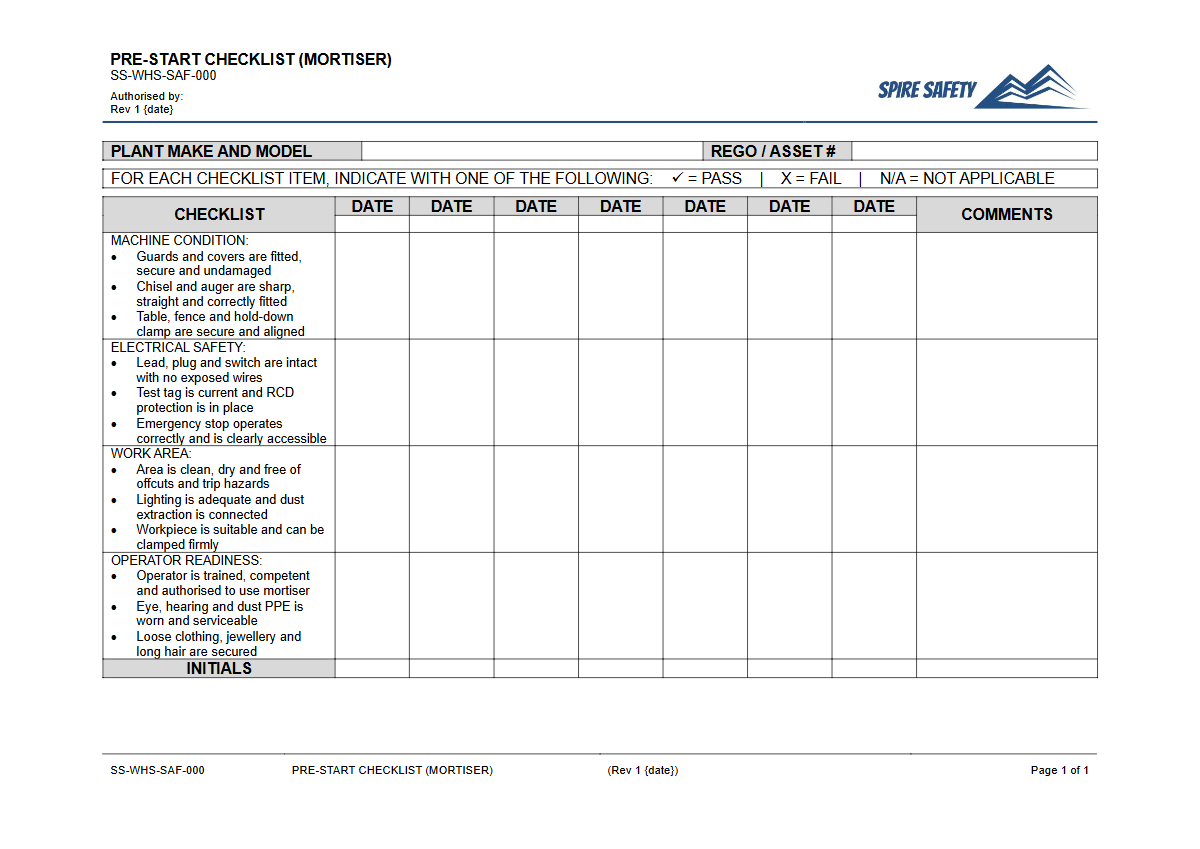
This template provides a structured starting point covering common safety elements of a mortiser. It prompts the user to inspect guards and covers, the functionality of emergency stops and control switches, the condition and sharpness of the chisel and bit or chain, and the integrity of the dust extraction system.
It also includes checks for electrical safety, such as inspecting cords and plugs for damage, and ensuring the general work area is clear of slip or trip hazards.
When customising the document, you may need to add checks specific to your machine, such as the hydraulic or pneumatic systems on more advanced models. You can look at our other templates, like our Free Pre-Start Checklist (CNC Router) Template, for ideas on how to structure checks for other complex woodworking equipment.
If you need assistance developing comprehensive safe operating procedures, seeking professional WHS consulting can provide tailored solutions for your workplace.
Common mistakes
Common mistakes to avoid
- Failing to customise the template to match the specific model of mortiser in use.
- Completing the checklist from memory without physically inspecting each item ('pencil-whipping').
- Not immediately reporting identified faults or continuing to use a machine with a known defect.
- Neglecting to check the sharpness of the chisel or chain, which can lead to excessive force being applied and increase the risk of an incident.
Legal references
Legal considerations
The following legal requirements may be relevant to this type of work.
- Work Health and Safety Act (Harmonised) — Provides the primary duties for protecting workers and other people from work health and safety risks.
- Work Health and Safety Regulations (Harmonised) — Sets out requirements supporting the management of workplace hazards and risks.
The following codes may be relevant to this type of work.
- Managing WHS Risks Code of Practice — Provides practical guidance on identifying hazards, assessing risks and applying effective controls.
- Work Health and Safety Consultation, Cooperation and Coordination Code of Practice — Provides practical guidance on consulting workers and coordinating with other duty holders.
- Managing the Work Environment and Facilities Code of Practice — Provides practical guidance on safe work environments, workplace facilities and related controls.
Did you know
Wood Dust Hazard
Inhaling fine wood dust is a serious health risk. It is classified as a carcinogen and can cause respiratory diseases, which is why checking the dust extraction system is a critical part of any woodworking machinery pre-start.
Types of Mortisers
The two most common types of mortisers are the hollow chisel mortiser, which uses a square chisel with an auger bit, and the chain mortiser, which uses a chainsaw-like bar and chain to cut the mortise.
FAQ
Frequently asked questions
01What is a mortiser pre-start checklist for?
02How often should a mortiser be inspected?
03Is this mortiser checklist a legal document?
04Can I use this template for other woodworking machinery?
Share this resource
Free Pre-Start Checklist (Mortiser) Template
Browse Categories
How To Use It
- 1Download and open in Word or PDF.
- 2Replace the placeholders with your business details.
- 3Get it reviewed by a WHS specialist before rollout.
Need it customised?
Our WHS consultants can adapt this template to your site, run a gap analysis, or audit what you already have in place.
Book a Free Consultation WHS consulting servicesor call 1300 156 382