
Free Pre-Start Checklist (Nail Gun) Template
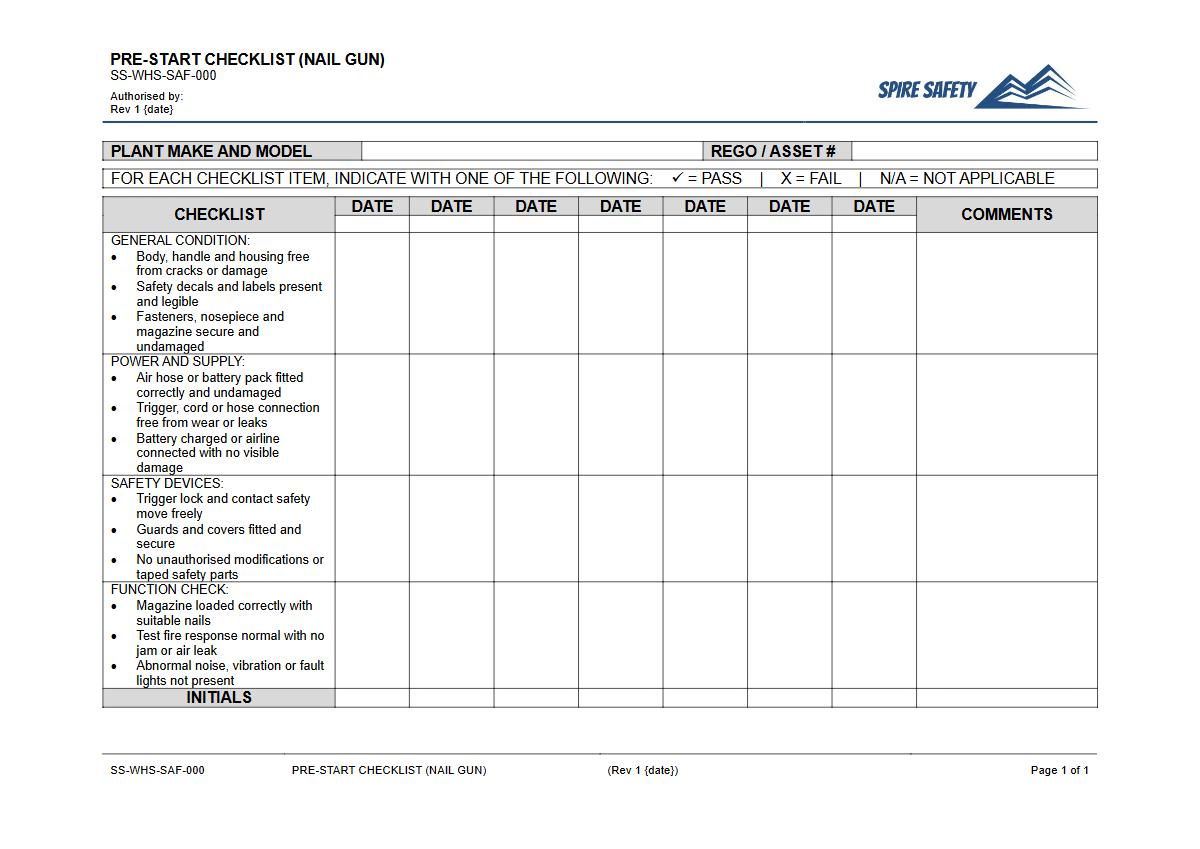
Download our free Pre-Start Checklist (Nail Gun) Template. This structured DOCX and PDF document helps formalise daily equipment safety checks. Get yours now.
Free Pre-Start Checklist (Nail Gun) Template
DOCX • 125 KB + PDF
Updated Oct 2026
No signup required
Purpose of the Free Pre-Start Checklist (Nail Gun) Template
Nail guns are powerful, high-risk tools common on construction sites and in workshops across Australia. Used incorrectly or without proper safety checks, they can cause serious puncture wounds and projectile injuries.
Our Free Pre-Start Checklist (Nail Gun) Template provides a structured framework for operators to conduct consistent, thorough inspections before use. Implementing this checklist helps your organisation identify potential faults, manage risks, and demonstrate a commitment to a safe system of work.
It formalises the process of checking critical components like the safety contact tip, trigger mechanism, and power source, ensuring the tool is in a safe condition before operation begins.
Using a pre-start checklist is a practical risk control measure that forms part of a broader safety framework. Integrating this simple check into your daily routine helps prevent incidents and reinforces safe work behaviour.
For a more robust safety program, these checklists should be incorporated into your overall WHS management system, providing documented evidence of your due diligence and risk management efforts.
Video walkthrough
How to use the Free Pre-Start Checklist (Nail Gun) Template
This Pre-Start Checklist for Nail Guns is designed to be straightforward and effective. After downloading the template in your preferred format (DOCX for easy editing or PDF for printing), you should familiarise yourself with its contents.
The checklist guides the operator through a series of critical inspection points, including the tool's housing, trigger, safety mechanisms, power supply (whether pneumatic, battery, or fuel cell), and fasteners. The operator simply inspects each item and ticks it off.
If any item fails the inspection, the tool must be immediately taken out of service, tagged appropriately, and reported for repair.
Important Note: This document is a template and must be customised for your specific needs. You should review and adapt the checklist to include the unique makes, models, and configurations of nail guns used in your workplace.
It is crucial to consult with operators and other relevant workers during this customisation process. While this template is aligned with Australian WHS practice, we are not liable for any incidents arising from its use; ultimate responsibility for safety rests with the PCBU.
When to use it
A nail gun pre-start inspection should be conducted at the beginning of each day or shift before the tool is first used. It is a non-negotiable part of the daily setup routine for any operator.
Additionally, a check should be performed if the operator changes, if the tool has been dropped, or if there is any reason to suspect it may be damaged or malfunctioning. This consistent use ensures that potential defects are identified early, before they can lead to an incident. This practice is similar to the checks required for other high-risk equipment, such as those detailed in our Pre-Start Checklist for Floor Saws.
Who should use it
The pre-start checklist is designed to be completed by the person operating the nail gun. The operator must be trained and competent not only in the safe use of the tool but also in how to properly conduct the pre-start inspection.
They need to understand what they are checking for and the consequences of a fault. Supervisors and managers also have a role; they are responsible for ensuring that operators are completing the checklists correctly and that faulty equipment is effectively removed from service.
This process of verification and oversight can be strengthened through regular WHS compliance auditing to ensure procedures are being followed consistently across the organisation.
Documenting competency and regular checks is vital across all workplace equipment. The principles in this checklist can be adapted for other workshop tools, as seen in our free Pre-Start Checklist (Bench Grinder) Template. For complex safety challenges or developing a comprehensive equipment safety program, it may be beneficial to seek professional WHS consulting to ensure all risks are adequately addressed.
This document is just one of many templates designed to assist your organisation in managing workplace health and safety. You can explore more checklists, policies, and forms in our free WHS resources library.
Common mistakes
Common mistakes to avoid
- Using a generic checklist without customising it for the specific nail gun model.
- Completing the checklist without physically inspecting each component ('pencil-whipping').
- Failing to immediately remove and tag faulty equipment from service.
- Neglecting to check the power source, such as air hose pressure, battery charge, or fuel cell condition.
Legal references
Legal considerations
The following legal requirements may be relevant to this type of work.
- Work Health and Safety Act (Harmonised) — Provides the primary duties for protecting workers and other people from work health and safety risks.
- Work Health and Safety Regulations (Harmonised) — Sets out requirements supporting the management of workplace hazards and risks.
The following codes may be relevant to this type of work.
- Managing WHS Risks Code of Practice — Provides practical guidance on identifying hazards, assessing risks and applying effective controls.
- Work Health and Safety Consultation, Cooperation and Coordination Code of Practice — Provides practical guidance on consulting workers and coordinating with other duty holders.
- Managing the Work Environment and Facilities Code of Practice — Provides practical guidance on safe work environments, workplace facilities and related controls.
Did you know
Trigger Mechanisms Matter
Nail guns with sequential trip triggers are significantly safer than those with contact trip ('bump fire') triggers, as they prevent unintentional firing and reduce injury rates.
Hand Injuries are Common
The most common nail gun injuries are puncture wounds to the non-dominant hand, often occurring when an operator holds materials in place while nailing.
FAQ
Frequently asked questions
01What should I do if I find a fault during a nail gun pre-start check?
02Is a pre-start checklist enough to ensure nail gun safety?
03How often should nail guns be professionally serviced?
04Can I use this digital template on a tablet or phone?
Share this resource
Free Pre-Start Checklist (Nail Gun) Template
Browse Categories
How To Use It
- 1Download and open in Word or PDF.
- 2Replace the placeholders with your business details.
- 3Get it reviewed by a WHS specialist before rollout.
Need it customised?
Our WHS consultants can adapt this template to your site, run a gap analysis, or audit what you already have in place.
Book a Free Consultation WHS consulting servicesor call 1300 156 382