
Free Pre-Start Checklist (Overhead Crane) Template
Need an overhead crane pre-start checklist? Our free template provides a structured starting point for your pre-operational safety inspections.
Free Pre-Start Checklist (Overhead Crane) Template
DOCX • 125 KB + PDF
Updated Oct 2026
No signup required
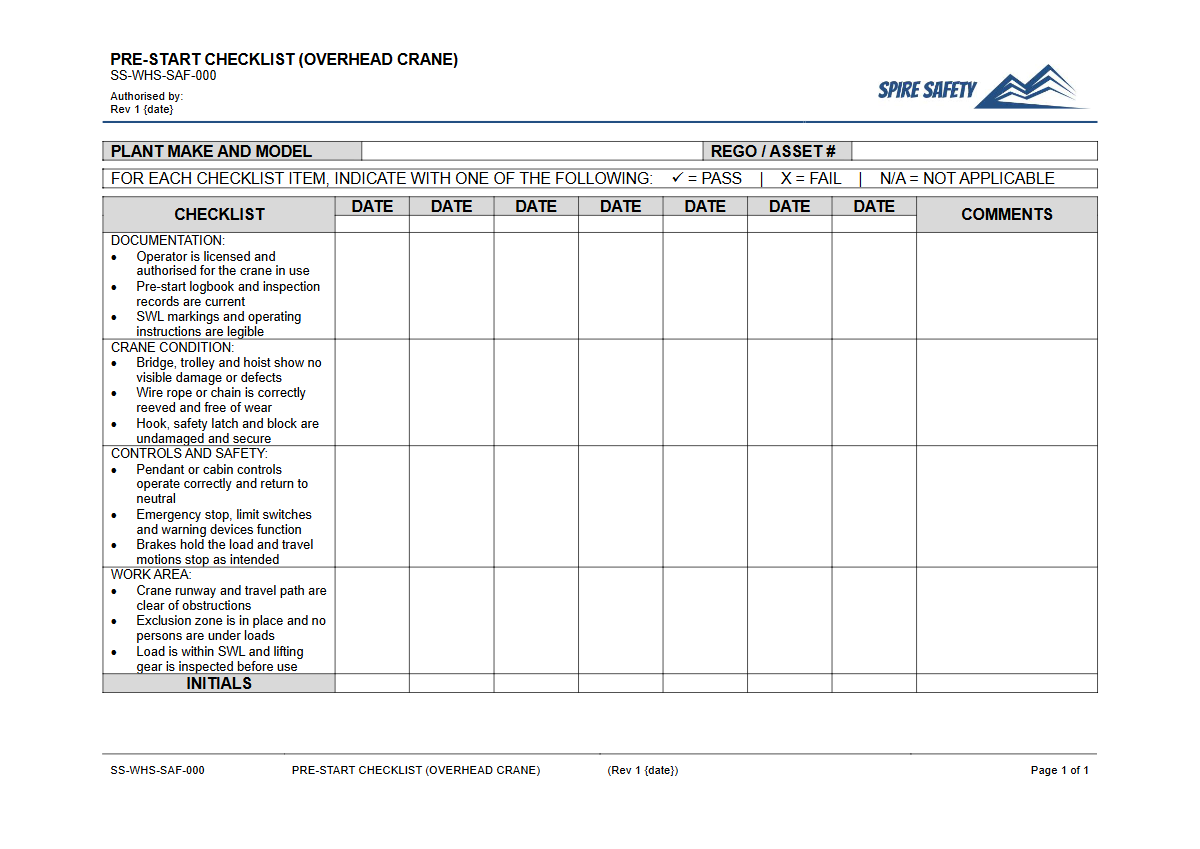
Purpose of the Free Pre-Start Checklist (Overhead Crane) Template
Conducting regular pre-start checks is a critical safety measure for any workplace that uses overhead cranes. This Free Pre-Start Checklist (Overhead Crane) Template provides a structured framework to help operators systematically inspect equipment before use, identifying potential faults or hazards that could lead to incidents, equipment damage, or serious injury.
By formalising this process, organisations can better demonstrate their commitment to proactive risk management and fulfilling their duties under WHS legislation. A consistent inspection routine not only enhances safety but also contributes to the longevity and reliability of the crane.
These daily checks form a crucial part of your overall safety management. They should be supported by regular safety discussions with your team, which can be guided by a resource like our Crane and Lifting Operations Safety Toolbox Talk Template.
Video walkthrough
How to use the Free Pre-Start Checklist (Overhead Crane) Template
To get the most value from this resource, it is vital to adapt it to your specific operational context. It serves as a comprehensive starting point, designed to be modified to suit the equipment and environment at your workplace.
Important: This is a template only
This document is a starting point. It is essential that you customise it to reflect the specific make, model, and configuration of your overhead crane(s), the types of loads being lifted, your site-specific hazards, and your organisation's procedures.
We recommend consulting with crane operators, maintenance personnel, and safety advisors during this process to ensure all relevant inspection points are covered.
The typical process for implementation includes:
- Download: Save the DOCX or PDF file to your system.
- Customise: Edit the DOCX version to add, remove, or modify checklist items. Include company branding and specific fields for operator names, dates, and crane identification numbers.
- Consult: Review the draft with experienced operators and supervisors to ensure it is practical and comprehensive.
- Train: Ensure all operators are trained on how to correctly complete the new checklist and what actions to take if a defect is found.
- Implement: Roll out the finalised checklist as a mandatory part of your pre-operational procedure.
- Review: Periodically review the checklist's effectiveness and update it following any changes to equipment, procedures, or regulations.
Beyond the equipment's condition, it is also crucial to ensure the person using it is competent for the task. This pre-start checklist can be used alongside a process to confirm operator skills, such as our Verification of Competency (Overhead Bridge Crane) Template.
When to use it
A Pre-Start Checklist for an overhead crane should be completed at several key intervals to ensure ongoing safety. These include:
- At the beginning of every shift or before the first use of the crane on any given day.
- After the crane has undergone maintenance or repairs, to verify it is safe to return to service.
- If the crane has been idle for an extended period.
- Following any incident or near-miss, as part of the investigation and recommissioning process.
Integrating these daily checks into a broader plant maintenance schedule is key. Structured conversations about safety routines can be facilitated using a Pre-Start Checks and Plant Maintenance Toolbox Talk Template, helping to reinforce good habits across all site equipment.
Who should use it
The primary user of this checklist is the crane operator. Responsibility lies with the person about to use the equipment. However, other personnel have a role in the process:
- Licensed and Competent Crane Operators: They are responsible for physically performing the inspection and accurately recording the results.
- Supervisors and Team Leaders: They must ensure the checks are being completed correctly and that any reported issues are addressed promptly.
- Maintenance Personnel: They will use the information from completed checklists to schedule repairs and preventative maintenance.
This checklist is a practical tool that forms one part of a complete safety framework. For assistance in developing or refining your overarching safety processes, Spire Safety offers expert WHS management systems consulting.
Integrating Checks into Safe Work Procedures
A pre-start check is not a standalone document; it is a critical control measure that supports wider safety procedures. The requirement to complete this checklist should be explicitly stated within your Safe Work Method Statements (SWMS) or other risk assessments for lifting operations.
This ensures the check is a non-negotiable step in the workflow.
For complex lifting tasks, the pre-start inspection complements the risk controls detailed in a document like a Safe Work Method Statement (Vehicle Loading Crane Operation) Template. For organisations needing support with their documentation, our WHS consulting services can provide expert guidance on creating integrated and effective safety systems.
Common mistakes
Common mistakes to avoid
- "Pencil-whipping" the checklist without physically inspecting each component.
- Using a generic checklist that does not match the specific crane's make, model, or features.
- Failing to immediately report and quarantine equipment with identified 'fail' items.
- Operators not receiving adequate training on what to look for during each inspection point.
Legal references
Legal considerations
The following legal requirements may be relevant to this type of work.
- Work Health and Safety Act (Harmonised) — Provides the primary duties for protecting workers and other people from work health and safety risks.
- Work Health and Safety Regulations (Harmonised) — Sets out requirements supporting the management of workplace hazards and risks.
The following codes may be relevant to this type of work.
- Managing WHS Risks Code of Practice — Provides practical guidance on identifying hazards, assessing risks and applying effective controls.
- Work Health and Safety Consultation, Cooperation and Coordination Code of Practice — Provides practical guidance on consulting workers and coordinating with other duty holders.
- Managing the Work Environment and Facilities Code of Practice — Provides practical guidance on safe work environments, workplace facilities and related controls.
Did you know
Chain of Command
Modern overhead cranes evolved from ancient Greek lifting devices. The first electrically powered overhead crane was built by the German company Demag in 1887, revolutionising heavy material handling in factories.
Critical Checks
According to industry incident data, a significant number of crane accidents are linked to mechanical failures or wire rope issues that could have been identified during routine pre-operational inspections.
FAQ
Frequently asked questions
01What is the purpose of an overhead crane pre-start inspection?
02How often should an overhead crane pre-start checklist be completed?
03Who is responsible for completing the overhead crane pre-start checklist?
04Is this template sufficient for WHS compliance?
Share this resource
Free Pre-Start Checklist (Overhead Crane) Template
Browse Categories
How To Use It
- 1Download and open in Word or PDF.
- 2Replace the placeholders with your business details.
- 3Get it reviewed by a WHS specialist before rollout.
Need it customised?
Our WHS consultants can adapt this template to your site, run a gap analysis, or audit what you already have in place.
Book a Free Consultation WHS consulting servicesor call 1300 156 382