
Free Pre-Start Checklist (Paint Mixer) Template
Download our Free Pre-Start Checklist (Paint Mixer) Template. This DOCX & PDF resource helps formalise safety checks before use. Get your free template.
Free Pre-Start Checklist (Paint Mixer) Template
DOCX • 125 KB + PDF
Updated Oct 2026
No signup required
Purpose of the Free Pre-Start Checklist (Paint Mixer) Template
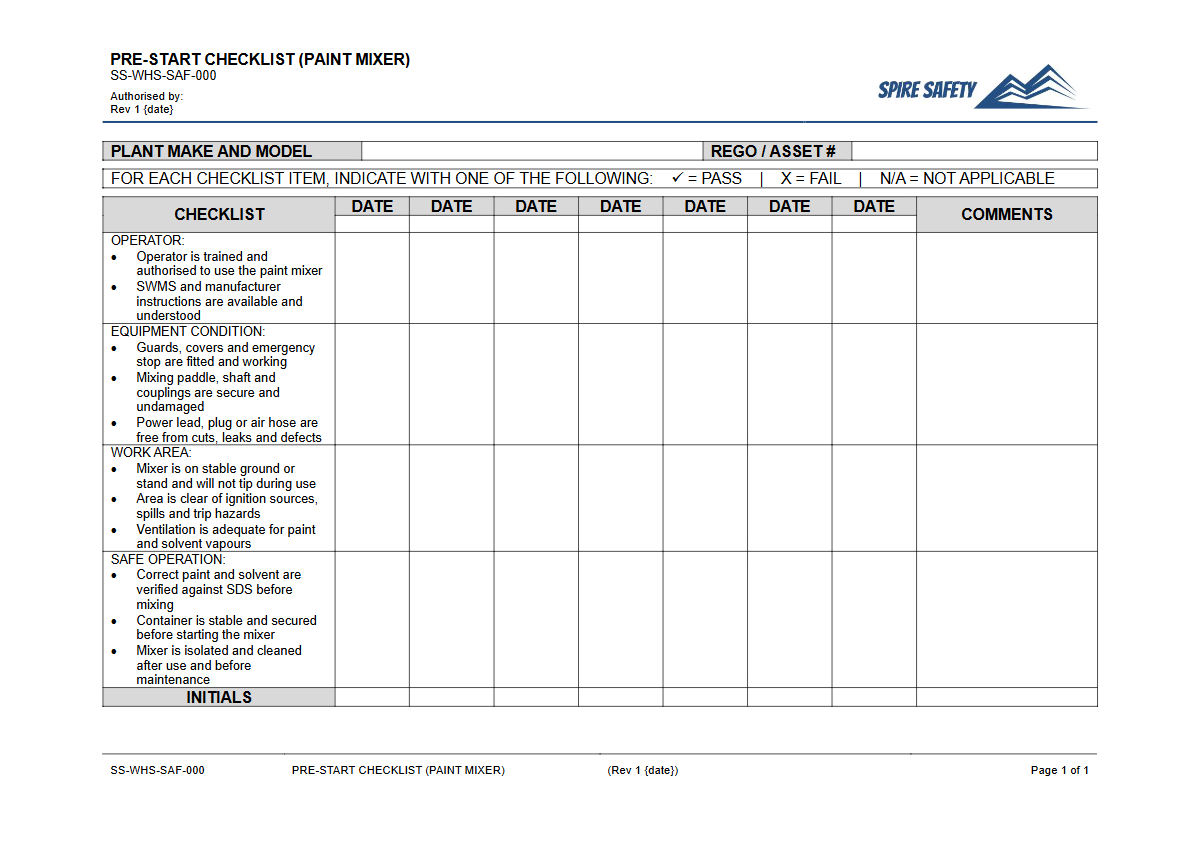
Using machinery like a paint mixer without prior inspection introduces unnecessary risks into the workplace. This Free Pre-Start Checklist (Paint Mixer) Template provides a structured framework for operators to conduct consistent, documented safety checks before each use.
Implementing these checks helps identify potential faults, damage, or missing safety features before they can cause an incident. By formalising this process, your organisation can demonstrate a commitment to proactive risk management and create a safer environment for workers operating powered equipment.
The checklist is designed as a starting point, aligned with Australian WHS principles, to help you manage hazards associated with rotating plant. While this document is specific to paint mixers, similar principles apply to other rotating equipment.
For instance, our Free Pre-Start Checklist (Agitator) Template covers key safety items for larger industrial agitators.
Video walkthrough
How to use the Free Pre-Start Checklist (Paint Mixer) Template
This template, available in both DOCX and PDF formats, is straightforward to implement. Operators should use it to guide their physical inspection of the paint mixer before commencing work.
The process involves visually inspecting components like the power cord, mixing paddle, guards, and emergency stop controls, then ticking off each item on the list. Any identified faults or defects must be reported immediately to a supervisor, and the equipment should be tagged out of service until it is repaired by a competent person and deemed safe to use.
Important: This is a generic template that must be customised to your specific needs. We haven't seen your workplace, your equipment, or the specific paints and chemicals you use.
You must adapt this document to reflect the make and model of your paint mixer, the specific hazards in your work environment, and your organisation's internal safety procedures. Integrating this process into your broader WHS management systems ensures it becomes a routine part of your operational safety culture.
When to use it
A pre-start check for a paint mixer should be conducted before every use or, at a minimum, at the beginning of each shift where the equipment is expected to be used. The brief time it takes to complete the check is a critical investment in preventing equipment failure and potential injuries.
Regular inspections are fundamental to any preventative maintenance program. This routine is reinforced in safety discussions like those outlined in our Pre-Start Checks and Plant Maintenance Toolbox Talk.
Who should use it
The pre-start check should be performed by the person who will be operating the paint mixer. Operators have the most direct interaction with the equipment and are best placed to notice subtle changes, damage, or malfunctions.
Supervisors are responsible for ensuring these checks are consistently completed and that any reported issues are addressed promptly. It is also crucial that operators are confirmed as competent to use the equipment safely.
You can adapt our Verification of Competency (Mortar Mixer) Template to assess and document operator skills for similar mixing equipment.
Depending on the substances being mixed, additional hazard awareness may be required. For example, when dealing with older paint surfaces or materials, understanding the risks is vital, a topic covered in our Lead Paint Awareness Toolbox Talk Template. Periodically, a supervisor or safety officer may observe the pre-start check process to verify it is being done correctly as part of routine site inspections.
You can formalise this verification through a structured WHS compliance auditing program. This ensures the system is working as intended and identifies opportunities for improvement.
Common mistakes
Common mistakes to avoid
- Failing to unplug the mixer before inspecting or cleaning the paddle.
- Using a damaged extension cord or plugging into an outlet without RCD protection.
- Neglecting to wear appropriate PPE, such as safety glasses, gloves, and respiratory protection.
- Operating the mixer with loose clothing, long hair, or jewellery that could become entangled.
Legal references
Legal considerations
The following legal requirements may be relevant to this type of work.
- Work Health and Safety Act (Harmonised) — Provides the primary duties for protecting workers and other people from work health and safety risks.
- Work Health and Safety Regulations (Harmonised) — Sets out requirements supporting the management of workplace hazards and risks.
The following codes may be relevant to this type of work.
- Managing WHS Risks Code of Practice — Provides practical guidance on identifying hazards, assessing risks and applying effective controls.
- Work Health and Safety Consultation, Cooperation and Coordination Code of Practice — Provides practical guidance on consulting workers and coordinating with other duty holders.
- Managing the Work Environment and Facilities Code of Practice — Provides practical guidance on safe work environments, workplace facilities and related controls.
Did you know
Entanglement Risk
Rotating shafts and paddles on mixers are a significant entanglement hazard. Even a small, portable mixer can generate enough torque to cause serious injuries if clothing, hair, or jewellery gets caught.
Paint Vapours
Many paints contain Volatile Organic Compounds (VOCs) that can be harmful when inhaled. Using mixers in a well-ventilated area and wearing appropriate respiratory protection is crucial to minimise exposure risks.
FAQ
Frequently asked questions
01Why is a pre-start check necessary for a paint mixer?
02What are the main hazards associated with paint mixers?
03How often should a paint mixer pre-start check be completed?
04Can this template be used for other types of mixers?
Share this resource
Free Pre-Start Checklist (Paint Mixer) Template
Browse Categories
How To Use It
- 1Download and open in Word or PDF.
- 2Replace the placeholders with your business details.
- 3Get it reviewed by a WHS specialist before rollout.
Need it customised?
Our WHS consultants can adapt this template to your site, run a gap analysis, or audit what you already have in place.
Book a Free Consultation WHS consulting servicesor call 1300 156 382