
Free Pre-Start Checklist (Paint Shaker) Template
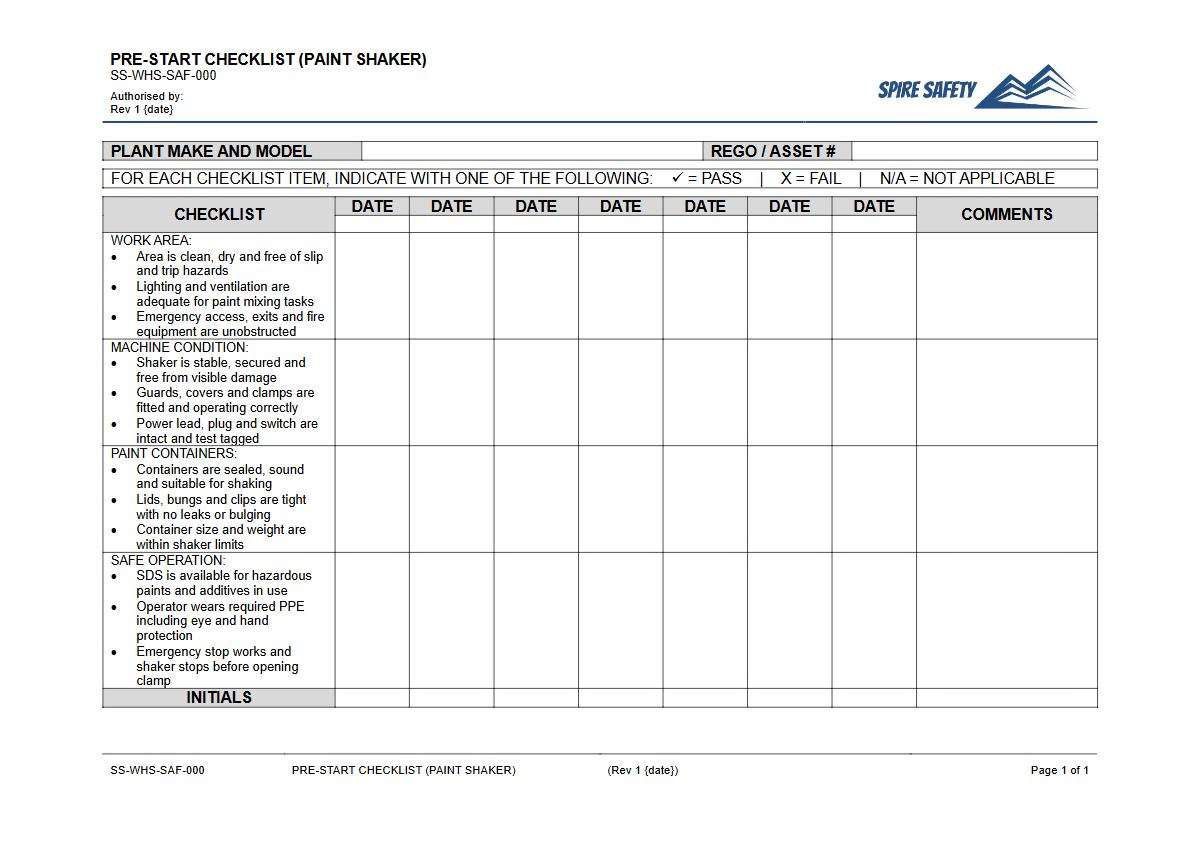
Download our Free Pre-Start Checklist (Paint Shaker) Template to formalise your equipment safety inspections.
Free Pre-Start Checklist (Paint Shaker) Template
DOCX • 125 KB + PDF
Updated Oct 2026
No signup required
Purpose of the Free Pre-Start Checklist (Paint Shaker) Template
A paint shaker, while common in retail and trade settings, presents mechanical, noise, and vibration hazards. Using a structured checklist before operation is a critical control measure to ensure the equipment is safe to use.
This Free Pre-Start Checklist (Paint Shaker) Template provides a systematic way to inspect the machine, helping operators identify potential faults, damage, or missing guards before they lead to an incident. Regular, documented checks demonstrate a commitment to proactive risk management and help maintain the equipment in safe working order.
Integrating these checks is fundamental to fulfilling your duty of care as a Person Conducting a Business or Undertaking (PCBU).
By formalising this process, you create a record that the equipment was verified as safe at a specific point in time. This can be invaluable for incident investigations, maintenance planning, and safety audits.
It also helps manage specific risks associated with paint, such as exposure to hazardous substances. For further training on this topic, consider using our Lead Paint Awareness Toolbox Talk Template to brief your team on associated chemical hazards.
Video walkthrough
How to use the Free Pre-Start Checklist (Paint Shaker) Template
This template is designed to be a practical tool for your workplace. Start by downloading the DOCX file and adapting it to the specific make and model of paint shaker you use.
It is crucial that the checklist reflects the unique features and risks of your equipment.
Follow these steps for effective implementation:
- Customise: Add your company branding. Review, add, or remove checklist items to align with the manufacturer's instructions and your own risk assessments. Please note: We provide this template as a starting point. You must customise it to suit the specific equipment, processes, and risks in your workplace.
- Train: Ensure all operators are trained not only on how to use the paint shaker safely but also on how to conduct a thorough pre-start inspection using the checklist. They must understand what each item means and what constitutes a 'pass' or 'fail'.
- Implement: Integrate the checklist into your daily operating procedures. Establish a clear process for what an operator must do if they identify a fault, such as stopping work, isolating the equipment, and reporting the issue to a supervisor.
- Review: Periodically review the completed checklists to identify recurring faults or trends, which can inform your maintenance schedule and purchasing decisions.
These documented procedures are a vital component of robust WHS management systems, providing tangible evidence of your safety processes in action.
When to use it
A pre-start checklist for a paint shaker should be completed before the first use of the day or at the beginning of each shift. It should also be used after any maintenance, repair, or adjustment has been made to the machine to verify it has been returned to a safe operational state.
If the equipment has been moved or potentially damaged, an inspection should be conducted before it is used again. A consistent routine for these checks is key to preventing complacency. To reinforce this habit across all types of equipment, you can use our Pre-Start Checks and Plant Maintenance Toolbox Talk Template.
Who should use it
The pre-start checklist should be completed by a worker who is competent and authorised to operate the paint shaker. This is typically the operator assigned to use the machine for the shift.
Their familiarity with the equipment makes them the ideal person to notice subtle changes or developing faults. Supervisors should also be familiar with the checklist so they can review completed forms and ensure the process is being followed correctly. Discussing the findings from these checks can be a valuable part of daily safety briefings; you can formalise these discussions using our free Pre-Start Meeting Template.
While this template is for a paint shaker, the principles apply to similar vibrating or rotating equipment. For instance, you might also find value in our free Pre-Start Checklist for an Agitator for other mixing processes. Periodically, an independent party, such as a maintenance manager or safety officer, should observe the pre-start process or conduct a spot check to verify its effectiveness, which can be part of broader WHS compliance auditing.
Common mistakes
Common mistakes to avoid
- Failing to customise the generic template for the specific paint shaker model.
- Operators completing the checklist from memory without physically inspecting each item (a 'tick and flick' exercise).
- Not immediately removing a faulty or 'failed' paint shaker from service for repair.
- Neglecting to train workers on what specific defects or warning signs to look for during the check.
Legal references
Legal considerations
The following legal requirements may be relevant to this type of work.
- Work Health and Safety Act (Harmonised) — Provides the primary duties for protecting workers and other people from work health and safety risks.
- Work Health and Safety Regulations (Harmonised) — Sets out requirements supporting the management of workplace hazards and risks.
The following codes may be relevant to this type of work.
- Managing WHS Risks Code of Practice — Provides practical guidance on identifying hazards, assessing risks and applying effective controls.
- Work Health and Safety Consultation, Cooperation and Coordination Code of Practice — Provides practical guidance on consulting workers and coordinating with other duty holders.
- Managing the Work Environment and Facilities Code of Practice — Provides practical guidance on safe work environments, workplace facilities and related controls.
Did you know
Vibration Risks
Prolonged exposure to vibration from equipment like paint shakers can lead to Hand-Arm Vibration Syndrome (HAVS), a painful and disabling condition affecting blood vessels, nerves, and joints.
The Original Shaker
One of the first widely successful paint shakers was invented by Harbil Manufacturing Company in the 1950s, dramatically speeding up the process of mixing custom paint colours in hardware stores.
FAQ
Frequently asked questions
01What are the main hazards of a paint shaker?
02How often should a paint shaker be inspected?
03Is this paint shaker checklist a legal document?
04Can I add my company logo and specific machine details to this template?
Share this resource
Free Pre-Start Checklist (Paint Shaker) Template
Browse Categories
How To Use It
- 1Download and open in Word or PDF.
- 2Replace the placeholders with your business details.
- 3Get it reviewed by a WHS specialist before rollout.
Need it customised?
Our WHS consultants can adapt this template to your site, run a gap analysis, or audit what you already have in place.
Book a Free Consultation WHS consulting servicesor call 1300 156 382