
Free Pre-Start Checklist (Paper Folder) Template
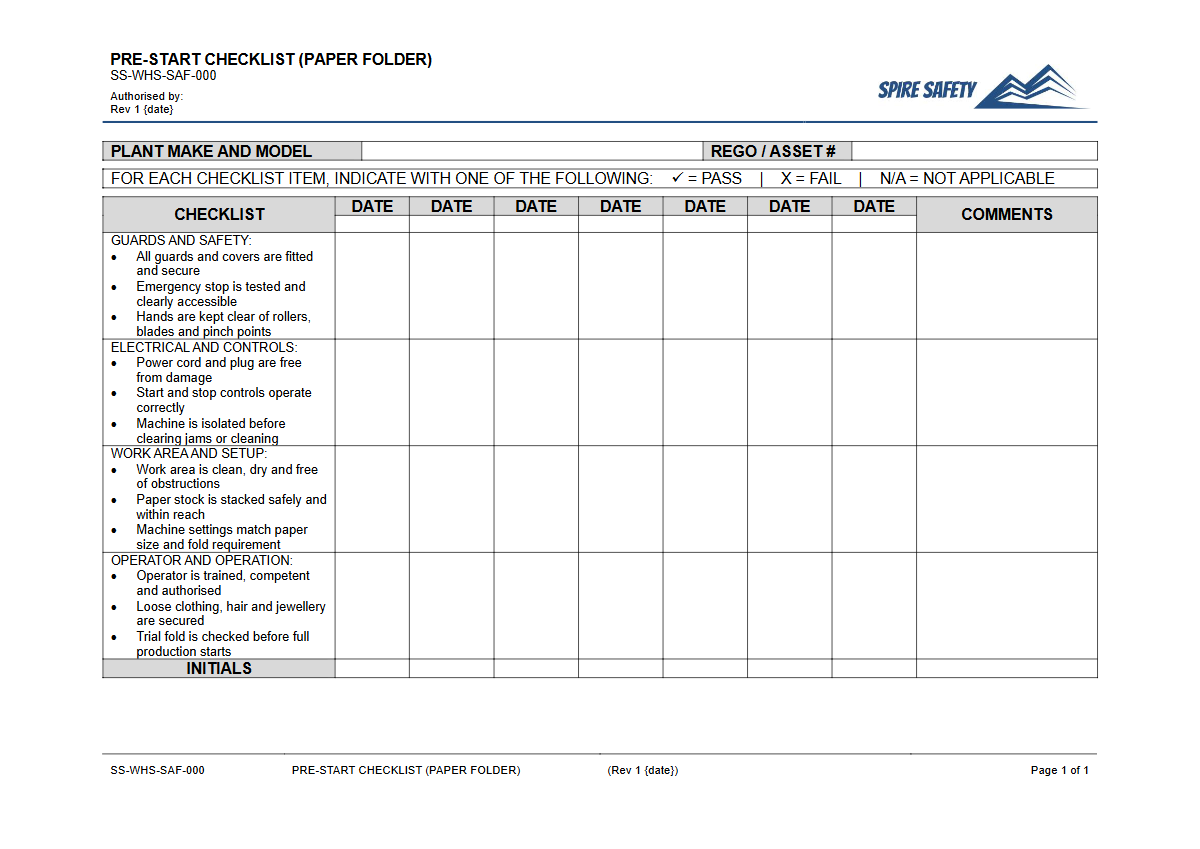
Download our free Pre-Start Checklist (Paper Folder) Template. This structured Word & PDF document helps formalise and organise your pre-use safety checks.
Free Pre-Start Checklist (Paper Folder) Template
DOCX • 125 KB + PDF
Updated Oct 2026
No signup required
Purpose of the Free Pre-Start Checklist (Paper Folder) Template
Implementing a consistent pre-start inspection routine is a cornerstone of proactive safety management. This Free Pre-Start Checklist (Paper Folder) Template provides a structured way to organise, store, and manage physical copies of your various equipment checklists.
It acts as a formal cover and filing system, ensuring that daily checks are not just completed but are also documented and auditable. Using a dedicated folder for a work area or project helps supervisors quickly verify that inspections have been conducted before work commences, reinforcing a safety-first culture.
A well-organised system of checks is fundamental to equipment safety and maintenance. To help communicate these principles to your team, you can use our Pre-Start Checks and Plant Maintenance Toolbox Talk to facilitate discussion and reinforce correct procedures.
This paper folder template serves as the physical container for the records generated from such procedures, creating a tangible trail of diligence.
Video walkthrough
How to use the Free Pre-Start Checklist (Paper Folder) Template
This resource is a template for a folder cover and organisational tool, designed to hold multiple, specific pre-start checklists. First, download the template in your preferred format (DOCX for easy editing or PDF for straightforward printing).
Customise the cover sheet with your company name, logo, project or department details, and the date range it covers.
Print the customised sheet and use it as the front of a physical folder or binder. Inside this folder, you will place the specific pre-start checklists for the machinery or tools used in that area.
For example, if your workshop uses a CNC router, you would file the completed forms from a resource like our Free Pre-Start Checklist (CNC Router) Template inside this master folder. This creates a centralised, organised repository for all pre-start records in a given work zone.
Important Note on Customisation
This document provides a general framework aligned with Australian WHS practices. It is not a complete, ready-to-use solution.
You must customise the contents of the folder by including checklists that are specific to the plant, equipment, and hazards present in your unique work environment. We recommend a competent person reviews and tailors all documentation to ensure it is fit for your specific operational purpose.
When to use it
A pre-start checklist folder should be a living document repository, updated daily. The system is most effective when used to collect checklists completed at the beginning of each shift or before a piece of equipment is used for the first time that day.
It's also particularly useful for project-based work, where a distinct set of machinery is mobilised to a site for a specific duration. The folder provides a complete safety record for that project's plant.
The information gathered in these folders is invaluable for safety meetings and planning. Supervisors can review the collected checklists before a shift briefing, using the findings to inform safety discussions documented with a Free Pre-Start Meeting Template.
Who should use it
While operators are the ones completing the individual checklists, this paper folder template is primarily designed for supervisors, team leaders, and WHS personnel. It provides them with a management tool to oversee the pre-start process effectively.
They can use the folder to ensure accountability, track completion rates, and quickly identify any recurring equipment faults or safety issues that need addressing.
It also serves as a crucial record for demonstrating due diligence. Ensuring that only trained and competent workers operate machinery is a parallel requirement.
The process of confirming worker skills can be formalised using a document such as a Verification of Competency (Pipe Threader) Template, which complements the equipment-focused checks managed by this folder system.
Integrating Pre-Start Checks into Your WHS System
Pre-start checks are not a standalone activity; they are a critical input into your overall safety framework. The data collected helps inform and validate risk assessments and control measures documented in higher-level documents.
For instance, a check might confirm that the safety features specified in a Safe Work Method Statement for Concrete Truck Operation are present and functional before the task begins.
This systematic approach to inspection and record-keeping is a foundational element of effective WHS management systems. Formal systems like ISO 45001 require organisations to have processes for hazard identification, operational control, and performance monitoring, all of which are supported by diligent pre-start routines.
Furthermore, well-maintained records are essential evidence during an internal or external audit. An auditor performing a WHS compliance auditing process will look for documented proof that plant is being inspected and maintained, and this folder system provides a clear, organised way to present that evidence. For more tools to support your safety system, explore our complete free WHS resources library.
Common mistakes
Common mistakes to avoid
- Using a generic folder without including customised, equipment-specific checklists inside.
- Allowing a 'tick and flick' culture where checks are done without genuine inspection.
- Failing to establish a clear process for reporting and rectifying faults found during checks.
- Poor record management, such as losing completed forms or not filing them centrally in the folder.
Legal references
Legal considerations
The following legal requirements may be relevant to this type of work.
- Work Health and Safety Act (Harmonised) — Provides the primary duties for protecting workers and other people from work health and safety risks.
- Work Health and Safety Regulations (Harmonised) — Sets out requirements supporting the management of workplace hazards and risks.
The following codes may be relevant to this type of work.
- Managing WHS Risks Code of Practice — Provides practical guidance on identifying hazards, assessing risks and applying effective controls.
- Work Health and Safety Consultation, Cooperation and Coordination Code of Practice — Provides practical guidance on consulting workers and coordinating with other duty holders.
- Managing the Work Environment and Facilities Code of Practice — Provides practical guidance on safe work environments, workplace facilities and related controls.
Did you know
Record Keeping
The model WHS Act requires a Person Conducting a Business or Undertaking (PCBU) to keep and maintain records, including those related to plant inspection and maintenance, to demonstrate compliance.
A Simple Check
Studies have shown that a significant percentage of workplace incidents involving machinery could have been prevented by proper pre-operational checks and routine maintenance.
FAQ
Frequently asked questions
01What is the difference between a pre-start checklist and a SWMS?
02How long should completed pre-start checklists be kept?
03What should happen if a fault is found during a pre-start check?
04Can I use this template for any type of equipment?
Share this resource
Free Pre-Start Checklist (Paper Folder) Template
Browse Categories
How To Use It
- 1Download and open in Word or PDF.
- 2Replace the placeholders with your business details.
- 3Get it reviewed by a WHS specialist before rollout.
Need it customised?
Our WHS consultants can adapt this template to your site, run a gap analysis, or audit what you already have in place.
Book a Free Consultation WHS consulting servicesor call 1300 156 382