
Free Pre-Start Checklist (Patient Monitor) Template
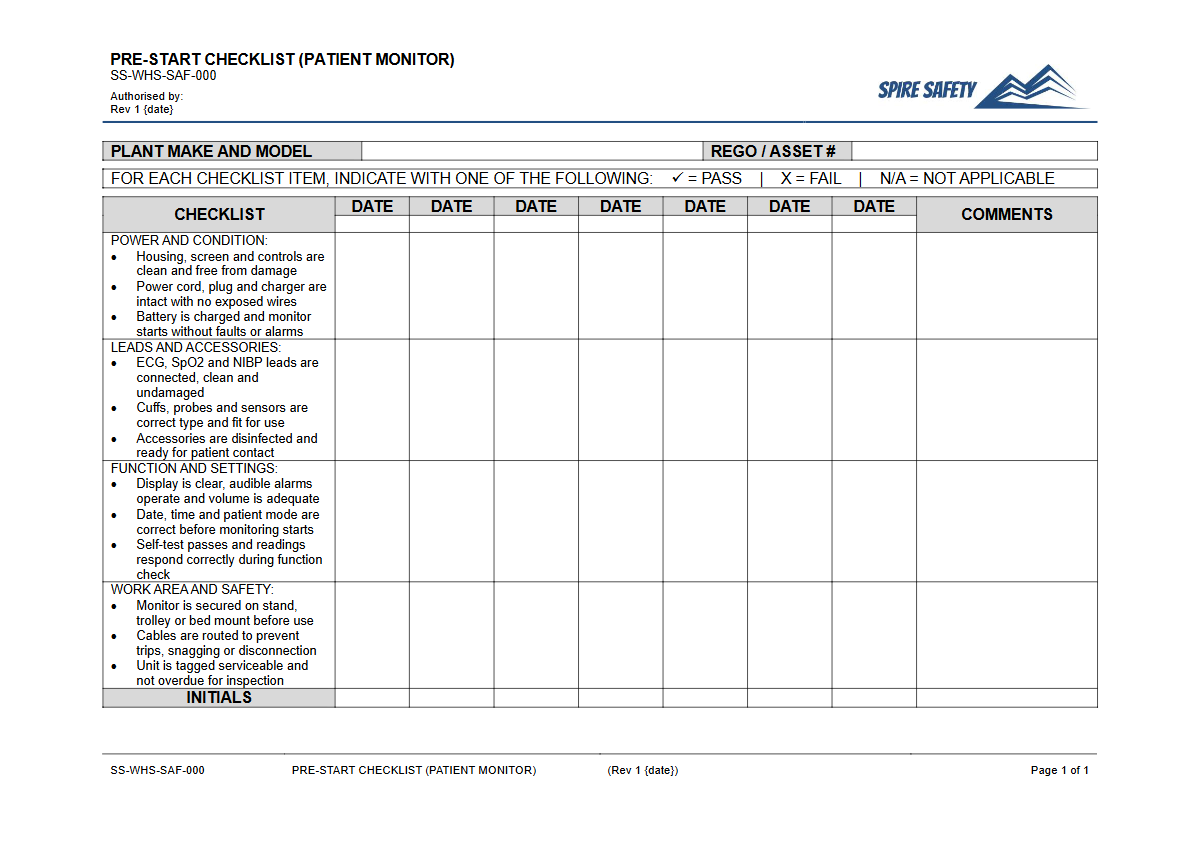
Download our free Pre-Start Checklist (Patient Monitor) Template (DOCX/PDF). A structured starting point for ensuring medical equipment is safe to use.
Free Pre-Start Checklist (Patient Monitor) Template
DOCX • 125 KB + PDF
Updated Oct 2026
No signup required
Purpose of the Free Pre-Start Checklist (Patient Monitor) Template
Ensuring medical equipment is safe, clean, and fully functional before use is a non-negotiable aspect of patient care and workplace safety. This free Pre-Start Checklist (Patient Monitor) Template provides a structured framework for healthcare professionals to conduct consistent and thorough inspections of patient monitoring devices.
Using a standardised checklist helps to systematically identify potential faults, damages, or cleanliness issues that could compromise patient safety or lead to inaccurate clinical data.
Implementing this checklist helps your organisation meet its primary duty of care under WHS legislation by managing risks associated with medical equipment. It formalises the inspection process, creating a record that a check was performed.
This proactive approach supports a strong safety culture and can be integrated into broader, comprehensive WHS management systems that address all foreseeable hazards.
Video walkthrough
How to use the Free Pre-Start Checklist (Patient Monitor) Template
This resource is provided in both DOCX and PDF formats for your convenience. The DOCX file is fully editable, allowing you to tailor the checklist to the specific makes and models of patient monitors used in your facility.
You can add or remove items, incorporate your organisation's branding, and align the checklist with your internal safe work procedures.
Important: This template is a guide and must be customised to your workplace. We are not familiar with your specific equipment, procedures, or the unique risks of your operational environment.
To ensure effectiveness, you must adapt this document to reflect the manufacturer's instructions for your patient monitors and your facility's specific infection control and safety protocols. Regular reviews of your customised checklist are also recommended to ensure it remains current.
When to use a Patient Monitor Pre-Start Checklist
A pre-start check should be conducted at several key points to ensure ongoing safety and functionality. The most common and critical time is at the beginning of every shift, or before the monitor's first use on a patient for the day.
This establishes a baseline of safe operation for the upcoming period of care.
Additional instances when the checklist should be used include:
- After the equipment has been moved between wards, rooms, or facilities.
- Following any cleaning or decontamination procedure.
- After the equipment has been returned from maintenance or repair.
- If there is any suspicion that the monitor may have been damaged or is not functioning correctly.
The core principle is to verify safety and functionality before the device is connected to a patient. The consistent use of this checklist helps reinforce this behaviour. You can further reinforce the importance of these inspections with a Pre-Start Checks and Plant Maintenance Toolbox Talk.
Who should use this checklist
This Pre-Start Checklist should be used by any person who is trained, competent, and authorised to operate patient monitoring equipment. This typically includes:
- Registered Nurses and Enrolled Nurses
- Medical Technicians
- Anaesthetists and Anaesthetic Technicians
- Biomedical Engineering Staff
- Other Allied Health Professionals
The responsibility for performing the check lies with the user. This empowers individuals to take ownership of safety in their immediate work environment.
It also creates a clear process for identifying and reporting faulty equipment, preventing it from being used inadvertently. In settings like aged care, it's also important to be aware of other environmental risks, such as manual handling risks, which can be addressed with an Aged Care Manual Handling Toolbox Talk Template.
Ultimately, a robust safety system involves checking not just the equipment, but also being prepared for patient-related hazards. This means addressing potential hazards like patient agitation with resources like a Patient and Client Aggression Toolbox Talk Template. The effectiveness of your safety protocols can be validated through regular WHS compliance auditing.
Common mistakes
Common mistakes to avoid
- Using the template 'as is' without customising it for the specific monitor models in use.
- Ignoring checks for physical damage like frayed power cords, cracked casings, or damaged probe connectors.
- Failing to check that all necessary leads, sensors, and cuffs are present, clean, and in-date.
- Completing the checklist but failing to document the results or take corrective action for identified faults.
Legal references
Legal considerations
The following legal requirements may be relevant to this type of work.
- Work Health and Safety Act (Harmonised) — Provides the primary duties for protecting workers and other people from work health and safety risks.
- Work Health and Safety Regulations (Harmonised) — Sets out requirements supporting the management of workplace hazards and risks.
The following codes may be relevant to this type of work.
- Managing WHS Risks Code of Practice — Provides practical guidance on identifying hazards, assessing risks and applying effective controls.
- Work Health and Safety Consultation, Cooperation and Coordination Code of Practice — Provides practical guidance on consulting workers and coordinating with other duty holders.
- Managing the Work Environment and Facilities Code of Practice — Provides practical guidance on safe work environments, workplace facilities and related controls.
Did you know
Decontamination is Critical
Studies have shown that patient monitors are frequently contaminated with pathogens. Regular cleaning, as prompted by a pre-start checklist, is a critical infection control measure to prevent healthcare-associated infections.
Alarm Fatigue
A significant patient safety risk is 'alarm fatigue,' where clinical staff become desensitised to frequent alarms. Pre-start checks that include verifying correct alarm settings help reduce nuisance alerts and ensure critical warnings are noticed.
FAQ
Frequently asked questions
01Is this patient monitor checklist a legal document?
02What should I do if a patient monitor fails a pre-start check?
03How often do patient monitors need professional calibration?
04Can I use this template for other medical devices like defibrillators or ECG machines?
Share this resource
Free Pre-Start Checklist (Patient Monitor) Template
Browse Categories
How To Use It
- 1Download and open in Word or PDF.
- 2Replace the placeholders with your business details.
- 3Get it reviewed by a WHS specialist before rollout.
Need it customised?
Our WHS consultants can adapt this template to your site, run a gap analysis, or audit what you already have in place.
Book a Free Consultation WHS consulting servicesor call 1300 156 382