
Free Pre-Start Checklist (Parts Washer) Template
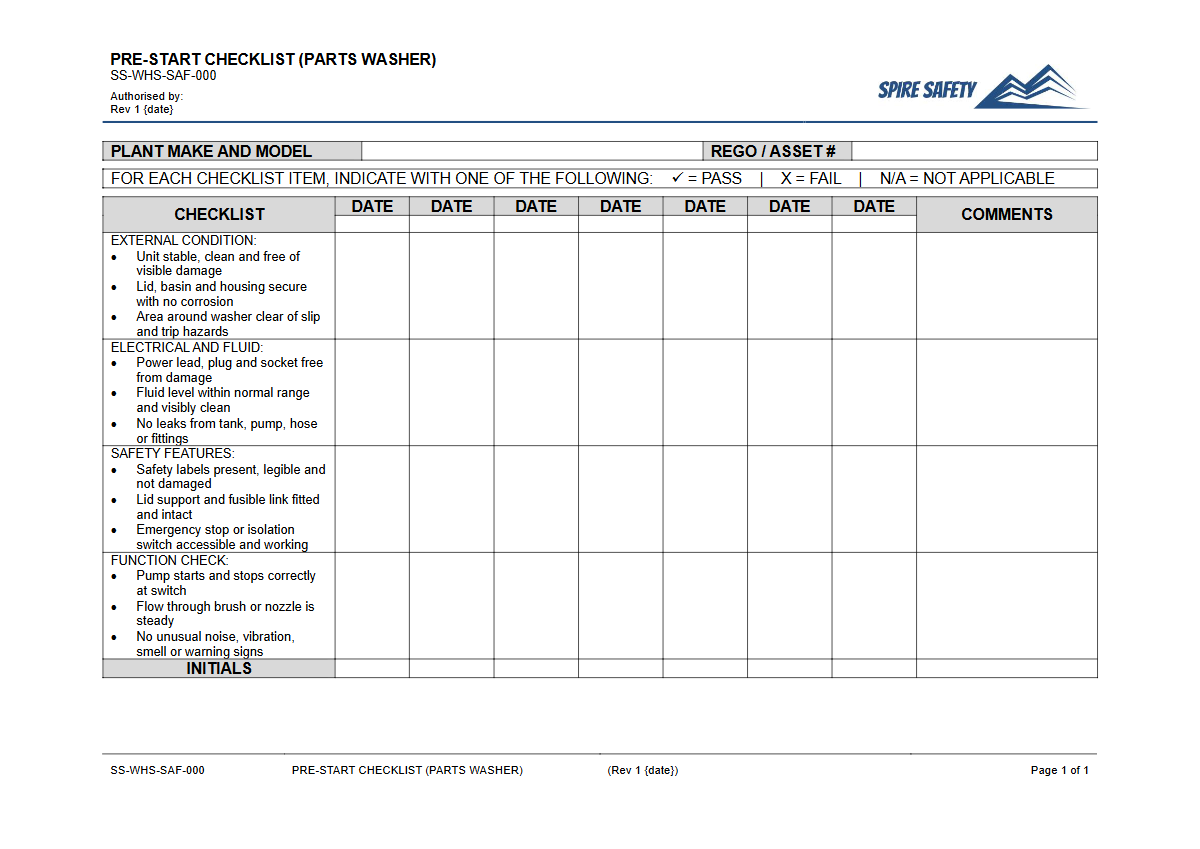
Download our free Pre-Start Checklist (Parts Washer) Template to formalise daily equipment checks. This structured DOCX & PDF helps manage WHS risks.
Free Pre-Start Checklist (Parts Washer) Template
DOCX • 125 KB + PDF
Updated Oct 2026
No signup required
Purpose of the Free Pre-Start Checklist (Parts Washer) Template
Operating industrial equipment like parts washers requires a systematic approach to safety. This Free Pre-Start Checklist (Parts Washer) Template provides a structured framework for conducting daily safety inspections before use.
Regular pre-start checks are a fundamental component of a safe system of work, helping to identify potential faults, damage, or operational issues before they can cause injury or incidents. By documenting these checks, organisations can demonstrate due diligence in managing risks associated with plant and hazardous chemicals, creating a safer environment for workers in workshops, garages, and manufacturing facilities.
This template is designed as a practical tool to support your safety procedures. It guides operators through a logical inspection sequence, covering critical components such as electrical safety, fluid levels, filtration systems, and safety features.
Using a formalised checklist promotes consistent inspection practices across all operators and shifts, ensuring that nothing is overlooked. Integrating this process into your daily operations is a key step in building robust WHS management systems and fostering a proactive safety culture.
Video walkthrough
How to use the Free Pre-Start Checklist (Parts Washer) Template
This document is a downloadable template provided in both DOCX and PDF formats, allowing for easy customisation and implementation. To use it effectively, operators should complete the checklist at the beginning of each shift or before using the parts washer for the first time that day.
The checklist prompts the user to visually inspect and test key functions, marking each item as satisfactory or identifying any faults. Any identified issues must be reported immediately according to your organisation’s fault-reporting procedure, and the equipment should be tagged out of service until it is repaired by a qualified person.
Important: This is a template, not a finished document. Every workplace is unique, with different models of equipment, types of solvents used, and specific environmental risks.
We have provided a comprehensive starting point, but you must customise this checklist to suit the specific make and model of your parts washer, the chemicals in use, and your operational context. This may involve adding, removing, or modifying checklist items to align with the manufacturer’s instructions and your own risk assessments.
When to use it
A pre-start checklist for a parts washer should be completed before every use or, at a minimum, at the start of each day or shift where the equipment is intended to be used. This frequency ensures that the equipment's condition is verified before it is put into operation, capturing any damage or faults that may have occurred overnight or during a previous shift.
It is also good practice to use the checklist after any maintenance or repair work to confirm the equipment has been returned to a safe operational state. Consistent use helps maintain a historical record of the equipment's condition, which can be valuable for maintenance planning and WHS compliance auditing.
Who should use it
This checklist should be used by any person who is required to operate a parts washer. This includes mechanics, technicians, factory workers, and maintenance personnel.
It is crucial that operators are not only provided with the checklist but are also trained on how to conduct the inspection properly. They must understand the function of each component they are checking and recognise the signs of a potential defect or hazard.
Supervisors and managers are responsible for ensuring these checks are being completed correctly and that any reported faults are addressed in a timely manner. Competency in this task is as important as competency in operating the machine itself.
Integrating with Other Safety Procedures
Pre-start checklists are most effective when they are part of a wider safety framework. For workshops with multiple pieces of equipment, you may also benefit from our free Pre-Start Checklist (Bench Grinder) Template to ensure consistency in your inspection processes.
The hazards associated with solvents in parts washers also highlight the importance of managing airborne contaminants. If your processes generate fumes, reviewing procedures for associated equipment with a Pre-Start Checklist for Fume Cabinets can help strengthen your overall chemical safety program.
For a broader range of similar documents covering various plant and equipment, our free WHS resources library has dozens of templates available for download.
Common mistakes
Common mistakes to avoid
- Using an incorrect or unauthorised cleaning solvent that is not compatible with the machine.
- Neglecting to wear appropriate Personal Protective Equipment (PPE), such as solvent-resistant gloves and safety glasses.
- Operating the parts washer in a poorly ventilated area, leading to a build-up of hazardous vapours.
- Ignoring small leaks or drips, which can indicate a failing seal or gasket that could lead to a major spill.
Legal references
Legal considerations
The following legal requirements may be relevant to this type of work.
- Work Health and Safety Act (Harmonised) — Provides the primary duties for protecting workers and other people from work health and safety risks.
- Work Health and Safety Regulations (Harmonised) — Sets out requirements supporting the management of workplace hazards and risks.
The following codes may be relevant to this type of work.
- Managing WHS Risks Code of Practice — Provides practical guidance on identifying hazards, assessing risks and applying effective controls.
- Work Health and Safety Consultation, Cooperation and Coordination Code of Practice — Provides practical guidance on consulting workers and coordinating with other duty holders.
- Managing the Work Environment and Facilities Code of Practice — Provides practical guidance on safe work environments, workplace facilities and related controls.
Did you know
Solvent Hazards
Many traditional parts washer solvents are classified as hazardous chemicals and can be absorbed through the skin or inhaled. Switching to less toxic, aqueous-based (water-based) cleaning solutions can significantly reduce health risks for workers.
Fire Risk
Parts washers that use flammable or combustible solvents are a significant fire risk. Many units have a fusible link that causes the lid to automatically close in the event of a fire, helping to smother the flames.
FAQ
Frequently asked questions
01What are the main hazards associated with using a parts washer?
02How often should a parts washer be formally inspected?
03Is specific training required to operate a parts washer?
04What should I do if I find a fault during a pre-start check?
Share this resource
Free Pre-Start Checklist (Parts Washer) Template
Browse Categories
How To Use It
- 1Download and open in Word or PDF.
- 2Replace the placeholders with your business details.
- 3Get it reviewed by a WHS specialist before rollout.
Need it customised?
Our WHS consultants can adapt this template to your site, run a gap analysis, or audit what you already have in place.
Book a Free Consultation WHS consulting servicesor call 1300 156 382