
Free Pre-Start Checklist (Parts Cleaner) Template
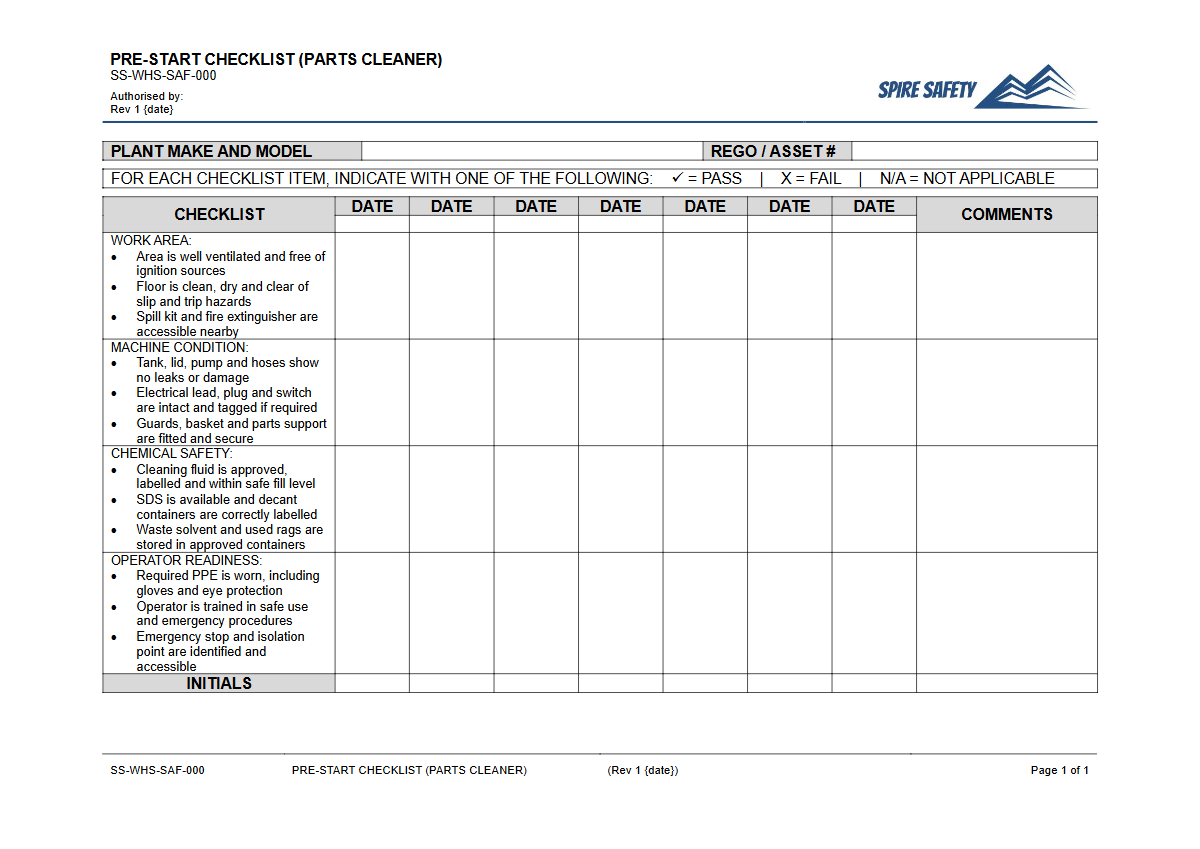
Download our free Pre-Start Checklist for Parts Cleaners. This template helps formalise equipment checks and identify hazards before use.
Free Pre-Start Checklist (Parts Cleaner) Template
DOCX • 125 KB + PDF
Updated Oct 2026
No signup required
Purpose of the Free Pre-Start Checklist (Parts Cleaner) Template
A parts cleaner is a common piece of equipment in many workshops, but it carries inherent risks related to chemical exposure, electrical components, and moving parts. Using a Free Pre-Start Checklist (Parts Cleaner) Template helps formalise the process of inspecting the machine before it is used.
This simple but critical step ensures the equipment is safe to operate, helps operators identify potential defects or faults early, and creates a documented record of safety diligence.
Regular pre-start inspections are a cornerstone of preventative maintenance, minimising the risk of breakdowns and accidents. By systematically checking key components like pumps, seals, heating elements, and safety features, organisations can address minor issues before they escalate into serious hazards or costly repairs. This proactive approach to safety can be reinforced with regular team discussions, such as those guided by our Pre-Start Checks and Plant Maintenance Toolbox Talk.
Video walkthrough
How to Use the Free Pre-Start Checklist (Parts Cleaner) Template
This downloadable template provides a structured starting point for developing your own site-specific checklist. It is available in both DOCX for easy customisation and PDF for straightforward printing and use.
Important Note on Customisation
This document is a template and must be customised to be effective. We recommend you adapt it to suit the specific make and model of your parts cleaner, the types of solvents or cleaning agents used, your operational procedures, and the unique hazards present in your workplace.
A generic checklist cannot account for all variables. It is your responsibility to ensure the final document is comprehensive and suitable for your needs.
To effectively implement the checklist:
- Review and Adapt: Compare the checklist items against the manufacturer’s operating manual and your internal risk assessments. Add or remove checks as necessary.
- Integrate with Procedures: Embed the pre-start check into your standard operating procedures (SOPs). This ensures it becomes a routine part of daily workflow, not an afterthought. The process should be a key component of your broader WHS management systems.
- Train Operators: Ensure all operators are trained not just on how to use the parts cleaner, but also on the importance of the pre-start check and how to complete it accurately.
- Establish a Reporting Process: Create a clear procedure for operators to follow if they identify a fault. This must include immediately taking the equipment out of service and reporting the issue to a supervisor. Regular reviews of these records can highlight recurring issues that may be addressed during a WHS compliance audit.
When to use it
The pre-start checklist should be completed before the first use of the parts cleaner on every shift. If multiple operators use the same machine during a shift, a new check should be conducted at each handover.
It should also be performed after any maintenance, repair, or relocation of the equipment to verify its safe operational status. Incorporating these checks into the daily schedule, perhaps after a morning briefing documented with a Pre-Start Meeting Template, helps build a consistent safety culture.
Who should use it
The primary person responsible for completing the checklist is the operator of the equipment. They have the most direct interaction with the machine and are best positioned to notice changes or potential defects.
Supervisors and managers also have a responsibility to ensure these checks are being performed correctly and consistently, and to act on any reported faults by arranging for repairs and ensuring the equipment is properly tagged out. The competency of an operator to not only use the machine but also inspect it is critical; verifying this is similar in principle to using a Pressure Cleaner VOC template to confirm skills on other equipment.
This disciplined approach to safety isn't limited to one type of machine. Just as you would conduct a pre-start on a parts cleaner, similar diligence is required for other workshop machinery.
For instance, our Free Pre-Start Checklist (CNC Router) Template provides a similar framework for another common piece of equipment, helping to standardise safety practices across your operations.
Common mistakes
Common mistakes to avoid
- Failing to customise the template for the specific parts cleaner model and solvents used.
- "Ticking and flicking" the checklist without performing the physical checks.
- Not removing faulty equipment from service immediately after a defect is identified.
- Inadequate operator training on how to properly conduct the inspection and identify faults.
Legal references
Legal considerations
The following legal requirements may be relevant to this type of work.
- Work Health and Safety Act (Harmonised) — Provides the primary duties for protecting workers and other people from work health and safety risks.
- Work Health and Safety Regulations (Harmonised) — Sets out requirements supporting the management of workplace hazards and risks.
The following codes may be relevant to this type of work.
- Managing WHS Risks Code of Practice — Provides practical guidance on identifying hazards, assessing risks and applying effective controls.
- Work Health and Safety Consultation, Cooperation and Coordination Code of Practice — Provides practical guidance on consulting workers and coordinating with other duty holders.
- Managing the Work Environment and Facilities Code of Practice — Provides practical guidance on safe work environments, workplace facilities and related controls.
Did you know
Solvent Risks
Many parts cleaner solvents contain volatile organic compounds (VOCs) that can cause respiratory irritation and long-term health effects. Proper mechanical ventilation and personal protective equipment are critical.
Fire Prevention
Using flammable solvents in a parts cleaner creates a significant fire risk. Ensure all ignition sources are controlled, the unit is properly earthed, and appropriate fire extinguishers are nearby.
FAQ
Frequently asked questions
01What are the main hazards of a parts cleaner?
02How often should a parts cleaner pre-start checklist be completed?
03Is this parts cleaner checklist a legal document?
04What should I do if a fault is found during a pre-start check?
Share this resource
Free Pre-Start Checklist (Parts Cleaner) Template
Browse Categories
How To Use It
- 1Download and open in Word or PDF.
- 2Replace the placeholders with your business details.
- 3Get it reviewed by a WHS specialist before rollout.
Need it customised?
Our WHS consultants can adapt this template to your site, run a gap analysis, or audit what you already have in place.
Book a Free Consultation WHS consulting servicesor call 1300 156 382