
Lead Paint Awareness Toolbox Talk Template
Download your free Lead Paint Awareness Toolbox Talk Template. A structured starting point for WHS discussions, aligned with Australian best practice.
Lead Paint Awareness Toolbox Talk Template
DOCX • 139 KB + PDF
Updated Oct 2026
No signup required
Purpose of this document
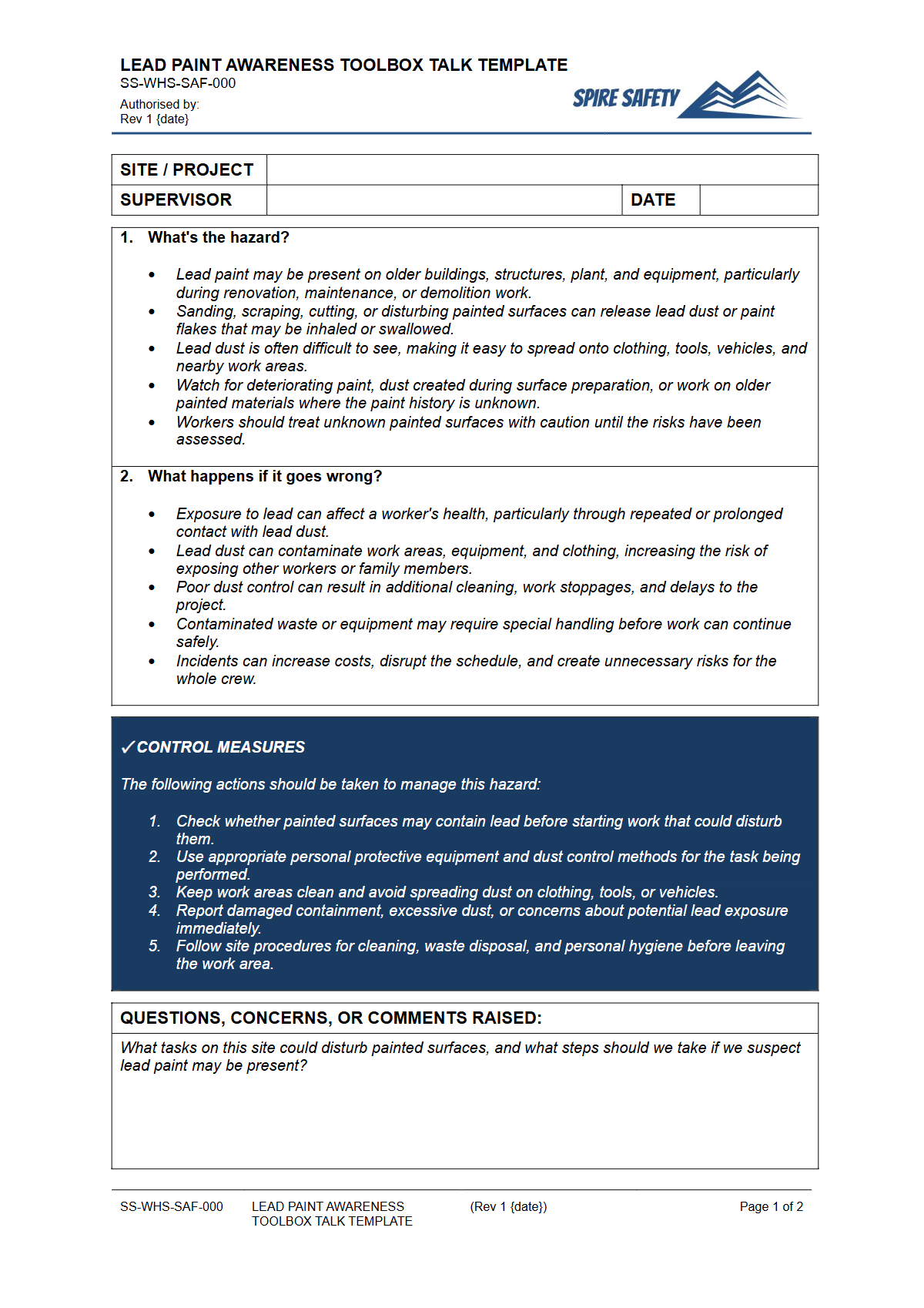
Our Lead Paint Awareness Toolbox Talk Template provides a structured framework for conducting workplace discussions on lead paint hazards and safe work practices. This template is designed to help organisations educate workers on the risks associated with lead-based paints, control measures, and emergency procedures. It serves as a foundational document to promote health and safety awareness, particularly in industries where lead paint may be encountered during renovation, demolition, or maintenance activities. Implementing regular toolbox talks using this template contributes to a proactive safety culture and helps prevent lead exposure incidents.
Video walkthrough
How to use this Safe Operating Procedure
This Lead Paint Awareness Toolbox Talk Template is provided in both DOCX and PDF formats for your convenience. The DOCX version is fully editable, allowing you to tailor the content to your specific workplace conditions, hazards, and control measures. To use this Safe Operating Procedure effectively, download the DOCX file and customise it by adding details relevant to your site, specific tasks involving lead paint, and any unique equipment or procedures your team uses. Crucially, this document must be customised to your workplace. Generic templates are a starting point; true safety is achieved when the information directly reflects your operational context, including site-specific risks and emergency contacts. Once customised, the template can be used to facilitate discussions, record attendance, and document key safety messages during toolbox talks. We offer further support for developing robust WHS management systems if required.
When to use it
This Lead Paint Awareness Toolbox Talk Template should be used whenever there is a potential for workers to encounter or disturb lead-based paints. This includes before commencing any renovation, demolition, stripping, or preparation work on older structures where lead paint might be present. It is also suitable for refresher training, new employee inductions, or after any incident or near-miss involving lead exposure. Regular use reinforces safe work practices and ensures ongoing awareness of lead hazards.
Who should use it
This template is ideal for WHS officers, supervisors, team leaders, and project managers responsible for health and safety briefings in workplaces where lead paint is a recognised hazard. It is also beneficial for trainers delivering WHS induction or ongoing training sessions. Workers who may be exposed to lead paint will be the primary recipients of the information presented through this toolbox talk. Visit our free WHS resources library for more valuable templates.
Common mistakes
Common mistakes to avoid
- Not customising the template to specific site conditions and tasks.
- Failing to conduct toolbox talks regularly or when new hazards arise.
- Not ensuring all workers attend and understand the content.
- Neglecting to document attendance and discussion points for record-keeping.
Legal references
Legal considerations
The following legal requirements may be relevant to this type of work.
- Work Health and Safety Act (Harmonised) — Provides the primary duties for protecting workers and other people from work health and safety risks.
- Work Health and Safety Regulations (Harmonised) — Sets out requirements supporting the management of workplace hazards and risks.
The following codes may be relevant to this type of work.
- Managing WHS Risks Code of Practice — Provides practical guidance on identifying hazards, assessing risks and applying effective controls.
- Work Health and Safety Consultation, Cooperation and Coordination Code of Practice — Provides practical guidance on consulting workers and coordinating with other duty holders.
- Managing the Work Environment and Facilities Code of Practice — Provides practical guidance on safe work environments, workplace facilities and related controls.
Did you know
Lead Paint Ban
Lead-based house paint was banned for sale in Australia in 1997, but industrial uses continued until 2010 for certain applications. Any paint manufactured before these dates could contain lead.
Invisible Threat
Lead dust, created when lead paint is disturbed, is often invisible to the naked eye but can be easily inhaled or ingested, making proper control measures crucial.
FAQ
Frequently asked questions
01What is a 'Toolbox Talk' in the WHS context?
02Why is lead paint still a concern in Australia?
03What are the common health risks associated with lead exposure?
04What is the primary download type for this template?
Share this resource
Lead Paint Awareness Toolbox Talk Template
Browse Categories
How To Use It
- 1Download and open in Word or PDF.
- 2Replace the placeholders with your business details.
- 3Get it reviewed by a WHS specialist before rollout.
Need it customised?
Our WHS consultants can adapt this template to your site, run a gap analysis, or audit what you already have in place.
Book a Free Consultation WHS consulting servicesor call 1300 156 382
Related templates
- Free 3D Printer SOP (Safe Operating Procedure) Template
- FREE Agricultural Equipment SOP (Safe Operating Procedure) Template
- Free Air Compressor SOP (Safe Operating Procedure) Template
- Free Angle Grinder SOP (Safe Operating Procedure) Template
- FREE Backhoe SOP (Safe Operating Procedure) Template
- FREE Baler SOP (Safe Operating Procedure) Template