
Free Pre-Start Checklist (Oxygen Unit) Template
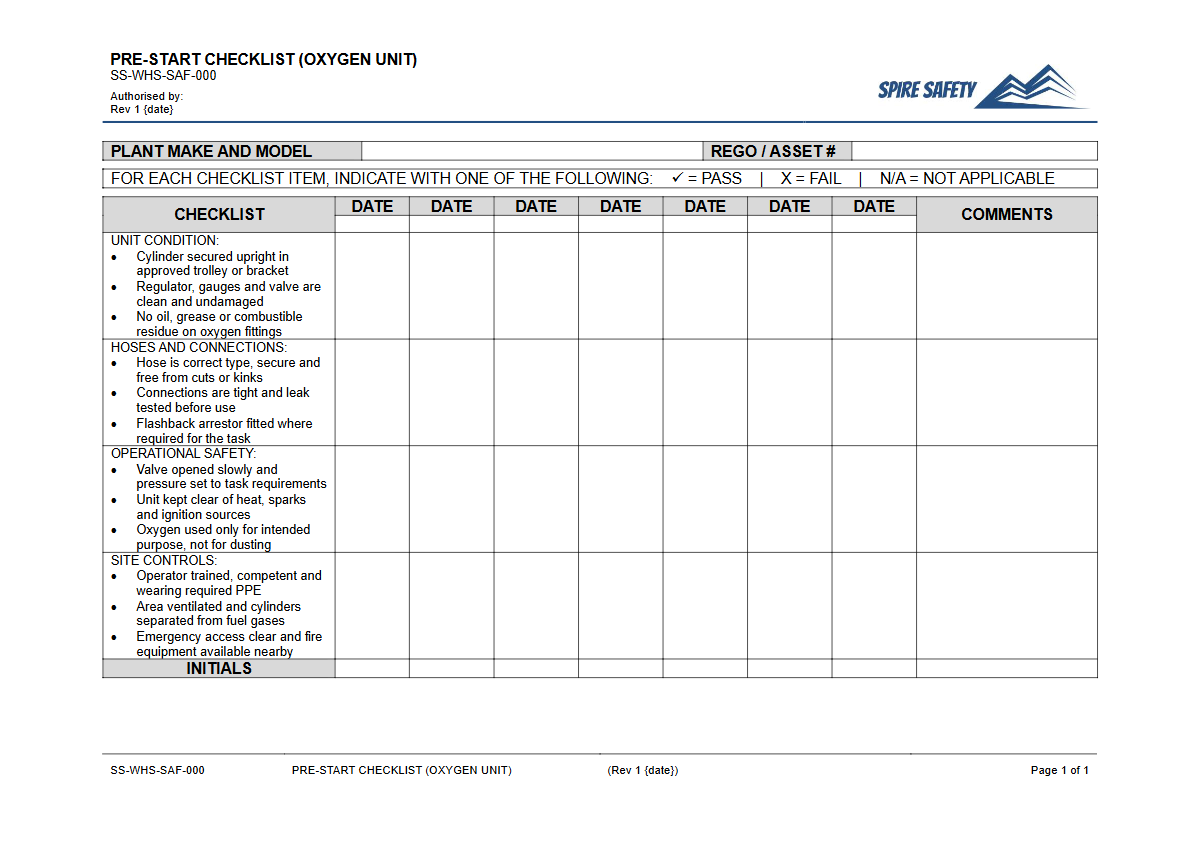
Download our free Pre-Start Checklist for Oxygen Units. This structured template (DOCX/PDF) helps formalise equipment safety inspections and risk management.
Free Pre-Start Checklist (Oxygen Unit) Template
DOCX • 125 KB + PDF
Updated Oct 2026
No signup required
Purpose of the Free Pre-Start Checklist (Oxygen Unit) Template
Using an oxygen unit, whether for medical or industrial purposes, carries significant risks if the equipment is faulty. A formal inspection process is essential for managing hazards like oxygen leaks, which can create a severe fire or explosion risk, as well as issues with regulators, hoses, and cylinder pressure.
This Free Pre-Start Checklist (Oxygen Unit) Template provides a structured starting point for your organisation to formalise these critical safety inspections.
By implementing a consistent pre-start routine, you create a verifiable record that equipment was in a safe condition before use. This practice helps a Person Conducting a Business or Undertaking (PCBU) meet their primary duty of care under WHS legislation.
It moves your safety process from an informal visual check to a documented, systematic procedure, reinforcing a positive safety culture. You can further support these checks by delivering targeted safety messages with our Pre-Start Checks and Plant Maintenance Toolbox Talk Template.
What this Pre-Start Checklist covers
This template is designed to guide operators through a comprehensive check of a typical oxygen unit, covering key areas such as:
- Cylinder condition (dents, corrosion, correct labelling)
- Regulator and pressure gauge functionality
- Hoses and connections for leaks or damage
- Flow meter accuracy
- Correct storage and handling
- Presence of safety and firefighting equipment
Video walkthrough
How to use the Free Pre-Start Checklist (Oxygen Unit) Template
This document provides a robust foundation for developing a site-specific pre-start check. Download the DOCX file and adapt it to the specific makes and models of oxygen equipment used in your workplace, your operational procedures, and the unique risks of your environment.
You can then save it as a PDF for easy distribution or printing.
A critical step in implementation is training. Ensure all operators understand not just what to check, but why each check is important and what to do if they identify a fault.
This checklist should be used as part of a broader system that includes procedures for tagging out and reporting faulty equipment. For inspecting other specialised gas equipment, you may need a different checklist, such as our Free Pre-Start Checklist (Air Arc) Template, which addresses different hazards.
Important: This is a template only. We have provided a structured starting point, but it is your responsibility to ensure the final document is customised to reflect the specific equipment, tasks, and risks in your workplace.
The checklist must be reviewed and approved by a competent person before implementation.
When to use a Pre-Start Checklist
An Oxygen Unit Pre-Start Checklist should be completed by the operator before the equipment is used for the first time on any given shift. It is a high-frequency check designed to catch faults that may have developed since the last use or been missed during previous inspections.
It does not replace the need for scheduled, in-depth maintenance or statutory inspections by a competent technician; rather, it complements them.
Integrating these checks into daily opening procedures ensures they are never missed. This consistent application is a fundamental component of effective WHS management systems, creating a reliable process for risk control at the source.
Who should use it
This checklist is designed for use by competent workers who have been trained and authorised to operate oxygen equipment. The responsibility for ensuring the checks are completed typically rests with the operator themselves.
Supervisors and managers should also be familiar with the checklist so they can conduct verifications, review completed records, and ensure the process is being followed correctly.
Involving workers in the customisation of the checklist is a powerful way to improve engagement and leverage their hands-on knowledge of the equipment. For organisations needing expert guidance on implementing such processes, engaging external WHS consulting services can provide clarity and help build a compliant and practical system.
The findings from pre-start checks can also serve as valuable input for daily safety briefings. Issues or trends identified across multiple checks can be discussed with the wider team using tools like our Free Pre-Start Meeting Template to foster collective awareness and problem-solving.
Common mistakes
Common mistakes to avoid
- Using the template without customising it for the specific make and model of the oxygen unit.
- Failing to train operators on how to perform each check and what to do if a fault is found.
- Operators 'pencil-whipping' the form without physically performing the inspections.
- Not immediately removing faulty equipment from service and clearly tagging it as 'out-of-service'.
Legal references
Legal considerations
The following legal requirements may be relevant to this type of work.
- Work Health and Safety Act (Harmonised) — Provides the primary duties for protecting workers and other people from work health and safety risks.
- Work Health and Safety Regulations (Harmonised) — Sets out requirements supporting the management of workplace hazards and risks.
The following codes may be relevant to this type of work.
- Managing WHS Risks Code of Practice — Provides practical guidance on identifying hazards, assessing risks and applying effective controls.
- Work Health and Safety Consultation, Cooperation and Coordination Code of Practice — Provides practical guidance on consulting workers and coordinating with other duty holders.
- Managing the Work Environment and Facilities Code of Practice — Provides practical guidance on safe work environments, workplace facilities and related controls.
Did you know
Oxygen-Enriched Atmospheres
An atmosphere with even a few percent more oxygen than normal air (20.9%) can cause materials like clothing, oil, and grease to ignite much more easily and burn with greater intensity.
Cylinder Colour Coding
In Australia, industrial oxygen cylinders are black, while medical oxygen cylinders are white. This colour-coding system is crucial for preventing accidental misuse between industrial and medical applications.
FAQ
Frequently asked questions
01Is this Pre-Start Checklist for an oxygen unit legally required?
02What are the main hazards of using an oxygen unit?
03How often should an oxygen unit be inspected?
04Can I use this template for acetylene or other gas cylinders?
Share this resource
Free Pre-Start Checklist (Oxygen Unit) Template
Browse Categories
How To Use It
- 1Download and open in Word or PDF.
- 2Replace the placeholders with your business details.
- 3Get it reviewed by a WHS specialist before rollout.
Need it customised?
Our WHS consultants can adapt this template to your site, run a gap analysis, or audit what you already have in place.
Book a Free Consultation WHS consulting servicesor call 1300 156 382