
Free Pre-Start Checklist (Padfoot Roller) Template
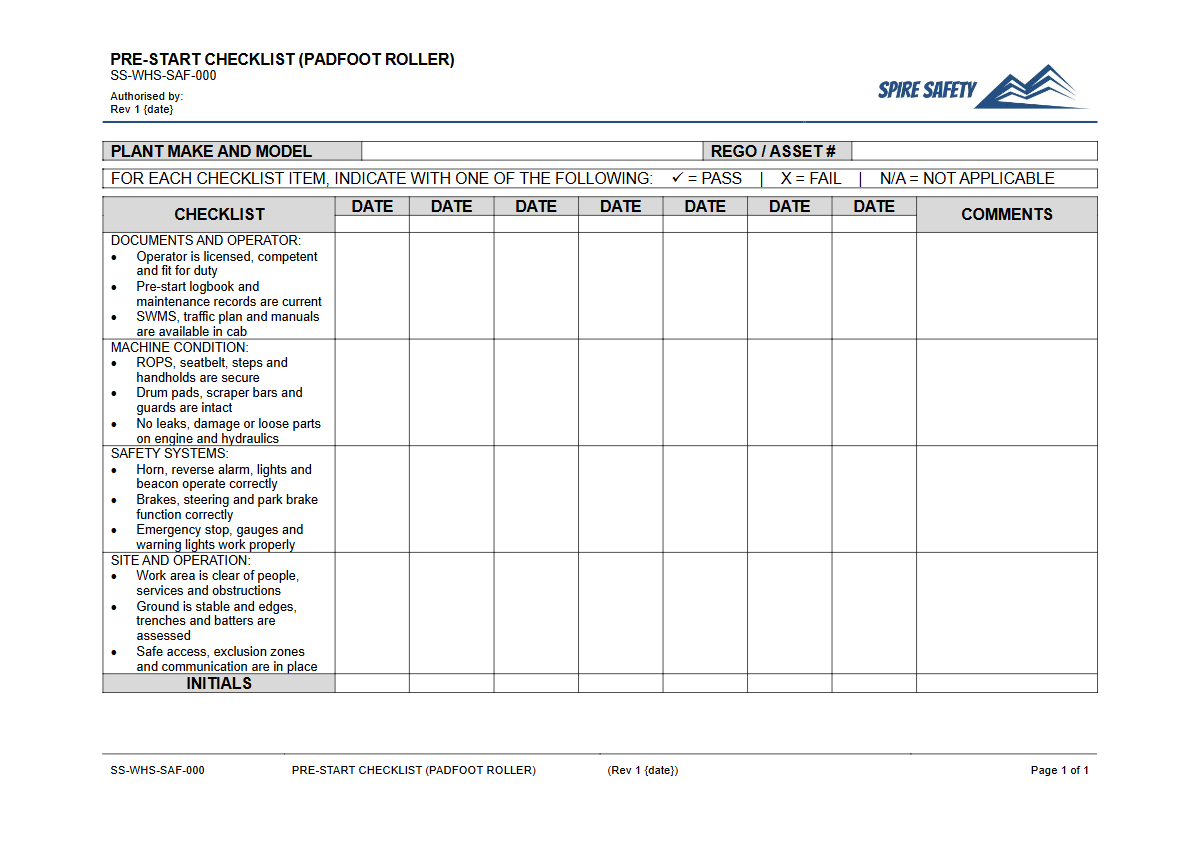
Download our free Pre-Start Checklist (Padfoot Roller) Template to formalise daily equipment inspections.
Free Pre-Start Checklist (Padfoot Roller) Template
DOCX • 125 KB + PDF
Updated Oct 2026
No signup required
Purpose of the Free Pre-Start Checklist (Padfoot Roller) Template
Operating heavy machinery like a padfoot roller involves significant risks. A systematic pre-start inspection is a fundamental safety measure to identify and control hazards before work begins.
This free Pre-Start Checklist (Padfoot Roller) Template provides a structured format for operators to conduct thorough daily checks, helping to prevent equipment failure, property damage, and serious injuries. Consistent use of this checklist helps create a documented record of your plant's condition, which is a key part of maintaining a safe system of work.
It formalises the inspection process, ensuring no critical safety component is overlooked.
By identifying issues such as hydraulic leaks, worn components, or faulty safety guards early, organisations can schedule proactive maintenance and avoid costly breakdowns or dangerous incidents. This proactive approach to safety can be reinforced with regular team discussions, using a Pre-Start Checks and Plant Maintenance toolbox talk to embed best practices across all teams.
Video walkthrough
How to use the Free Pre-Start Checklist (Padfoot Roller) Template
This template is provided as a starting point in both DOCX and PDF formats. Download the file and integrate it into your daily operational procedures.
The checklist guides the operator through a logical sequence of checks, covering everything from the general condition and structural integrity to specific mechanical and safety systems like brakes, steering, lights, and the condition of the roller drum and pads.
Operators should complete the checklist at the beginning of their shift, before starting the engine. Each item should be visually inspected and verified.
The form includes sections to record any faults or defects discovered, the date, the machine's details, and the operator's signature. Any identified issues must be reported immediately according to your site's procedures, and the machine should not be used until it is deemed safe.
The checklist is an operational tool that complements a Safe Work Method Statement (SWMS) for padfoot roller operations, which outlines the high-risk tasks themselves.
IMPORTANT: This document is a template and must be customised to suit your specific needs. We recommend you edit the checklist to include details relevant to your particular make and model of padfoot roller, your site-specific hazards, and your organisation's internal procedures.
This should be done in consultation with your operators and other relevant workers.
When to use it
A pre-start checklist for a padfoot roller should be completed before every shift or period of use. It is not a one-off task.
The repetitive nature of the check ensures that any changes in the machine's condition, whether from the previous shift's use or overnight factors, are caught before it becomes a hazard. This routine is a critical part of the overall safe use of the equipment, as defined in your Roller Safe Operating Procedure (SOP). The completed forms should be filed and retained as part of your WHS records, providing valuable data for maintenance scheduling and safety audits.
Who should use it
This checklist is designed primarily for the plant operator. They are the person with the most hands-on interaction with the equipment and are best placed to notice subtle changes in its condition or performance. However, other personnel have a role to play:
- Supervisors and Site Foremen: They are responsible for ensuring that operators are completing the checks correctly and consistently. They also manage the process for reporting and rectifying defects found during inspections.
- Maintenance Personnel: They will use the information from completed checklists to diagnose faults, schedule repairs, and conduct preventative maintenance.
- WHS Managers: They use the records to monitor compliance, identify trends in equipment failure, and verify the effectiveness of safety procedures. The data feeds into the organisation's broader WHS management systems.
Proper implementation ensures that safety is a shared responsibility, with clear roles for everyone involved in the lifecycle of the plant's operation. If your organisation requires assistance in defining these roles and embedding them into your procedures, you may wish to consider professional WHS consulting services to ensure your framework is robust and effective.
Common mistakes
Common mistakes to avoid
- Failing to customise the template for the specific make, model, and work environment.
- "Pencil-whipping" the form without actually performing the physical checks.
- Not immediately reporting defects or failing to take faulty equipment out of service.
- Poor record-keeping, making it difficult to track maintenance history or prove due diligence.
Legal references
Legal considerations
The following legal requirements may be relevant to this type of work.
- Work Health and Safety Act (Harmonised) — Provides the primary duties for protecting workers and other people from work health and safety risks.
- Work Health and Safety Regulations (Harmonised) — Sets out requirements supporting the management of workplace hazards and risks.
The following codes may be relevant to this type of work.
- Managing WHS Risks Code of Practice — Provides practical guidance on identifying hazards, assessing risks and applying effective controls.
- Work Health and Safety Consultation, Cooperation and Coordination Code of Practice — Provides practical guidance on consulting workers and coordinating with other duty holders.
- Managing the Work Environment and Facilities Code of Practice — Provides practical guidance on safe work environments, workplace facilities and related controls.
Did you know
The 'Foot' in Padfoot
The 'pads' or 'feet' on a padfoot roller are designed to concentrate the machine's weight onto a small surface area. This creates a kneading, manipulative force that is highly effective at compacting cohesive soils like clay and silt.
Plant Incidents
According to Safe Work Australia, incidents involving machinery and fixed plant are a leading cause of workplace fatalities and serious injuries, highlighting the critical importance of pre-operational checks and safe systems of work.
FAQ
Frequently asked questions
01What key items should a padfoot roller pre-start check include?
02How often does a padfoot roller need a pre-start check?
03What happens if a defect is found during a padfoot roller pre-start check?
04Is a paper pre-start checklist still effective?
Share this resource
Free Pre-Start Checklist (Padfoot Roller) Template
Browse Categories
How To Use It
- 1Download and open in Word or PDF.
- 2Replace the placeholders with your business details.
- 3Get it reviewed by a WHS specialist before rollout.
Need it customised?
Our WHS consultants can adapt this template to your site, run a gap analysis, or audit what you already have in place.
Book a Free Consultation WHS consulting servicesor call 1300 156 382