
Safe Work Method Statement (Padfoot Roller Operation) Template
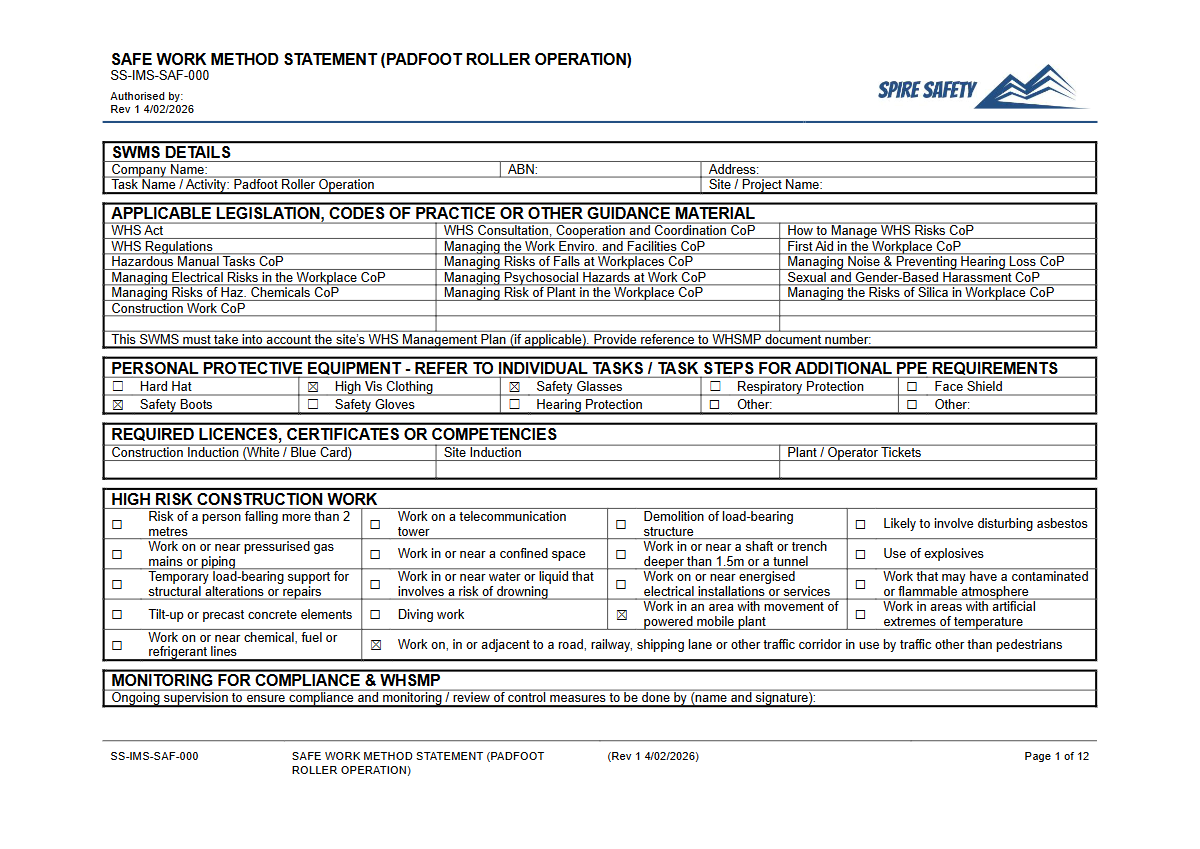
Streamline your WHS planning with our free Safe Work Method Statement (Padfoot Roller Operation) template.
Safe Work Method Statement (Padfoot Roller Operation) Template
DOCX • 160 KB + PDF
Updated Oct 2026
No signup required
Purpose of the Safe Work Method Statement (Padfoot Roller Operation) Template
Our Safe Work Method Statement (Padfoot Roller Operation) template provides a structured starting point for identifying hazards and controlling risks associated with using padfoot rollers in a workplace. This essential document, often referred to as an SWMS, helps organisations plan and implement safe work practices, ensuring the well-being of workers and others who may be affected by these operations.
By systematically outlining the steps involved, potential hazards, and required control measures, this template assists in meeting obligations under the Australian Work Health and Safety (WHS) framework.
Using a well-developed SWMS is crucial for high-risk construction activities or any task involving plant like a padfoot roller. This free resource from Spire Safety is designed to assist businesses in developing site-specific documents that promote a safe work environment.
Video walkthrough
How to use the Safe Work Method Statement (Padfoot Roller Operation) Template
This Safe Work Method Statement (Padfoot Roller Operation) template is a comprehensive foundation to build upon. To effectively implement it in your workplace, you must customise it to reflect your specific site conditions, equipment, personnel, and task variations. Start by downloading the DOCX version for easy editing, or use the PDF for a quick review.
Identify Specifics: Detail the exact type of padfoot roller being used, its attachments, and the specific work environment (e.g., soil type, slope, proximity to other plant or workers).
Hazard Review: Thoroughly review the pre-filled hazards and add any other hazards unique to your operation. Consider environmental factors, ground conditions, operator competency, and maintenance status of the plant.
Control Measures: Implement appropriate control measures for each identified hazard. This may involve engineering controls (e.g., roll-over protective structures), administrative controls (e.g., exclusion zones, communication plans), or personal protective equipment (PPE).
Consultation: Engage with your workers and their representatives in the development and review of this SWMS. Their practical input is invaluable for identifying hazards and devising effective controls.
Training and Instruction: Ensure all workers involved in padfoot roller operation are adequately trained and instructed on the SWMS content and safe operating procedures.
Regular Review: This SWMS should be reviewed regularly, especially if there are changes to the work process, equipment, site conditions, or after any incidents or near misses. This proactive approach is a cornerstone of effective WHS management systems.
When to use it
This template should be used before commencing any operation involving a padfoot roller, particularly when the activity is classified as high-risk construction work or involves other risks requiring formal documentation. It serves as a critical planning tool for supervisors, operators, and WHS personnel to ensure all safety considerations are addressed proactively.
Use it during project planning, before new tasks, or when introducing new equipment or personnel to maintain a consistent approach to safety across your operations.
Who should use it
This resource is ideal for WHS officers, site managers, project supervisors, small business owners, and anyone responsible for planning or overseeing padfoot roller operations in Australian workplaces. Plant operators themselves should also review and understand its contents prior to commencing work.
Organisations seeking to improve their WHS documentation and demonstrate due diligence will find this template highly beneficial. For tailored support in implementing or auditing your WHS documentation, consider WHS compliance auditing.
Common mistakes
Common mistakes to avoid
- Failing to customise the SWMS for specific site conditions and equipment.
- Not consulting with workers during the development or review of the SWMS.
- Failing to review and update the SWMS after incidents, near misses, or changes to the work.
- Treating the SWMS as a sign-off formality rather than a dynamic risk management tool.
Legal references
Legal considerations
The following legal requirements may be relevant to this type of work.
- Work Health and Safety Act (Harmonised) — Provides the primary duties for protecting workers and other people from work health and safety risks.
- Work Health and Safety Regulations (Harmonised) — Sets out requirements supporting the management of workplace hazards and risks.
The following codes may be relevant to this type of work.
- Managing WHS Risks Code of Practice — Provides practical guidance on identifying hazards, assessing risks and applying effective controls.
- Work Health and Safety Consultation, Cooperation and Coordination Code of Practice — Provides practical guidance on consulting workers and coordinating with other duty holders.
- Managing the Work Environment and Facilities Code of Practice — Provides practical guidance on safe work environments, workplace facilities and related controls.
Did you know
Padfoot Rollers vs. Smooth Drum Rollers
Padfoot rollers, with their 'feet' or 'pads', are designed for compacting cohesive soils like clay, as they knead and mix the soil to achieve denser compaction. Smooth drum rollers, conversely, are best suited for granular soils such as sand and gravel, or for finishing asphalt surfaces.
FAQ
Frequently asked questions
01What is a Safe Work Method Statement (SWMS)?
02Is an SWMS legally required for all work with a padfoot roller?
03How often should an SWMS for padfoot roller operation be reviewed?
04Can this template be used outside Australia?
Share this resource
Safe Work Method Statement (Padfoot Roller Operation) Template
Browse Categories
How To Use It
- 1Download and open in Word or PDF.
- 2Replace the placeholders with your business details.
- 3Get it reviewed by a WHS specialist before rollout.
Need it customised?
Our WHS consultants can adapt this template to your site, run a gap analysis, or audit what you already have in place.
Book a Free Consultation WHS consulting servicesor call 1300 156 382
Related templates
- Safe Work Method Statement (Prime Mover Operation) Template
- Safe Work Method Statement (Scissor Lift Operation) Template
- Safe Work Method Statement (Scraper Operation) Template
- Safe Work Method Statement (Skid Steer Loader Operation) Template
- Safe Work Method Statement (Smooth Drum Roller Operation) Template
- Safe Work Method Statement (Telehandler Operation) Template