
Safe Work Method Statement (Prime Mover Operation) Template
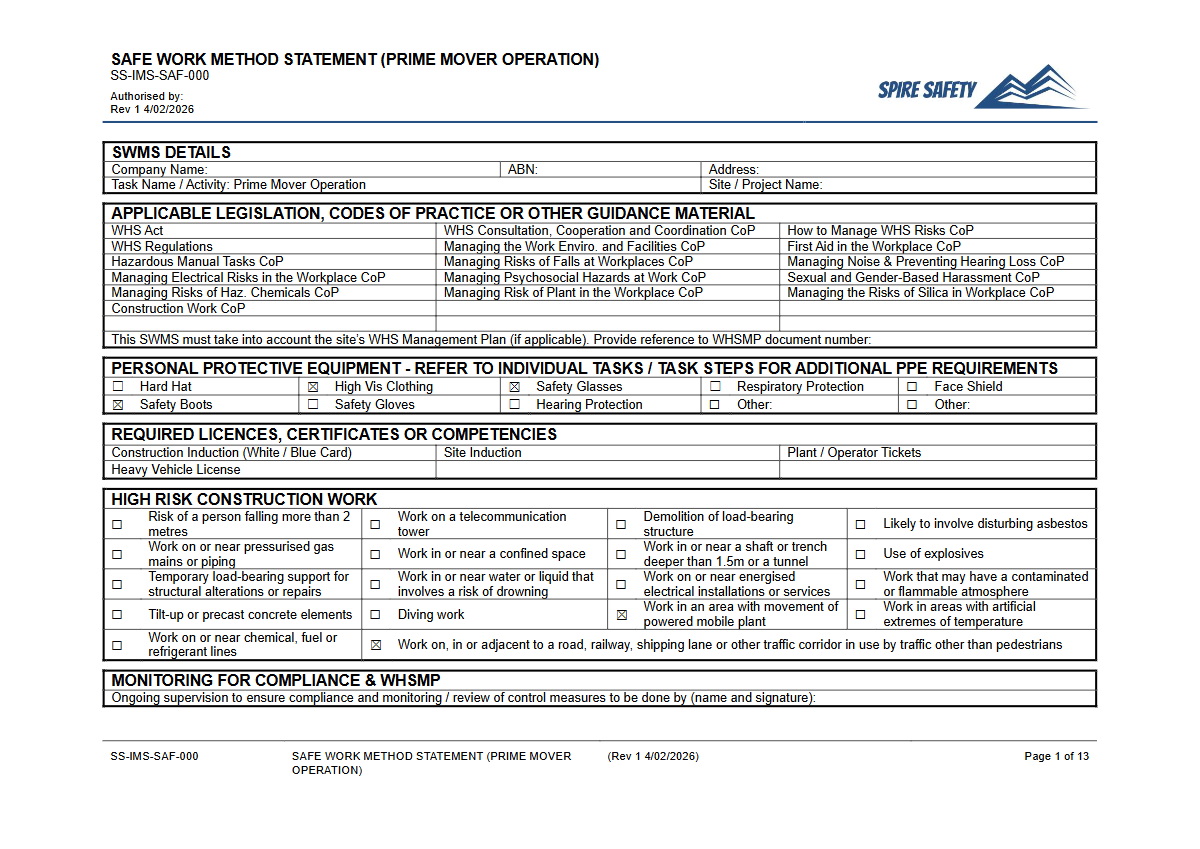
Download our free Safe Work Method Statement (Prime Mover Operation) Template. A structured starting point for managing risks in prime mover operations.
Safe Work Method Statement (Prime Mover Operation) Template
DOCX • 161 KB + PDF
Updated Oct 2026
No signup required
Purpose of the Safe Work Method Statement (Prime Mover Operation) Template
Our Safe Work Method Statement (Prime Mover Operation) Template provides a structured framework for identifying hazards and controlling risks associated with prime mover operation in your workplace. This resource is designed to assist organisations in developing a systematic approach to ensure the health and safety of workers and others who may be affected by these activities.
The template serves as a foundational document, guiding you through the critical steps of risk assessment and control implementation specific to prime mover use.
By utilising this template, you can systematically document potential dangers, outline safe work procedures, and specify the necessary control measures to mitigate risks effectively. It’s an essential tool for demonstrating due diligence and fostering a proactive safety culture within your organisation, aligned with Australian WHS practice.
Video walkthrough
How to use the Safe Work Method Statement (Prime Mover Operation) Template
This Safe Work Method Statement (Prime Mover Operation) Template is provided in an editable DOCX format, allowing for complete customisation to your specific workplace conditions and operational requirements. We cannot stress enough that this is a template; it must be customised to your workplace, specific prime mover models, operational environment, and the tasks being performed.
Begin by reviewing the pre-filled sections and adapting them to reflect your actual operations. Identify all potential hazards inherent in your prime mover activities, assess the associated risks, and detail the control measures you will implement.
Include information on who is responsible for each step, the required training, and the personal protective equipment (PPE) necessary.
Regular review and updates are crucial to ensure the SWMS remains relevant and effective. For assistance in tailoring your WHS documentation or implementing a comprehensive WHS management system, consider expert WHS consulting services.
When to use it
A Safe Work Method Statement for prime mover operations should be developed before any work involving a prime mover commences, especially if the work is considered high-risk construction work or involves other significant hazards identified in your risk assessments. It is also required whenever there are changes to equipment, work processes, the work environment, or after any incident involving prime mover operation.
Essentially, any time a prime mover is used in your workplace, an up-to-date and relevant SWMS should be in place.
Who should use it
This template is intended for anyone involved in managing safety for prime mover operations. This includes WHS officers, supervisors, team leaders, project managers, and business owners responsible for ensuring a safe working environment.
Operators of prime movers should also be familiar with the contents of the SWMS specific to their tasks. While the template provides a solid foundation, ensuring its proper implementation and adherence is a collective responsibility.
Review and Improvement
Regular review of your Safe Work Method Statements is vital to maintaining an effective WHS system. This includes scheduled reviews, reviews after incidents, or when new information about hazards or control measures becomes available.
An effective review process ensures that your SWMS continues to reflect current best practices and operational realities. For guidance on systematic reviews and continuous improvement, particularly within the framework of ISO 45001 consulting, Spire Safety can provide expert advice.
Additional Resources
For more free safety resources and templates, explore our comprehensive free WHS resources library. These tools are designed to support Australian businesses in upholding high standards of workplace health and safety.
Common mistakes
Common mistakes to avoid
- Not customising the template to specific site conditions and equipment.
- Failing to adequately consult with workers who perform the prime mover tasks.
- Not regularly reviewing and updating the SWMS after changes or incidents.
- Treating the SWMS as a 'tick and flick' exercise rather than a live safety document.
Legal references
Legal considerations
The following legal requirements may be relevant to this type of work.
- Work Health and Safety Act (Harmonised) — Provides the primary duties for protecting workers and other people from work health and safety risks.
- Work Health and Safety Regulations (Harmonised) — Sets out requirements supporting the management of workplace hazards and risks.
The following codes may be relevant to this type of work.
- Managing WHS Risks Code of Practice — Provides practical guidance on identifying hazards, assessing risks and applying effective controls.
- Work Health and Safety Consultation, Cooperation and Coordination Code of Practice — Provides practical guidance on consulting workers and coordinating with other duty holders.
- Managing the Work Environment and Facilities Code of Practice — Provides practical guidance on safe work environments, workplace facilities and related controls.
Did you know
Road Freight Dominance
In Australia, road freight accounts for over 75% of domestic freight movements, highlighting the pervasive use of prime movers and the importance of stringent safety protocols.
Heavy Vehicle Rollovers
Rollovers are a significant hazard in heavy vehicle operations. Contributing factors often include excessive speed for conditions, improper load distribution, and driver fatigue, underscoring the need for detailed SWMS.
FAQ
Frequently asked questions
01What is a Safe Work Method Statement (SWMS)?
02Is this Prime Mover Operation SWMS template WHS-aligned?
03Who is responsible for developing an SWMS for prime mover operations?
04How often should a Prime Mover Operation SWMS be reviewed?
Share this resource
Safe Work Method Statement (Prime Mover Operation) Template
Browse Categories
How To Use It
- 1Download and open in Word or PDF.
- 2Replace the placeholders with your business details.
- 3Get it reviewed by a WHS specialist before rollout.
Need it customised?
Our WHS consultants can adapt this template to your site, run a gap analysis, or audit what you already have in place.
Book a Free Consultation WHS consulting servicesor call 1300 156 382
Related templates
- Safe Work Method Statement (Scissor Lift Operation) Template
- Safe Work Method Statement (Scraper Operation) Template
- Safe Work Method Statement (Skid Steer Loader Operation) Template
- Safe Work Method Statement (Smooth Drum Roller Operation) Template
- Safe Work Method Statement (Telehandler Operation) Template
- Safe Work Method Statement (Tip Truck or Trailer Operation) Template