
Free Pre-Start Checklist (Oxy Set) Template
Download our free Pre-Start Checklist (Oxy Set) Template to formalise safety inspections for oxy-acetylene equipment. Get your DOCX & PDF now.
Free Pre-Start Checklist (Oxy Set) Template
DOCX • 125 KB + PDF
Updated Oct 2026
No signup required
Purpose of the Free Pre-Start Checklist (Oxy Set) Template
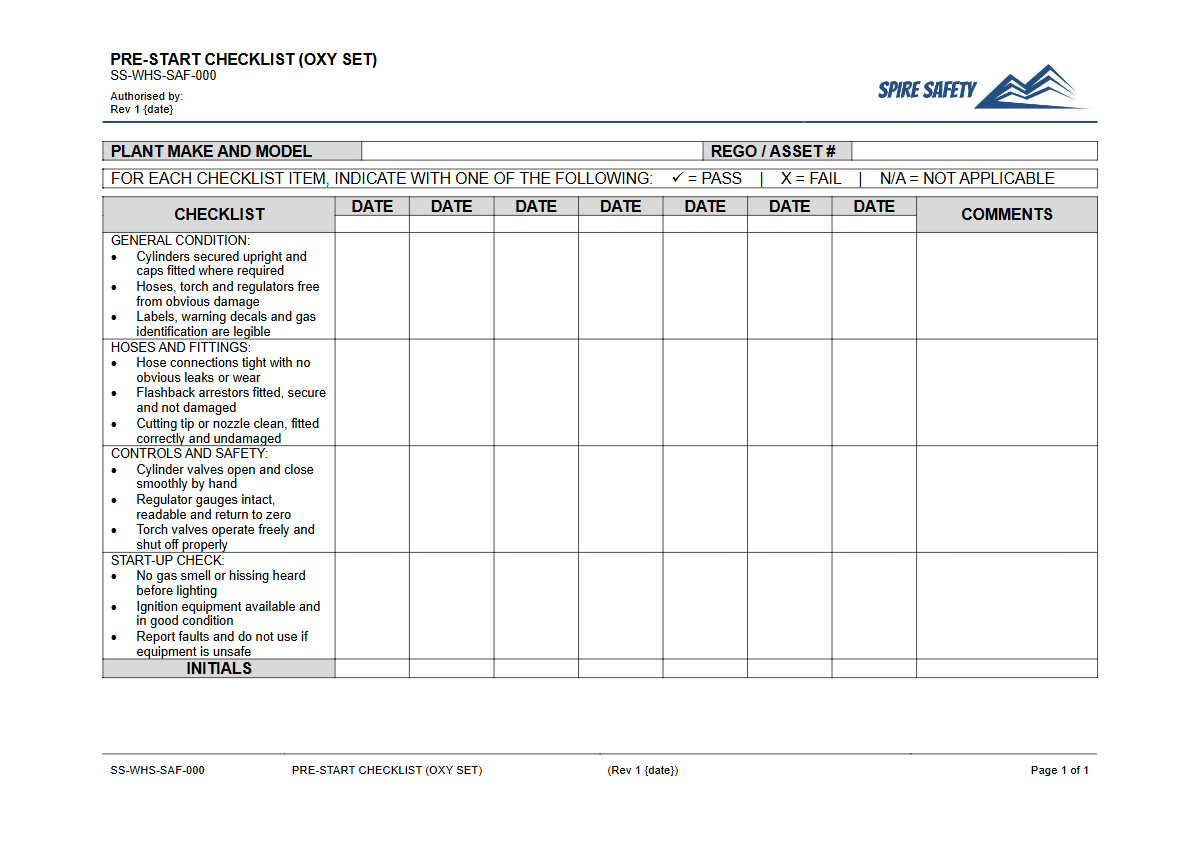
Effectively managing the risks associated with oxy-acetylene equipment is a critical WHS responsibility. Our Free Pre-Start Checklist (Oxy Set) Template provides a structured starting point for formalising your daily equipment inspections.
Using this checklist helps workers systematically verify that key safety components—including regulators, hoses, connections, flashback arrestors, and trolley condition—are safe for use before work commences. Regular, documented checks are a fundamental part of a proactive safety culture, helping your organisation meet its duty of care obligations by identifying potential faults or hazards before they can cause an incident.
This document is designed to be integrated into your broader risk management processes. It encourages a methodical approach to safety, similar to the checks required for other workshop equipment. For example, the same principles of pre-use inspection apply whether using an oxy set or working with equipment covered by our free Pre-Start Checklist for a Bench Grinder.
Video walkthrough
How to Use the Free Pre-Start Checklist (Oxy Set) Template
This resource is available as a fully editable DOCX file and a print-ready PDF. After downloading, you should adapt the checklist to the specific make, model, and configuration of the oxy sets used in your workplace.
This is not a one-size-fits-all document; it is a template designed for customisation.
Note: We have created this template as a guide based on common WHS principles. You must customise this document to reflect the specific equipment, tasks, and control measures relevant to your site.
This includes adding or removing checklist items, incorporating manufacturer's instructions, and referencing your organisation's safe work procedures. Spire Safety is not liable for any incidents that may occur from the use of this template.
Once customised, the checklist should be a core component of your operational procedures. It helps ensure that safety measures for associated hazards, such as the generation of fumes during cutting or welding, are considered.
Proper ventilation is key, a principle that also applies when using equipment detailed in resources like our Fume Cabinet Pre-Start Checklist. Integrating this checklist into your overarching WHS management systems ensures consistency and accountability.
When to Use This Pre-Start Checklist
A pre-start inspection should be completed by a competent operator before the first use of the oxy set on any given shift. The check should also be performed if the equipment has been moved, repaired, or serviced.
Establishing a non-negotiable routine of 'check before you light' is essential for preventing incidents related to equipment failure. Completed checklists should be retained as part of your safety records, providing valuable data for maintenance scheduling and safety audits.
Who Should Use This Pre-Start Checklist
This checklist must be completed by a person who is trained, competent, and authorised to operate oxy-acetylene equipment. This includes having a thorough understanding of the specific hazards associated with pressurised oxygen and flammable gases.
Supervisors and managers also have a responsibility to ensure these checks are being completed correctly and consistently. They should periodically review the completed records to verify compliance and identify any recurring equipment issues or gaps in training.
These records are often a key focus area during a WHS compliance auditing process. You can find many other templates like this one in our free WHS resources library to support your team.
Common mistakes
Common mistakes to avoid
- Using oil, grease, or other hydrocarbons on oxygen fittings, which can cause spontaneous combustion.
- Opening cylinder valves too quickly, which can damage the regulator diaphragm through adiabatic compression.
- Failing to purge lines before lighting the torch, leading to a mixed gas explosion in the hoses.
- Not performing a leak test on connections after setting up or changing cylinders.
Legal references
Legal considerations
The following legal requirements may be relevant to this type of work.
- Work Health and Safety Act (Harmonised) — Provides the primary duties for protecting workers and other people from work health and safety risks.
- Work Health and Safety Regulations (Harmonised) — Sets out requirements supporting the management of workplace hazards and risks.
The following codes may be relevant to this type of work.
- Managing WHS Risks Code of Practice — Provides practical guidance on identifying hazards, assessing risks and applying effective controls.
- Work Health and Safety Consultation, Cooperation and Coordination Code of Practice — Provides practical guidance on consulting workers and coordinating with other duty holders.
- Managing the Work Environment and Facilities Code of Practice — Provides practical guidance on safe work environments, workplace facilities and related controls.
Did you know
Acetylene Instability
Free acetylene gas is highly unstable and can explode when compressed above 15 PSI (103 kPa). This is why it's stored dissolved in acetone within a porous mass inside the cylinder, allowing it to be stored at higher pressures safely.
Oxygen Hazards
Leaking oxygen can create an oxygen-enriched atmosphere, where materials not normally flammable in air can ignite easily and burn vigorously. Never use oil or grease on oxygen fittings, as it can cause a spontaneous and violent reaction.
FAQ
Frequently asked questions
01What are flashback arrestors and why are they important on an oxy set?
02How often should oxy-acetylene hoses be inspected?
03Can I use this template for LPG or other fuel gas sets?
04What is the correct way to test for gas leaks on an oxy set?
Share this resource
Free Pre-Start Checklist (Oxy Set) Template
Browse Categories
How To Use It
- 1Download and open in Word or PDF.
- 2Replace the placeholders with your business details.
- 3Get it reviewed by a WHS specialist before rollout.
Need it customised?
Our WHS consultants can adapt this template to your site, run a gap analysis, or audit what you already have in place.
Book a Free Consultation WHS consulting servicesor call 1300 156 382