
Free Pre-Start Checklist (Orbital Shaker) Template
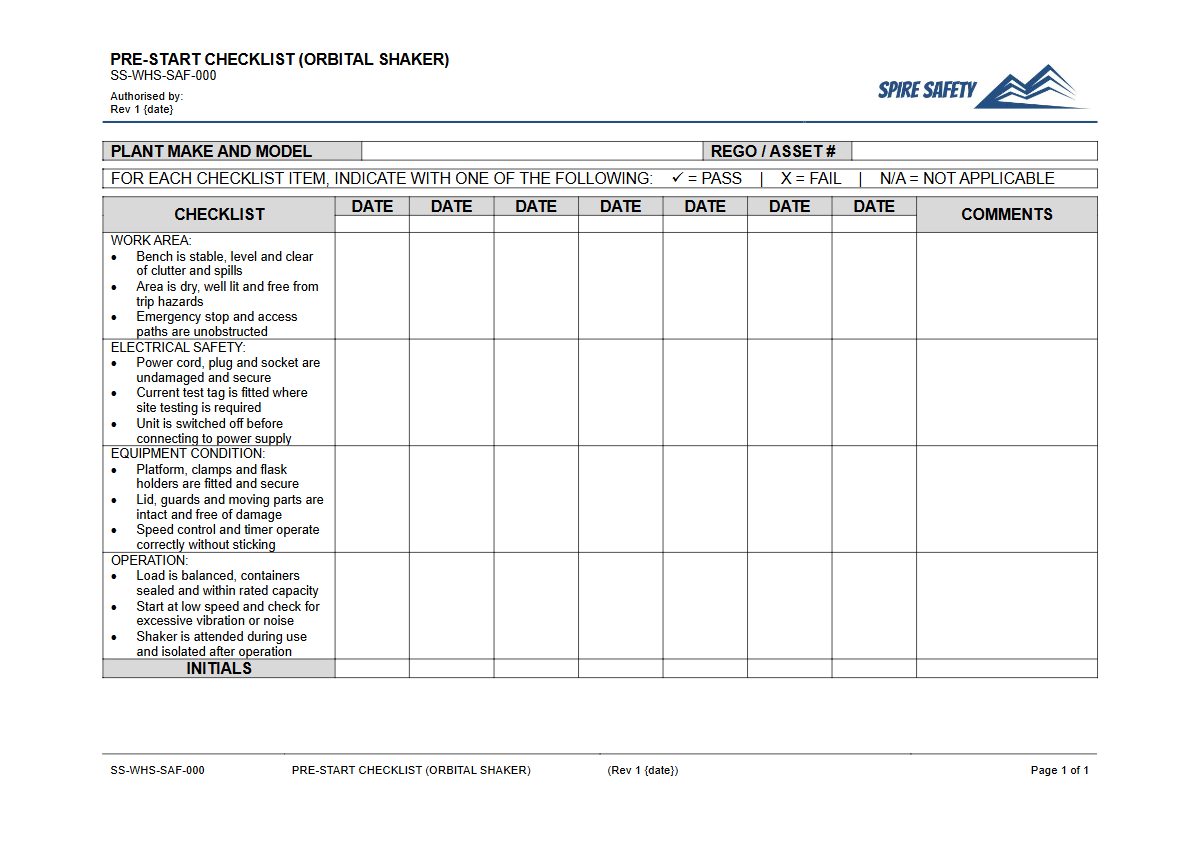
Download our free Pre-Start Checklist (Orbital Shaker) Template to formalise daily equipment inspections.
Free Pre-Start Checklist (Orbital Shaker) Template
DOCX • 125 KB + PDF
Updated Oct 2026
No signup required
Purpose of the Free Pre-Start Checklist (Orbital Shaker) Template
An orbital shaker is a common piece of equipment in laboratories and workshops, but it carries inherent risks, including mechanical, electrical, and biological or chemical hazards. Using a structured Free Pre-Start Checklist (Orbital Shaker) Template helps formalise the process of inspecting the equipment before each use.
This simple but effective tool is designed to systematically identify potential faults or unsafe conditions, such as damaged power cords, unstable housing, or signs of previous spills. Regular checks are a cornerstone of proactive safety management, helping to prevent equipment failure, reduce the risk of operator injury, and ensure the integrity of experimental materials.
Implementing these checks helps create a documented history of the equipment's condition, which is invaluable for maintenance planning and incident investigations. By making these inspections a routine part of daily operations, organisations demonstrate a commitment to fulfilling their duty of care under Australian WHS legislation.
You can reinforce these principles across your team by using a dedicated pre-start checks and plant maintenance toolbox talk to discuss procedures and expectations.
Video walkthrough
How to use the Free Pre-Start Checklist (Orbital Shaker) Template
This checklist is provided as a structured starting point, available in both DOCX and PDF formats for your convenience. The first step is to download the document and adapt it to your specific operational context.
It is vital to recognise that this template is not a one-size-fits-all solution; we have developed it to be customised. You must adapt it to reflect the specific make and model of your orbital shaker, the types of substances being agitated, and your workplace’s unique risk profile and safety procedures.
Key Customisation Areas
- Equipment Specifics: Add or remove checks relevant to your particular model, such as specific clamps, platform types, or digital control interfaces.
- Task-Related Risks: Incorporate checks related to the materials being used, for example, ensuring appropriate secondary containment for hazardous chemicals or verifying seals on containers with biological agents.
- Environmental Factors: Consider the location of the shaker. Is it on a stable, level surface? Is there adequate clearance from other equipment and edge of the bench?
Once customised, the checklist should be integrated into your organisation's safety procedures. This includes training all relevant personnel on how to complete it correctly and what actions to take if a fault is identified.
The checklist forms one component of comprehensive WHS management systems that document and manage risk effectively.
For similar rotating or mixing equipment, you may also find value in adapting our free checklist for agitators as part of your equipment safety program.
When to use it
The pre-start checklist for an orbital shaker should be completed before the equipment is used for the first time on any given day or shift. This ensures that its condition is verified prior to operation, catching any issues that may have developed overnight or during a previous shift.
If multiple operators use the same shaker during a single shift, it is good practice for each new operator to conduct their own quick review of the key safety functions. The goal is to make the check a non-negotiable, routine step that becomes second nature, just like putting on other personal protective equipment (PPE).
Who should use it
The primary user of this checklist is the operator—the laboratory technician, scientist, or worker directly tasked with using the orbital shaker. These individuals are best placed to notice subtle changes in the equipment's performance or condition.
Supervisors and managers also have a responsibility to ensure these checks are being performed consistently and correctly, and to review completed checklists periodically to identify recurring issues or training gaps.
Competency is key to the effective use of any workplace equipment. Operators should not only be trained on how to use the shaker but also on how to inspect it safely.
You can formalise this by adapting a document like our Verification of Competency for a random orbital sander to confirm and record operator skill.
Ensuring that these documented procedures are actually followed on the ground is a key part of maintaining safety compliance. Processes like these are often examined during regular WHS compliance auditing to verify that the system is working as intended.
This template is one of many documents available in our free WHS resources library, designed to assist Australian businesses in building stronger safety practices.
Common mistakes
Common mistakes to avoid
- Failing to customise the generic template for the specific shaker model and substances being used.
- Operators 'pencil-whipping' the checklist without physically performing the required checks.
- Not immediately removing faulty equipment from service and clearly tagging it as 'Out of Service'.
- Poor record-keeping practices, making it impossible to track equipment degradation or identify recurring faults over time.
Legal references
Legal considerations
The following legal requirements may be relevant to this type of work.
- Work Health and Safety Act (Harmonised) — Provides the primary duties for protecting workers and other people from work health and safety risks.
- Work Health and Safety Regulations (Harmonised) — Sets out requirements supporting the management of workplace hazards and risks.
The following codes may be relevant to this type of work.
- Managing WHS Risks Code of Practice — Provides practical guidance on identifying hazards, assessing risks and applying effective controls.
- Work Health and Safety Consultation, Cooperation and Coordination Code of Practice — Provides practical guidance on consulting workers and coordinating with other duty holders.
- Managing the Work Environment and Facilities Code of Practice — Provides practical guidance on safe work environments, workplace facilities and related controls.
Did you know
The 'Walking' Shaker
An improperly balanced load can cause an orbital shaker to vibrate excessively and 'walk' across a benchtop. This creates a serious risk of the unit falling, potentially causing spills of hazardous materials, equipment damage, and personal injury.
Aerosol Generation
Shaking unsealed or improperly sealed containers, especially those with biological or volatile chemical materials, can generate hazardous aerosols. These invisible airborne particles can be inhaled by operators, posing a significant health risk.
FAQ
Frequently asked questions
01Is an orbital shaker pre-start checklist legally required in Australia?
02How often should we review and update our orbital shaker checklist?
03What is the difference between a pre-start check and regular maintenance?
04Can this template be used for other types of laboratory shakers?
Share this resource
Free Pre-Start Checklist (Orbital Shaker) Template
Browse Categories
How To Use It
- 1Download and open in Word or PDF.
- 2Replace the placeholders with your business details.
- 3Get it reviewed by a WHS specialist before rollout.
Need it customised?
Our WHS consultants can adapt this template to your site, run a gap analysis, or audit what you already have in place.
Book a Free Consultation WHS consulting servicesor call 1300 156 382