
Free Pre-Start Checklist (Nebuliser) Template
Download our free Pre-Start Checklist (Nebuliser) Template for Australian workplaces. This DOCX & PDF resource helps formalise equipment safety checks.
Free Pre-Start Checklist (Nebuliser) Template
DOCX • 125 KB + PDF
Updated Oct 2026
No signup required
Purpose of the Free Pre-Start Checklist (Nebuliser) Template
Using a structured Free Pre-Start Checklist (Nebuliser) Template is a proactive step in maintaining a safe work environment. This template helps operators and persons conducting a business or undertaking (PCBUs) to formalise the process of inspecting a nebuliser before it is used.
The primary goal is to systematically identify any potential defects, damage, or contamination that could lead to equipment malfunction, electrical shock, or improper administration of substances. Regular checks ensure the equipment operates as intended by the manufacturer, minimising risks to both operators and patients or clients.
By documenting these checks, organisations create a clear record of due diligence and maintenance activity. This is particularly important in environments like healthcare and aged care, where equipment reliability is paramount.
Consistent pre-start inspections also reinforce safe work habits among staff. In settings where multiple risks are present, integrating equipment checks with other safety protocols is essential; for example, combining it with safe handling procedures as outlined in our Aged Care Manual Handling Toolbox Talk Template can create a more holistic safety approach.
Video walkthrough
How to use the Free Pre-Start Checklist (Nebuliser) Template
This Free Pre-Start Checklist (Nebuliser) Template is provided as a starting point. To implement it effectively, begin by downloading the DOCX file, which can be fully edited, or the ready-to-use PDF.
The core of using this document is customisation. It must be adapted to suit the specific context of your workplace, including the exact make and model of the nebulisers in use, the types of substances being aerosolised, and your organisation's internal safety procedures.
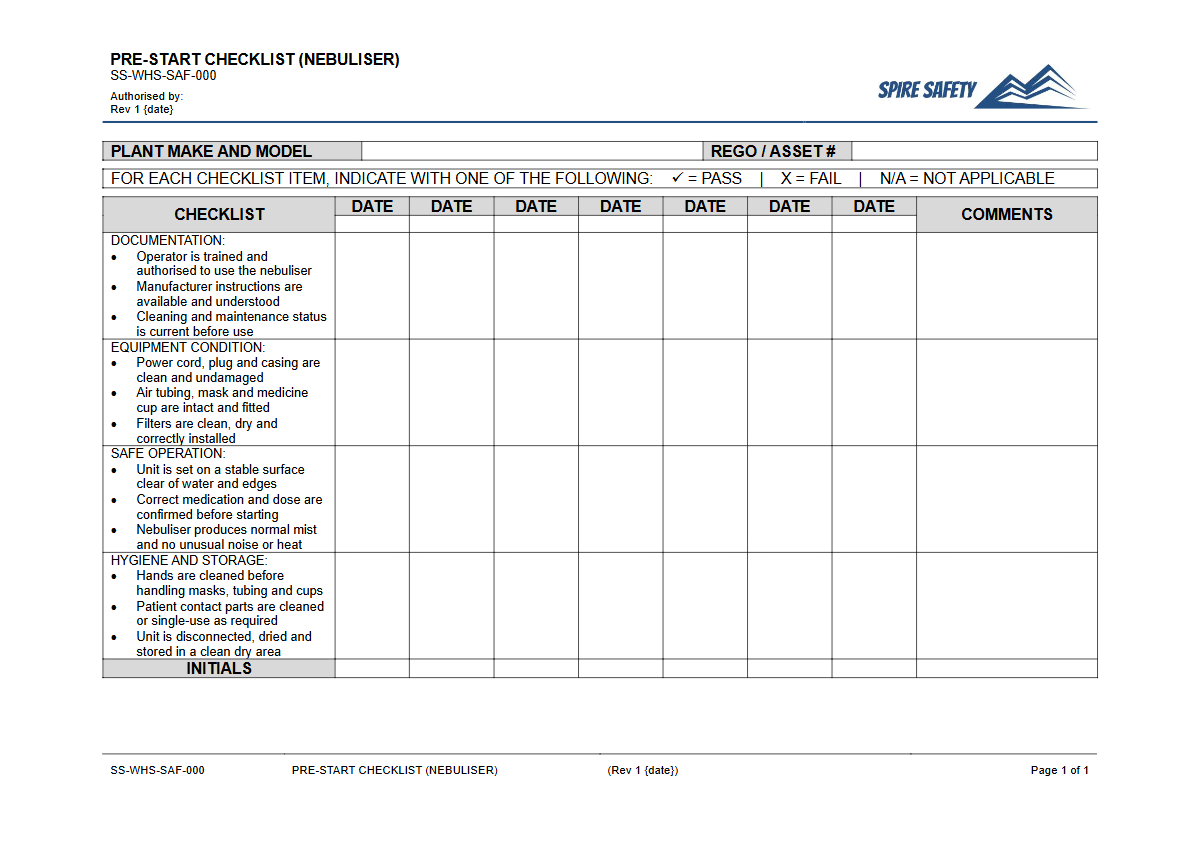
The checklist guides the user through inspecting critical components, such as the power cord and plug, tubing, medication cup, filter, and overall cleanliness. Operators should be trained on how to perform each check correctly and what to do if a fault is found, such as tagging the equipment out of service and reporting the issue to a supervisor. The general principles of pre-start inspections are a fundamental part of workplace safety, a topic covered more broadly in our Pre-Start Checks and Plant Maintenance Toolbox Talk.
Important: This is a template, not a finished document. To ensure it aligns with your specific operational risks and legal obligations, we strongly recommend you customise this checklist. You must adapt it to reflect the specific equipment, tasks, and control measures relevant to your workplace.
When to use it
A pre-start checklist for a nebuliser should be completed before its first use on any given day or shift. For equipment that is used infrequently, it should be inspected before each use.
The goal is to catch any potential issues before the device is operated, preventing incidents from occurring. Establishing this routine ensures that no machine is used without a basic safety verification.
Integrating this checklist into daily opening procedures or pre-treatment workflows helps embed it as a standard, non-negotiable task. This simple but effective tool forms one part of a comprehensive safety framework. A robust safety system ensures that procedures like pre-start checks are consistently applied, monitored, and reviewed, which is a core component of effective WHS management systems.
Who should use it
The pre-start checklist should be completed by the person operating the nebuliser. This must be a worker who is trained and deemed competent not only in the device's operation but also in the inspection procedure itself.
They need to understand what they are looking for and the potential risks associated with each checkpoint.
Supervisors or managers also have a role. They are responsible for ensuring that operators are trained, that the checks are being completed correctly, and that records are maintained.
They must also take action when defects are reported, ensuring faulty equipment is repaired or replaced. These records are often a key piece of evidence examined during safety assessments, and maintaining them is crucial for demonstrating compliance in the event of a WHS compliance auditing process.
A checklist is just one tool for managing safety. Many modern workplaces use a diverse range of equipment, each requiring its own safety protocols.
For instance, a workshop might use a Free Pre-Start Checklist (3D Printer) Template in addition to other machinery checks. The principle remains the same: formalise inspections to proactively identify hazards. For more tools to support your safety processes, explore our complete free WHS resources library.
Common mistakes
Common mistakes to avoid
- Failing to customise the generic template for the specific nebuliser model.
- Overlooking checks for the power cord and plug, leading to electrical hazards.
- 'Pencil-whipping' the form without physically inspecting the equipment.
- Neglecting to remove a faulty unit from service after a defect is identified.
Legal references
Legal considerations
The following legal requirements may be relevant to this type of work.
- Work Health and Safety Act (Harmonised) — Provides the primary duties for protecting workers and other people from work health and safety risks.
- Work Health and Safety Regulations (Harmonised) — Sets out requirements supporting the management of workplace hazards and risks.
The following codes may be relevant to this type of work.
- Managing WHS Risks Code of Practice — Provides practical guidance on identifying hazards, assessing risks and applying effective controls.
- Work Health and Safety Consultation, Cooperation and Coordination Code of Practice — Provides practical guidance on consulting workers and coordinating with other duty holders.
- Managing the Work Environment and Facilities Code of Practice — Provides practical guidance on safe work environments, workplace facilities and related controls.
Did you know
Aerosol Hazards
Nebulisers create aerosols by design. If used for cleaning or disinfection, these aerosols can contain hazardous chemicals, making proper ventilation and PPE critical components of the safe operating procedure.
Invention for Inhalation
The first steam-powered nebuliser was invented in France in 1858. The goal was to deliver medication directly to the lungs in a more effective manner than previous methods.
FAQ
Frequently asked questions
01What is a pre-start checklist for a nebuliser?
02Is it a legal requirement in Australia to use a pre-start checklist for nebulisers?
03Who is responsible for completing the nebuliser pre-start check?
04What should happen if a fault is found during a pre-start check?
Share this resource
Free Pre-Start Checklist (Nebuliser) Template
Browse Categories
How To Use It
- 1Download and open in Word or PDF.
- 2Replace the placeholders with your business details.
- 3Get it reviewed by a WHS specialist before rollout.
Need it customised?
Our WHS consultants can adapt this template to your site, run a gap analysis, or audit what you already have in place.
Book a Free Consultation WHS consulting servicesor call 1300 156 382