
Free Pre-Start Checklist (Mulcher) Template
Download our Free Pre-Start Checklist (Mulcher) Template to formalise equipment safety checks. This DOCX & PDF resource aligns with Australian WHS practice.
Free Pre-Start Checklist (Mulcher) Template
DOCX • 125 KB + PDF
Updated Oct 2026
No signup required
Purpose of the Free Pre-Start Checklist (Mulcher) Template
Using a mulcher involves significant risks, from entanglement to being struck by flying debris. A structured safety inspection before each use is a fundamental control measure.
Our Free Pre-Start Checklist (Mulcher) Template provides a formalised way for operators to verify that the equipment is safe to operate, helping your organisation meet its WHS duties. This downloadable resource is available in both DOCX and PDF formats for easy integration into your existing safety procedures.
The primary purpose is to prevent incidents by identifying mechanical faults, damage, or missing safety features before the equipment is used.
Regularly completing these checks creates a consistent record of due diligence, demonstrating a proactive approach to safety management. Integrating such tools is a key part of developing a robust WHS management system that protects workers and the business.
Video walkthrough
How to use the Free Pre-Start Checklist (Mulcher) Template
To get started, download the template in your preferred format—DOCX for easy editing or PDF for printing. It is crucial that you then customise the checklist to suit the specific make and model of your mulcher(s), the environment it's used in, and any unique hazards present at your workplace.
We have provided a comprehensive starting point, but you must adapt it to ensure it is fit for your specific purpose. Once finalised, train all operators on how to complete the checklist correctly and the procedures to follow if a fault is found. This process is similar for other types of outdoor power equipment, like the machinery covered in our Free Pre-Start Checklist (Lawn Tractor) Template.
When to use the Pre-Start Checklist
A pre-start inspection should be carried out before every use of the mulcher, or at the minimum, at the beginning of each shift where the machine will be operated. This frequency ensures that any damage or defects that may have occurred during previous operation, transport, or storage are identified promptly.
All completed checklists should be signed, dated, and stored for a set period as part of your safety records. This documentation is invaluable for tracking the condition of equipment over time, similar to the process used for larger machinery detailed in our free Pre-Start Checklist (Forwarder) Template.
Who should use the Pre-Start Checklist
The pre-start checklist should be completed by a worker who is trained, competent, and authorised to operate the mulcher. They must have a thorough understanding of the machine's functions and safety features to conduct an effective inspection.
Supervisors and managers also have a role in periodically reviewing the completed checklists to identify any recurring issues or gaps in the inspection process. These reviews can form an important evidence base during a formal WHS compliance auditing program.
Key Areas Covered in the Checklist
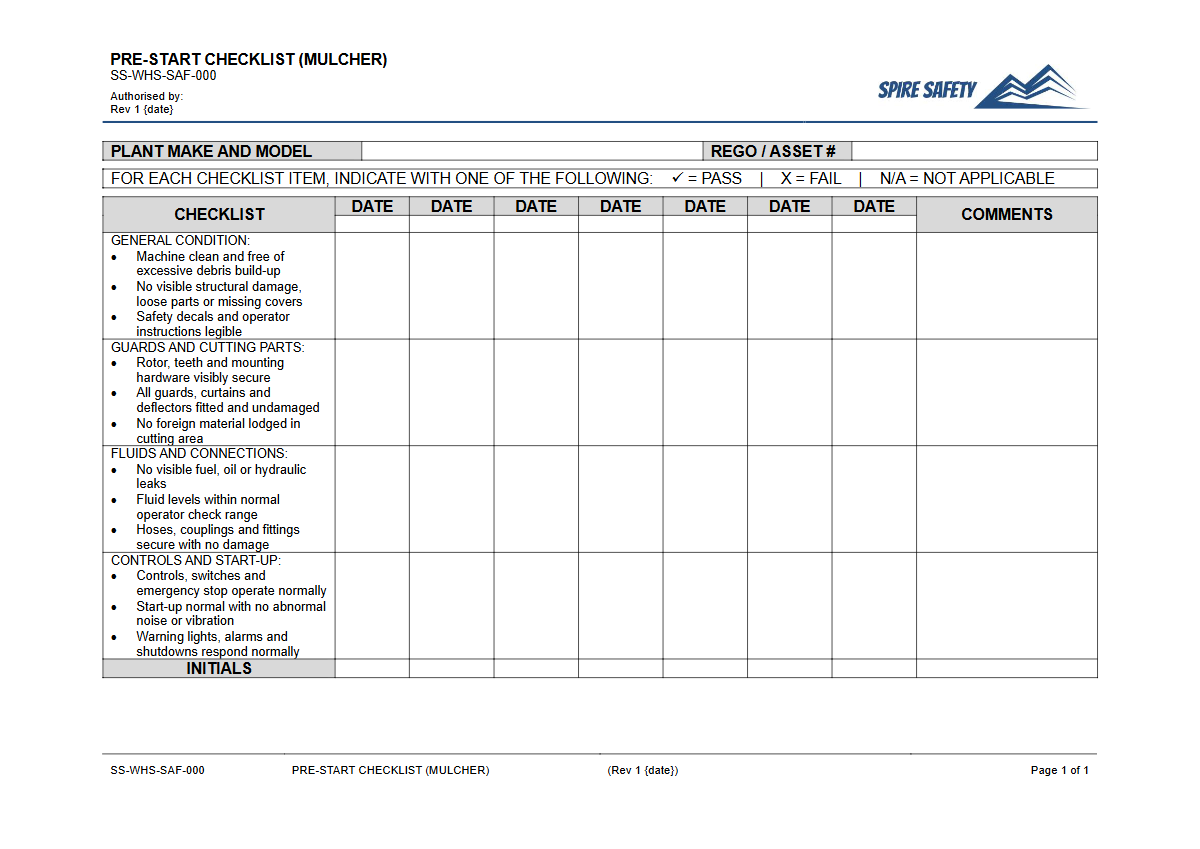
This template provides a structured framework covering critical safety components of a typical mulcher. Key sections prompt the operator to inspect:
- Guards & Shields: Ensuring all guards, particularly for the infeed hopper and discharge chute, are in place, secure, and undamaged.
- Blades & Cutting System: Checking for sharpness, damage, cracks, or missing components in the cutting drum or disc.
- Emergency Stops: Verifying that all E-stops and safety bars function correctly and are easily accessible.
- Controls & Operation: Testing the throttle, clutch, and feed controls for smooth and proper operation.
- General Condition: Looking for fluid leaks, loose or missing bolts, structural cracks, and checking tyre pressure and condition.
This systematic approach is essential for any equipment with high-speed cutting parts, a principle that also applies to tools covered in our Pre-Start Checklist for Floor Saws. By embedding this checklist into your daily operations, you create a powerful habit of safety-first thinking, moving it from an abstract concept to a practical, documented action. For more tools to enhance your safety systems, explore our complete free WHS resources library.
Common mistakes
Common mistakes to avoid
- Using a generic checklist without customising it for the specific mulcher make and model.
- Operators 'pencil-whipping' the checklist without physically or visually inspecting the items.
- Failing to immediately remove a faulty mulcher from service after a defect is found.
- Neglecting to have completed checklists reviewed by supervisors to identify recurring faults or operator knowledge gaps.
Legal references
Legal considerations
The following legal requirements may be relevant to this type of work.
- Work Health and Safety Act (Harmonised) — Provides the primary duties for protecting workers and other people from work health and safety risks.
- Work Health and Safety Regulations (Harmonised) — Sets out requirements supporting the management of workplace hazards and risks.
The following codes may be relevant to this type of work.
- Managing WHS Risks Code of Practice — Provides practical guidance on identifying hazards, assessing risks and applying effective controls.
- Work Health and Safety Consultation, Cooperation and Coordination Code of Practice — Provides practical guidance on consulting workers and coordinating with other duty holders.
- Managing the Work Environment and Facilities Code of Practice — Provides practical guidance on safe work environments, workplace facilities and related controls.
Did you know
Flying Debris Hazards
Mulchers can eject wood chips, rocks, and other debris at speeds over 160 km/h. This poses a major risk to the operator and anyone nearby, making functional guards and a safe exclusion zone critical.
Lock-Out/Tag-Out is Crucial
Many severe mulcher-related injuries happen during maintenance or when clearing blockages. Always follow formal lock-out/tag-out procedures to de-energise the machine completely before any hands-on work.
FAQ
Frequently asked questions
01Is a pre-start checklist legally required for a mulcher in Australia?
02What should happen if a fault is found during a mulcher pre-start check?
03How often should mulcher pre-start checks be completed?
04Can I use this template for any type of mulcher?
Share this resource
Free Pre-Start Checklist (Mulcher) Template
Browse Categories
How To Use It
- 1Download and open in Word or PDF.
- 2Replace the placeholders with your business details.
- 3Get it reviewed by a WHS specialist before rollout.
Need it customised?
Our WHS consultants can adapt this template to your site, run a gap analysis, or audit what you already have in place.
Book a Free Consultation WHS consulting servicesor call 1300 156 382