
Free Pre-Start Checklist (Mulcher Attachment) Template
Download our free Pre-Start Checklist for Mulcher Attachments.
Free Pre-Start Checklist (Mulcher Attachment) Template
DOCX • 125 KB + PDF
Updated Oct 2026
No signup required
Purpose of the Free Pre-Start Checklist (Mulcher Attachment) Template
Operating machinery with a mulcher attachment presents significant workplace health and safety risks. These attachments, whether fitted to excavators, skid steers, or tractors, involve high-speed rotating parts that can cause severe injuries from entanglement or ejected projectiles.
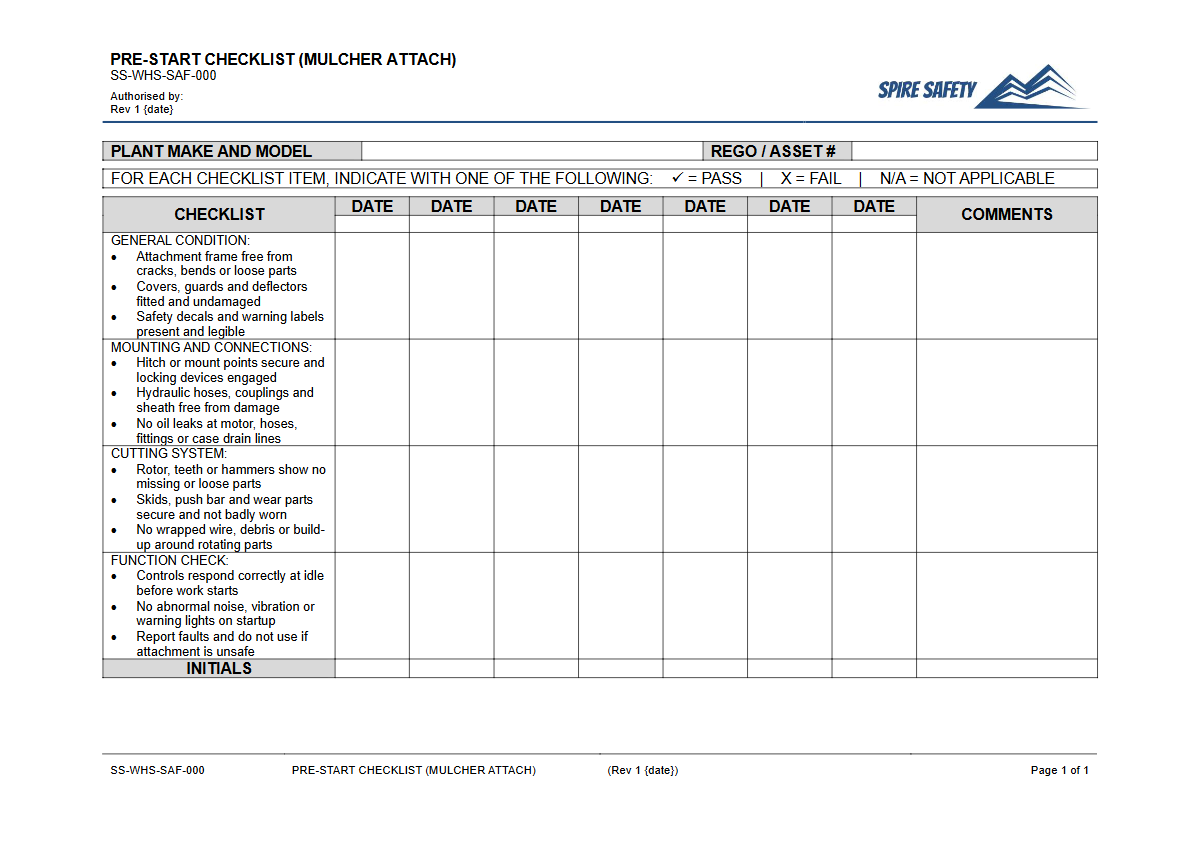
This free Pre-Start Checklist (Mulcher Attachment) Template provides a structured framework for operators to conduct thorough, documented inspections before each use.
Using this checklist helps a Person Conducting a Business or Undertaking (PCBU) fulfil their duty of care by formalising the process of identifying and controlling hazards. It prompts checks on critical components like cutting teeth, guarding, hydraulic systems, and mounting points, ensuring the equipment is in a safe condition before work commences.
Regular use promotes a proactive safety culture, helps prevent incidents, and provides a record of due diligence.
Video walkthrough
How to use the Free Pre-Start Checklist (Mulcher Attachment) Template
This resource is available for immediate download in both DOCX and PDF formats. The DOCX file is fully editable, allowing you to tailor the checklist to your specific operational needs.
Effective safety management requires documentation that reflects the reality of your workplace, not just a generic form.
Important: This document is a template. We have designed it as a structured starting point that you must adapt to your specific mulcher models (e.g., flail, drum, disc), the prime movers they are attached to, your unique work tasks, and the operational environment.
We strongly recommend consulting with operators, maintenance staff, and other relevant workers during the customisation process. Their hands-on experience is invaluable for identifying all relevant hazards and control measures. Integrating such customised documents is a core part of building effective WHS management systems.
When to use a Pre-Start Checklist
A pre-start inspection should be completed by a competent operator before the commencement of every work shift or before the first use of the mulcher attachment each day. This routine is crucial for identifying potential faults or damage that may have occurred during previous operation, transport, or overnight.
Issues like hydraulic leaks, loose parts, or structural damage can develop quickly and present an immediate danger if not detected before the equipment is energised.
The checklist should also be used after any significant event, such as after hitting a large object, after maintenance has been performed, or if the attachment has been inactive for an extended period. For related heavy machinery used in similar environments, a comparable routine is essential, as detailed in our Free Pre-Start Checklist (Forwarder) Template.
Who should use it
The primary person responsible for completing the Pre-Start Checklist is the machinery operator. The operator is in the best position to notice subtle changes in the equipment's condition or performance from one day to the next.
They must be deemed competent through appropriate training, information, and instruction to operate the machinery and to understand the specific hazards associated with the mulcher attachment.
Supervisors and managers also have a role. They are responsible for ensuring the pre-start check system is implemented and followed correctly.
They should review completed checklists periodically to identify recurring issues or trends that might indicate a need for improved maintenance procedures or additional operator training. This review process can be verified through periodic WHS compliance auditing to ensure the system is effective.
Key Inspection Areas
A thorough inspection covers several critical areas to ensure the mulcher is safe for operation:
- Guards & Deflectors: Check that all safety guards, chains, and rubber deflectors are securely in place, free from damage, and functioning as intended to prevent projectiles.
- Cutting Components: Inspect blades, teeth, or flails for signs of excessive wear, cracks, or looseness. A missing or failing cutter head component can become a high-velocity projectile, posing a lethal risk. The principles of checking rotating parts are also vital for workshop tools, as covered in our Free Pre-Start Checklist (Bench Grinder) Template.
- Hydraulic System: Visually inspect all hydraulic hoses, fittings, and cylinders for leaks, abrasion, or other damage. Hydraulic fluid under pressure can cause severe injection injuries. Ensure all connections are secure.
- Attachment & Mounting: Verify that the attachment is securely connected to the prime mover. For quick-hitch systems, ensure safety pins are engaged. For bolted systems, check for security. An insecure attachment can detach during operation. This is as crucial as checking attachments on smaller equipment, like those used with a Free Pre-Start Checklist (Lawn Tractor) Template.
- Structural Integrity: Look for any cracks, bends, or damage to the mulcher's main body, frame, and mounting plates. Ensure all safety decals and warning labels are legible.
By formalising these checks, organisations can significantly reduce the risk of incidents and demonstrate a clear commitment to machinery safety. For more templates and safety documents, browse our complete free WHS resources library.
Common mistakes
Common mistakes to avoid
- Neglecting to check for loose or damaged cutting teeth, flails, or blades.
- Failing to inspect hydraulic lines for leaks, abrasion, or damage, which can lead to failure.
- Overlooking the condition and security of safety guards, chains, and deflectors.
- Not physically verifying that the attachment is securely locked onto the prime mover's hitch.
Legal references
Legal considerations
The following legal requirements may be relevant to this type of work.
- Work Health and Safety Act (Harmonised) — Provides the primary duties for protecting workers and other people from work health and safety risks.
- Work Health and Safety Regulations (Harmonised) — Sets out requirements supporting the management of workplace hazards and risks.
The following codes may be relevant to this type of work.
- Managing WHS Risks Code of Practice — Provides practical guidance on identifying hazards, assessing risks and applying effective controls.
- Work Health and Safety Consultation, Cooperation and Coordination Code of Practice — Provides practical guidance on consulting workers and coordinating with other duty holders.
- Managing the Work Environment and Facilities Code of Practice — Provides practical guidance on safe work environments, workplace facilities and related controls.
Did you know
Projectile Risk
Objects ejected by mulchers can travel at speeds over 150 km/h, posing a significant risk to the operator and anyone within the work zone. This is why checking guards and maintaining a safe exclusion zone is critical.
FAQ
Frequently asked questions
01What are the most critical checks for a mulcher attachment pre-start?
02How often should a mulcher pre-start inspection be completed?
03Is this checklist template suitable for all types of mulchers?
04Who is responsible for completing the mulcher pre-start checklist?
Share this resource
Free Pre-Start Checklist (Mulcher Attachment) Template
Browse Categories
How To Use It
- 1Download and open in Word or PDF.
- 2Replace the placeholders with your business details.
- 3Get it reviewed by a WHS specialist before rollout.
Need it customised?
Our WHS consultants can adapt this template to your site, run a gap analysis, or audit what you already have in place.
Book a Free Consultation WHS consulting servicesor call 1300 156 382