
Free Pre-Start Checklist (Mortar Pump) Template
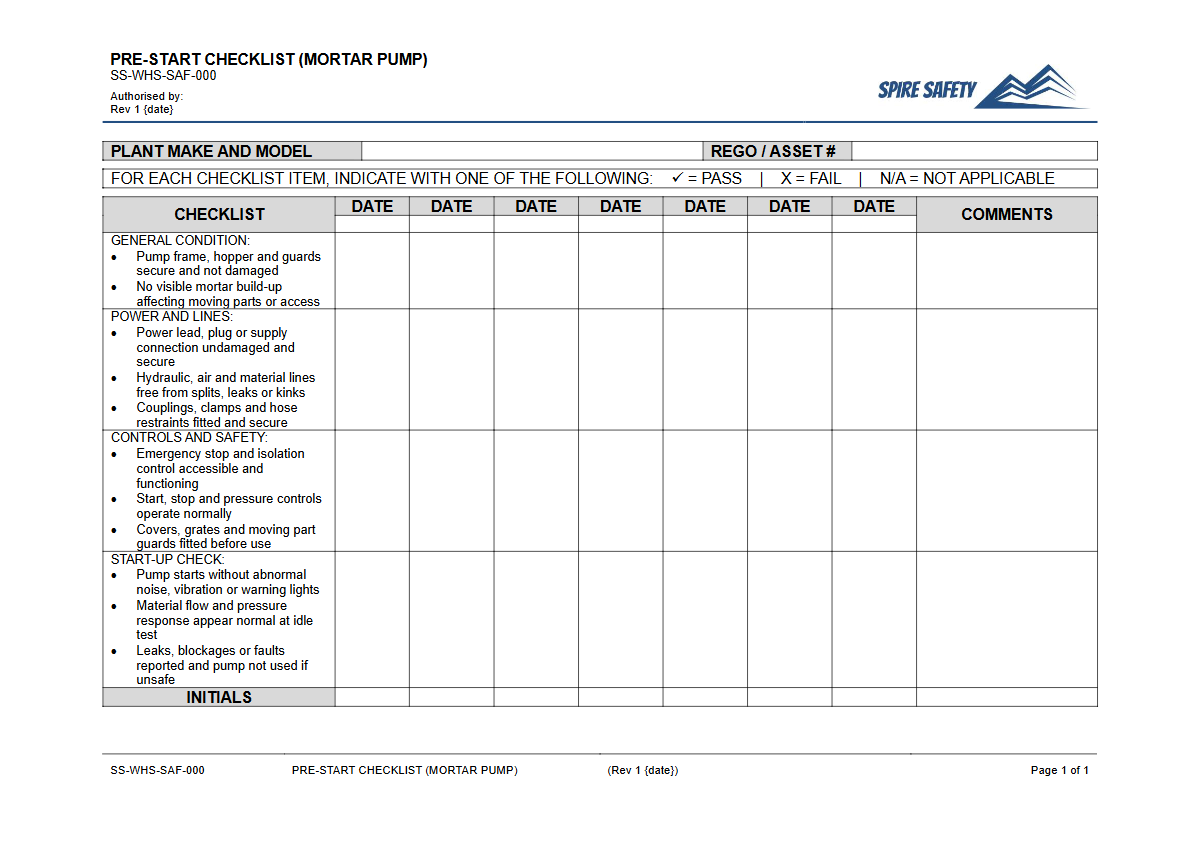
Download our free Pre-Start Checklist for Mortar Pumps. This structured DOCX and PDF template helps operators conduct systematic safety checks before each use.
Free Pre-Start Checklist (Mortar Pump) Template
DOCX • 125 KB + PDF
Updated Oct 2026
No signup required
Purpose of the Free Pre-Start Checklist (Mortar Pump) Template
Operating a mortar pump involves significant risks, including high-pressure material injection, mechanical entanglement, and electrical hazards. A systematic pre-start inspection is a critical control measure to ensure the equipment is safe to use before any work begins.
This Free Pre-Start Checklist (Mortar Pump) Template provides a structured framework for operators to conduct thorough and consistent safety checks, helping your organisation identify potential faults, manage WHS risks, and demonstrate due diligence. Consistent use of this checklist helps create a documented record of equipment condition, which is a key component of a robust safety management system.
This checklist is designed as a practical tool aligned with Australian WHS best practices. It assists a Person Conducting a Business or Undertaking (PCBU) in meeting their primary duty of care to ensure the health and safety of workers by providing and maintaining safe plant and structures.
Video walkthrough
How to use the Free Pre-Start Checklist (Mortar Pump) Template
Using this template effectively involves more than just ticking boxes. It should be integrated into your daily operational procedures to create a safer working environment. The process is straightforward:
- Download: Choose between the DOCX file for easy editing or the PDF for immediate use.
- Customise: Adapt the checklist to suit the specific make and model of your mortar pump, the types of materials being used (e.g., grout, render, plaster), and the specific hazards of your worksite.
- Train: Ensure all operators are trained not only on how to use the mortar pump but also on the importance and correct procedure for completing the pre-start checklist.
- Implement: Make the pre-start check a non-negotiable first step for every shift or before each use. Store completed checklists for record-keeping and review.
Important: This document is a template and must be customised. We have provided a comprehensive starting point, but you must review and amend it to reflect the specific equipment, tasks, and control measures relevant to your workplace.
Integrating this process into your broader WHS management systems ensures a holistic approach to safety.
Key Inspection Points for a Mortar Pump
A thorough pre-start check covers all critical components of the mortar pump. While our template provides a detailed list, key areas of focus include:
Mechanical and Structural Checks
- Hopper and Grate: Ensure the grate is securely in place and not damaged. This prevents foreign objects from entering the system and protects workers from the internal auger.
- Hoses and Couplings: Inspect all hoses for wear, abrasion, cracks, or bulges. Check that all couplings are secure, safety clips are in place, and gaskets are in good condition to prevent high-pressure blowouts.
- Frame and Wheels: Check for structural integrity, cracks in welds, and ensure wheels and towing equipment are in good working order.
Safety and Emergency Systems
- Guards and Shields: Verify that all safety guards, particularly around the engine, moving parts, and hopper, are fitted correctly and are not damaged.
- Emergency Stop: Test the emergency stop button to ensure it functions correctly and immediately cuts power to the machine.
- Warning Labels: Confirm all safety decals and warning labels are legible and in place. Similar principles apply to other high-risk construction machinery, as detailed in our Pre-Start Checklist for Floor Saws.
Power and Fluid Checks
- Engine/Motor: Check fuel and oil levels for petrol/diesel models, or inspect electrical cables and plugs for damage on electric models.
- Hydraulic System: Look for any leaks in hydraulic lines or fittings and check hydraulic fluid levels as per manufacturer specifications.
When to use this Pre-Start Checklist
The pre-start inspection should be completed before the mortar pump is used for the first time each day or at the beginning of each shift. If the equipment is relocated or has been idle for an extended period during a shift, a quick re-inspection of key components is also advisable.
The goal is to catch potential issues before they can lead to an incident. A robust program of checks should also be applied to other critical site equipment, as outlined in resources like our Free Pre-Start Checklist (Fire Pump) Template.
Who should use this Pre-Start Checklist
This checklist should be completed by a worker who is deemed competent to operate the mortar pump. 'Competent' means they have received the necessary information, training, and instruction to perform the task safely.
Supervisors should periodically review completed checklists to verify that inspections are being carried out correctly and to identify any recurring maintenance issues that need addressing. The review of these safety documents can be a key input for a formal WHS compliance auditing program.
Explore our extensive free WHS resources library for more templates and guides to support your safety and compliance efforts across all areas of your operation.
Common mistakes
Common mistakes to avoid
- Failing to inspect the full length of hoses for hidden wear and tear.
- Neglecting to test the emergency stop function before starting work.
- Using the pump with the hopper safety grate removed or disabled.
- Not checking that hose coupling safety pins or clips are securely in place.
Legal references
Legal considerations
The following legal requirements may be relevant to this type of work.
- Work Health and Safety Act (Harmonised) — Provides the primary duties for protecting workers and other people from work health and safety risks.
- Work Health and Safety Regulations (Harmonised) — Sets out requirements supporting the management of workplace hazards and risks.
The following codes may be relevant to this type of work.
- Managing WHS Risks Code of Practice — Provides practical guidance on identifying hazards, assessing risks and applying effective controls.
- Work Health and Safety Consultation, Cooperation and Coordination Code of Practice — Provides practical guidance on consulting workers and coordinating with other duty holders.
- Managing the Work Environment and Facilities Code of Practice — Provides practical guidance on safe work environments, workplace facilities and related controls.
Did you know
Injection Injury Risk
High-pressure injection injuries from equipment like mortar pumps can be severe, even if the initial wound appears minor. Material injected into the skin can cause extensive tissue damage and requires immediate specialist medical attention.
Blockage Dangers
A significant number of incidents involving mortar and concrete pumps occur when operators attempt to clear blockages while the machine is still energised. Always follow safe isolation and lockout-tagout procedures before any maintenance or blockage clearing.
FAQ
Frequently asked questions
01Why is a pre-start checklist essential for a mortar pump?
02What are the main hazards associated with operating mortar pumps?
03How often should a mortar pump pre-start check be completed?
04Can this template be used for other types of construction pumps?
Share this resource
Free Pre-Start Checklist (Mortar Pump) Template
Browse Categories
How To Use It
- 1Download and open in Word or PDF.
- 2Replace the placeholders with your business details.
- 3Get it reviewed by a WHS specialist before rollout.
Need it customised?
Our WHS consultants can adapt this template to your site, run a gap analysis, or audit what you already have in place.
Book a Free Consultation WHS consulting servicesor call 1300 156 382