
Free Pre-Start Checklist (Mini Loader) Template
Download our free Pre-Start Checklist (Mini Loader) Template. This DOCX & PDF resource helps formalise daily equipment checks and manage WHS risks.
Free Pre-Start Checklist (Mini Loader) Template
DOCX • 125 KB + PDF
Updated Oct 2026
No signup required
Purpose of the Free Pre-Start Checklist (Mini Loader) Template
Mini loaders, including brands like Dingo, Kanga, and Bobcat, are powerful and versatile pieces of mobile plant common on construction, landscaping, and agricultural sites. However, their operation comes with significant risks, including rollovers, crush injuries, and hazards from hydraulic systems and attachments.
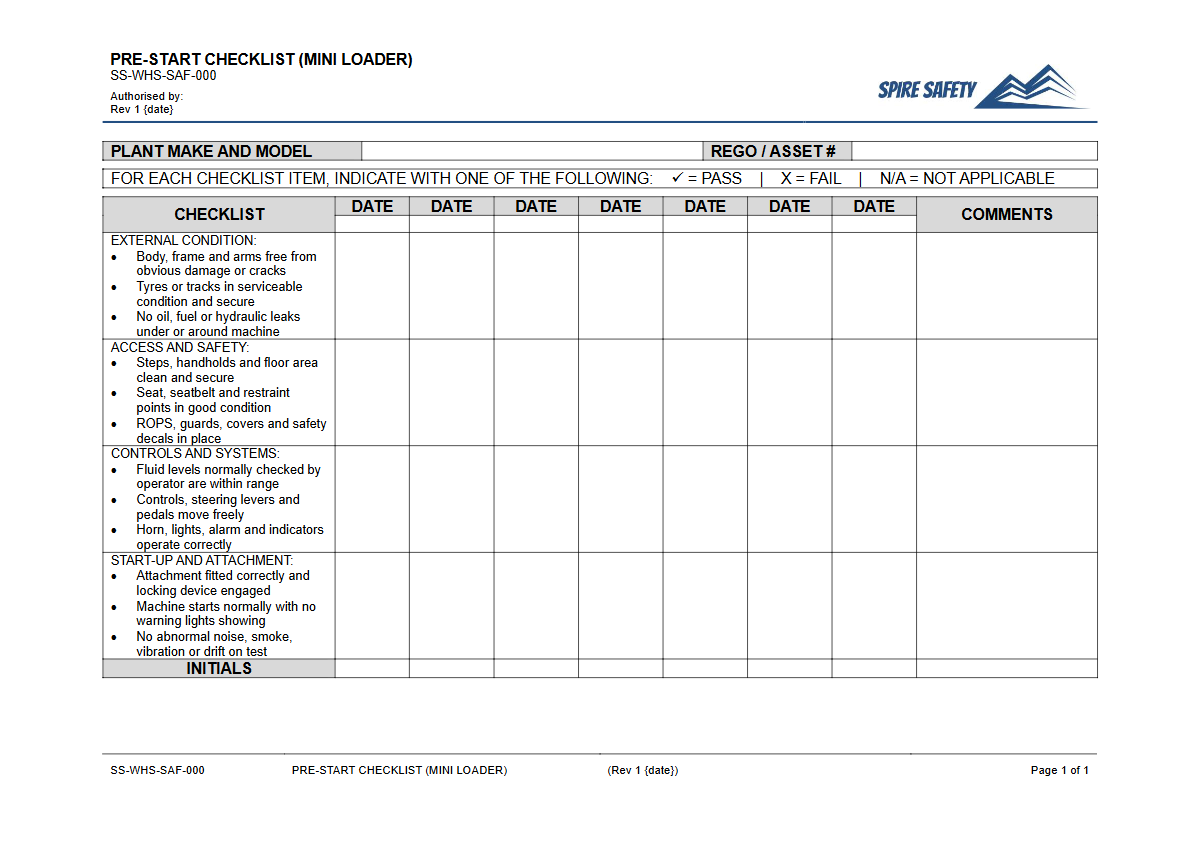
This Free Pre-Start Checklist (Mini Loader) Template provides a structured framework for operators to conduct thorough inspections before use. Its primary purpose is to systematically identify potential faults, damage, or defects that could compromise safety.
By formalising this process, you create a documented record of due diligence, helping your organisation meet its primary duty of care under Australian WHS laws. A consistent inspection routine is a fundamental component of proactive risk management.
Integrating such procedures into daily operations demonstrates a commitment to safety and is a key element of a robust safety framework. Developing comprehensive WHS management systems ensures that processes like pre-start checks are implemented, monitored, and improved over time, creating a safer working environment for everyone.
Video walkthrough
How to Use the Free Pre-Start Checklist (Mini Loader) Template
This template is provided as a starting point. It covers common inspection points for mini loaders but must be adapted for your specific context.
Start by downloading the DOCX version to enable easy editing. Review the checklist against the manufacturer's operating manual for your specific make and model of mini loader.
Add, remove, or modify check items to reflect your machine’s features, the various attachments you use (e.g., buckets, augers, trenchers), and your site's unique environmental conditions. Once finalised, ensure all operators are trained on how to use the checklist correctly, including the process for reporting any identified 'fail' items.
Important: This is a template document that we expect you to customise. To be effective, it must reflect the specific equipment and risks present in your workplace.
It should be reviewed and approved by a competent person before implementation. Similar diligence is required when managing other specialised equipment, such as when adapting our Free Pre-Start Checklist (Floor Saw) Template for concrete cutting tasks.
When to Use It
A pre-start checklist for a mini loader should be completed before the start of every shift or before the first use of the machine on any given day. If operators change during a shift, the incoming operator should also perform a check to verify the machine's condition before they commence work.
This frequency ensures that any issues that may have occurred overnight—such as fluid leaks, vandalism, or damage from previous use—are identified before the plant is put into service. Conducting checks daily is a critical control for managing the risks associated with high-use machinery.
The principle of pre-use inspection is universal across heavy machinery to prevent incidents. For instance, operators of specialised logging equipment would follow a similar routine using a document like our Free Pre-Start Checklist (Forwarder) Template to ensure safety in a forestry environment.
Who Should Use It
The primary user of the checklist is the person operating the mini loader. They must be trained and competent not only in the machine's operation but also in conducting the pre-start inspection.
They have a direct responsibility to ensure the equipment they are about to use is safe. Supervisors and managers also have a role.
They are responsible for ensuring that operators are completing the checklists diligently and that a clear process is in place to address reported defects. This includes 'tagging out' unsafe equipment and arranging for timely repairs by a qualified mechanic.
Records of these completed checks should be retained as part of your safety documentation.
Systematic checks and verifications are a cornerstone of WHS compliance. Regular reviews, such as those conducted during a WHS compliance auditing process, can confirm that these essential safety procedures are being consistently followed and are effective in practice. Consistent checks on hydraulic systems are particularly important, a principle that also applies to equipment like that covered in our Free Pre-Start Checklist (Bin Lifter) Template.
By implementing and enforcing the use of this Pre-Start Checklist, your organisation takes a significant step towards preventing incidents and fostering a stronger safety culture. You can find more helpful documents and guides in our free WHS resources library to support your safety objectives.
Common mistakes
Common mistakes to avoid
- "Pencil-whipping" the form without physically performing each inspection point.
- Using a generic checklist that doesn't cover the specific model or attachments in use.
- Failing to immediately report and 'tag out' a machine with a identified safety defect.
- Treating the checklist as a paperwork exercise rather than a critical safety function.
Legal references
Legal considerations
The following legal requirements may be relevant to this type of work.
- Work Health and Safety Act (Harmonised) — Provides the primary duties for protecting workers and other people from work health and safety risks.
- Work Health and Safety Regulations (Harmonised) — Sets out requirements supporting the management of workplace hazards and risks.
The following codes may be relevant to this type of work.
- Managing WHS Risks Code of Practice — Provides practical guidance on identifying hazards, assessing risks and applying effective controls.
- Work Health and Safety Consultation, Cooperation and Coordination Code of Practice — Provides practical guidance on consulting workers and coordinating with other duty holders.
- Managing the Work Environment and Facilities Code of Practice — Provides practical guidance on safe work environments, workplace facilities and related controls.
Did you know
High-Risk Plant
Mini loaders are classified as mobile plant and their operation is considered a high-risk activity. A thorough pre-start check is a critical administrative control measure required under model WHS regulations to manage associated risks.
Record Keeping
Completed pre-start checklists are valuable WHS records. They help demonstrate due diligence, track equipment condition over time, and can provide crucial evidence during an incident investigation or maintenance audit.
FAQ
Frequently asked questions
01What should be included in a mini loader pre-start checklist?
02How often should you inspect a mini loader?
03Who is responsible for completing a mini loader pre-start check?
04Is this mini loader pre-start checklist compliant with WHS law?
Share this resource
Free Pre-Start Checklist (Mini Loader) Template
Browse Categories
How To Use It
- 1Download and open in Word or PDF.
- 2Replace the placeholders with your business details.
- 3Get it reviewed by a WHS specialist before rollout.
Need it customised?
Our WHS consultants can adapt this template to your site, run a gap analysis, or audit what you already have in place.
Book a Free Consultation WHS consulting servicesor call 1300 156 382