
Free Pre-Start Checklist (Mini Excavator) Template
Download our free Pre-Start Checklist (Mini Excavator) Template. This structured DOCX & PDF resource helps formalise equipment checks and ensure safe operation.
Free Pre-Start Checklist (Mini Excavator) Template
DOCX • 125 KB + PDF
Updated Oct 2026
No signup required
Purpose of the Free Pre-Start Checklist (Mini Excavator) Template
Using a mini excavator without performing safety checks exposes operators and others to significant risk. Our Free Pre-Start Checklist (Mini Excavator) Template provides a structured and methodical way to inspect equipment before use, helping to identify potential hazards before they cause an incident.
This downloadable DOCX and PDF document is designed as a starting point for developing a robust inspection process within your organisation.
The primary goal of a pre-start check is to verify that the equipment is in safe working order. It is a proactive measure to catch mechanical defects, fluid leaks, structural damage, or missing safety components before the plant is operated.
Formalising this process with a checklist ensures that inspections are consistent, thorough, and that nothing is overlooked.
A completed checklist also serves as a valuable record. It demonstrates that the Person Conducting a Business or Undertaking (PCBU) is exercising due diligence in maintaining safe plant and equipment.
These records can be crucial during safety audits or incident investigations. A formal checklist supports this process and can be a valuable topic for a pre-start checks and plant maintenance toolbox talk to reinforce its importance with your team.
Video walkthrough
How to use the Free Pre-Start Checklist (Mini Excavator) Template
Begin by downloading the template in your preferred format (DOCX for easy editing or PDF). The checklist is aligned with Australian WHS principles but must be adapted for your specific operational needs.
Important: This document is a template, not a finished product. We have provided a comprehensive starting point, but you must customise it to suit the specific make and model of your mini excavator, the attachments used, your site conditions, and your organisation's procedures.
The pre-start check is one component of managing plant safety. It should be used alongside a free excavator risk assessment to ensure all potential hazards associated with the task and environment have been considered.
Once customised, the checklist should be integrated into the daily start-of-shift procedure for all operators.
Key Components of a Mini Excavator Pre-Start Check
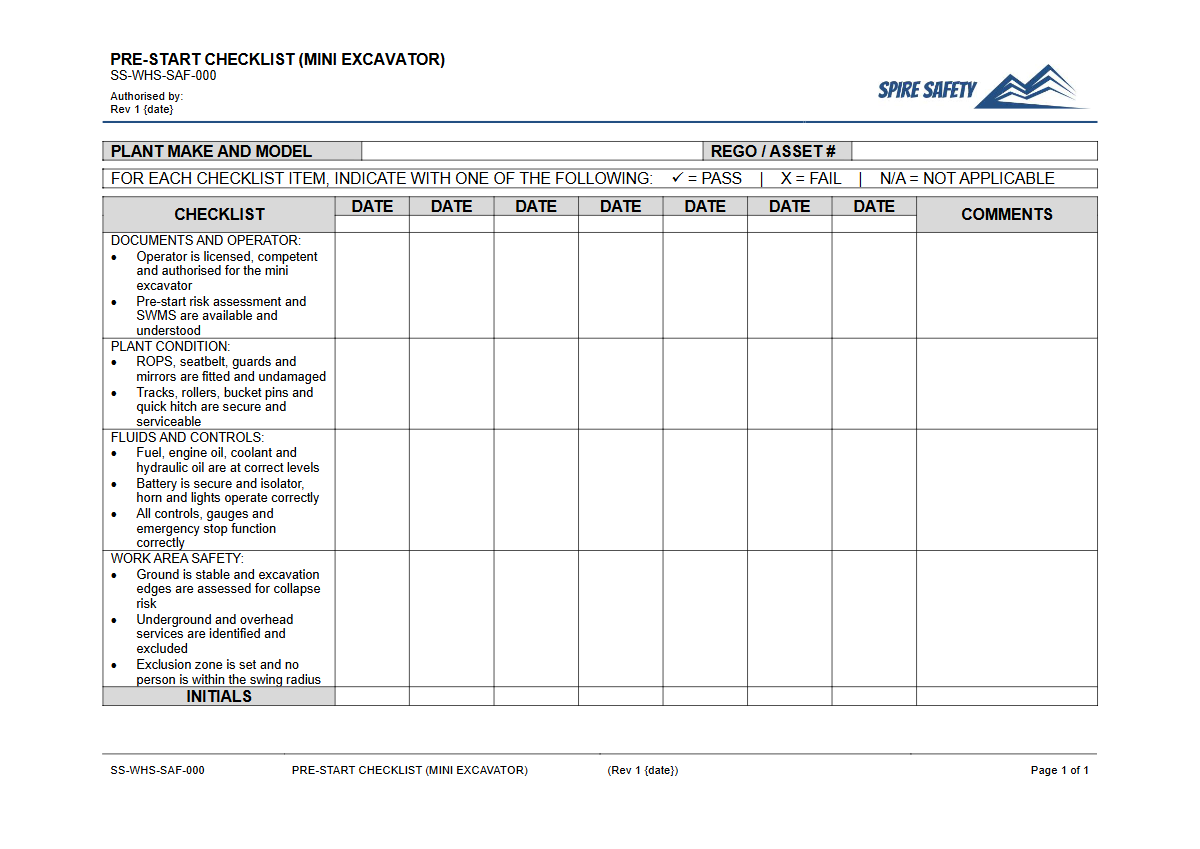
Your customised checklist should cover several key areas to ensure a comprehensive inspection. This template includes sections for:
- General & Structural: Checking for obvious signs of damage, cracks in the chassis or boom, and the condition of tracks or wheels.
- Fluid Levels: Verifying engine oil, hydraulic fluid, coolant, and fuel levels are adequate for operation.
- Operator Cabin & Controls: Ensuring the cabin is clean, controls are clearly labelled and functional, and safety features like seatbelts and mirrors are in good condition.
- Hydraulics & Attachments: Inspecting hoses for leaks or damage, and ensuring attachments like buckets or augers are securely fitted.
- Safety Features: Testing lights, horns, travel alarms, and ensuring fire extinguishers are present and serviceable.
Effective safety documentation, like this checklist, forms a critical part of a comprehensive WHS management system, helping to formalise procedures and demonstrate due-diligence.
When to use it
A pre-start inspection must be conducted before the mini excavator is used for the first time on any shift or work day. If the operator changes during a shift, the new operator should also perform a check to verify the machine's condition before they begin work.
This consistent frequency ensures that any damage or faults that may have occurred overnight or during previous use are identified promptly before they can escalate.
Who should use it
The pre-start check should be completed by the person who will be operating the mini excavator. The operator has the most immediate responsibility for ensuring the plant is safe to use.
They must be deemed competent to both operate the machinery and conduct a thorough inspection. They should be trained to recognise what constitutes a defect and understand the procedure for reporting any issues found.
Verifying an operator's ability to perform these checks is a key part of ensuring overall safety. You can formalise this assessment using a mini excavator verification of competency (VOC) to confirm their skills and knowledge.
This process ensures they not only know how to operate the machine but also how to inspect it correctly.
Failing to implement and enforce pre-start checks can have severe consequences. Documented inspections are a vital record that demonstrates an organisation is actively managing its WHS duties, which can be critical in the event of an investigation into tragic incidents involving excavators.
Common mistakes
Common mistakes to avoid
- Treating the check as a 'tick and flick' exercise without proper physical inspection.
- Failing to report or rectify identified defects immediately, allowing unsafe plant to be used.
- Using a generic checklist not specific to the mini excavator model or its attachments.
- Neglecting to check fluid levels (hydraulic, engine oil, coolant) correctly before starting the engine.
Legal references
Legal considerations
The following legal requirements may be relevant to this type of work.
- Work Health and Safety Act (Harmonised) — Provides the primary duties for protecting workers and other people from work health and safety risks.
- Work Health and Safety Regulations (Harmonised) — Sets out requirements supporting the management of workplace hazards and risks.
The following codes may be relevant to this type of work.
- Managing WHS Risks Code of Practice — Provides practical guidance on identifying hazards, assessing risks and applying effective controls.
- Work Health and Safety Consultation, Cooperation and Coordination Code of Practice — Provides practical guidance on consulting workers and coordinating with other duty holders.
- Managing the Work Environment and Facilities Code of Practice — Provides practical guidance on safe work environments, workplace facilities and related controls.
Did you know
Mechanical Failures
A significant portion of workplace incidents involving mobile plant are linked to mechanical failure or a lack of maintenance—issues that are often identified during thorough pre-start checks.
FAQ
Frequently asked questions
01What is the purpose of a mini excavator pre-start checklist?
02How often should a mini excavator pre-start check be completed?
03Is a digital pre-start checklist better than a paper one?
04What happens if a defect is found during a mini excavator pre-start inspection?
Share this resource
Free Pre-Start Checklist (Mini Excavator) Template
Browse Categories
How To Use It
- 1Download and open in Word or PDF.
- 2Replace the placeholders with your business details.
- 3Get it reviewed by a WHS specialist before rollout.
Need it customised?
Our WHS consultants can adapt this template to your site, run a gap analysis, or audit what you already have in place.
Book a Free Consultation WHS consulting servicesor call 1300 156 382