
Free Pre-Start Checklist (Milk Vat) Template
Download our Free Pre-Start Checklist (Milk Vat) Template in DOCX & PDF.
Free Pre-Start Checklist (Milk Vat) Template
DOCX • 125 KB + PDF
Updated Oct 2026
No signup required
Purpose of the Free Pre-Start Checklist (Milk Vat) Template
Regularly inspecting plant and equipment before use is a fundamental practice in Australian workplaces. This is especially critical for equipment like milk vats, which combine mechanical, electrical, thermal, and chemical hazards.
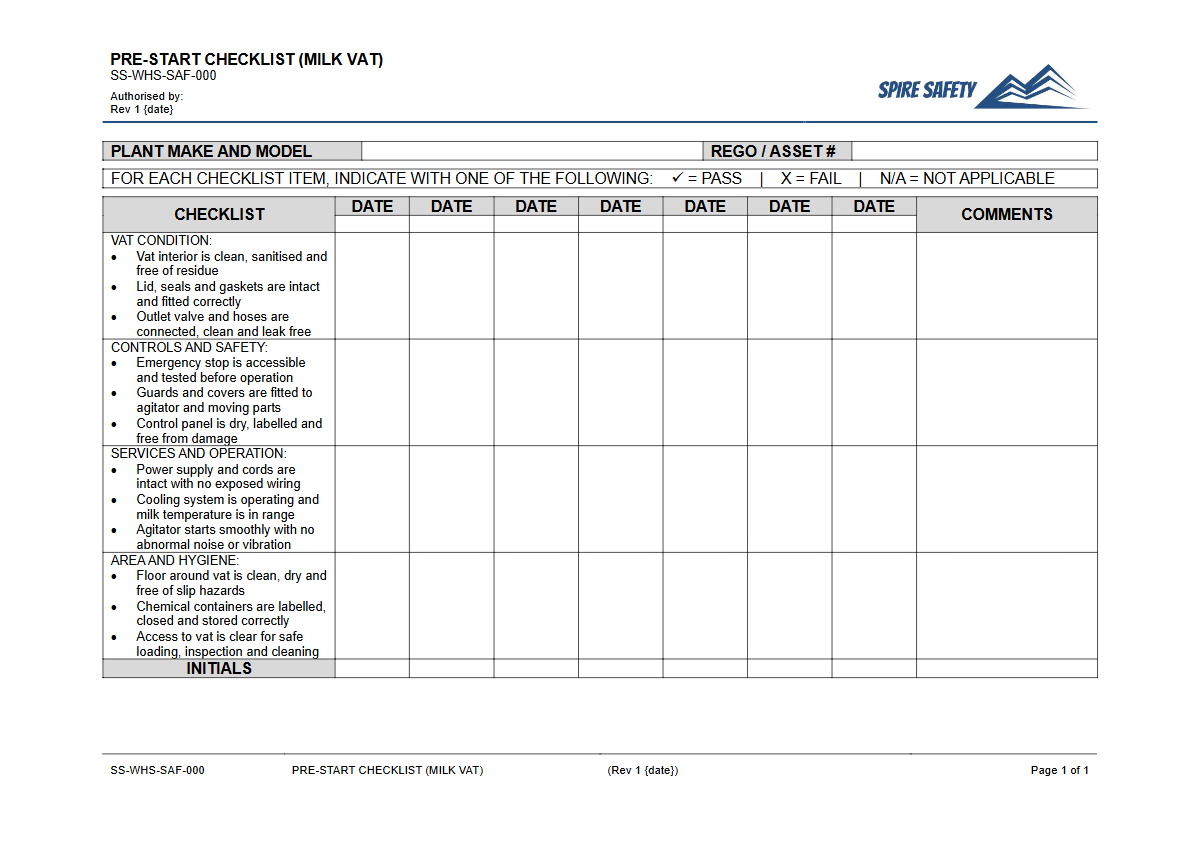
The primary purpose of this Free Pre-Start Checklist (Milk Vat) Template is to provide a structured and repeatable process for operators to verify that a milk vat is safe to use before each shift. Using a checklist helps formalise inspections, ensuring no critical safety or operational component is overlooked.
By identifying potential faults, damage, or hygiene issues early, organisations can prevent incidents, reduce the risk of product contamination, minimise costly downtime, and demonstrate proactive WHS management. This process is similar in principle to other equipment checks, and many workplaces find it useful to standardise their approach where possible; for example, similar principles apply when using our Free Pre-Start Checklist (Agitator) Template for standalone units.
Video walkthrough
How to use the Free Pre-Start Checklist (Milk Vat) Template
This template provides a solid foundation for developing your site-specific milk vat inspection process. It is delivered as a fully editable DOCX file, with a PDF version also included for convenience.
- Download and Customise: Download the template and open the Word document. Add your company branding and specific details about your milk vat, including its make, model, location, and unique asset number.
- Adapt the Checklist Items: Review and modify the checklist items to reflect the specific features and hazards of your equipment and operational environment. Consider aspects like the vat's agitator, cooling system, control panel, seals, valves, and connections for the Clean-in-Place (CIP) system.
- Train Operators: Ensure all operators are thoroughly trained on how to correctly perform each check and what to do if they identify a fault or non-conformance. This includes understanding the escalation process for reporting defects.
- Integrate and Monitor: Integrate the completed checklist into your daily operational workflow and records management. This documentation becomes a core component of your organisation's overall WHS management systems.
Important: This is a template only. To be effective, you must customise this document to suit the specific equipment, tasks, and risks in your workplace.
We are not responsible for any incidents that may occur from the use of this template.
When to use it
The pre-start check should be completed by a competent operator before the milk vat is used for the first time on any given shift. If the vat is used continuously across multiple shifts, the incoming operator should perform their own check at the start of their shift.
This creates a clear line of accountability and ensures the equipment's condition is verified at regular intervals.
Consistency is key to building a strong safety culture. Making the pre-start check a non-negotiable first step of the job reinforces its importance.
You can further reinforce this habit through regular training, such as with a Pre-Start Checks and Plant Maintenance Toolbox Talk, to remind workers of their responsibilities.
Who should use it
This checklist is designed to be used by trained and competent personnel who are authorised to operate the milk vat. These individuals are best placed to notice subtle changes in the equipment's condition or performance.
Supervisors and team leaders should also be familiar with the checklist to conduct spot checks, verify completion, and ensure any reported issues are addressed promptly.
Maintenance personnel may use the checklist as a reference when investigating reported faults, and WHS managers can use the completed records for safety audits and trend analysis. If your organisation needs help defining these roles and responsibilities, engaging with a WHS consulting provider can provide clarity and structure to your safety framework.
What to Check on a Milk Vat
While your customised checklist will be specific to your equipment, a typical milk vat inspection should cover several key areas. These include checking for any physical damage to the vat's interior or exterior, ensuring all safety guards for moving parts (like the agitator drive) are in place and secure, and verifying that seals and gaskets are intact to prevent leaks.
The inspection should also confirm that electrical controls, displays, and emergency stops are functioning correctly. Key issues or safety concerns can then be communicated to the wider team during pre-start meetings.
This template serves as a robust starting point for documenting your safety procedures. For a wider selection of safety documents, you can explore our complete free WHS resources library for more templates and guides.
Common mistakes
Common mistakes to avoid
- "Pencil-whipping" the checklist without physically performing each inspection point.
- Failing to adapt the template to the specific make, model, and condition of the vat in use.
- Neglecting to take immediate action on identified faults, allowing unsafe equipment to remain in service.
- Poor record-keeping, making it difficult to track recurring faults or provide evidence of inspections during an audit.
Legal references
Legal considerations
The following legal requirements may be relevant to this type of work.
- Work Health and Safety Act (Harmonised) — Provides the primary duties for protecting workers and other people from work health and safety risks.
- Work Health and Safety Regulations (Harmonised) — Sets out requirements supporting the management of workplace hazards and risks.
The following codes may be relevant to this type of work.
- Managing WHS Risks Code of Practice — Provides practical guidance on identifying hazards, assessing risks and applying effective controls.
- Work Health and Safety Consultation, Cooperation and Coordination Code of Practice — Provides practical guidance on consulting workers and coordinating with other duty holders.
- Managing the Work Environment and Facilities Code of Practice — Provides practical guidance on safe work environments, workplace facilities and related controls.
Did you know
Cooling is Critical
Modern milk vats are designed to cool raw milk from 35°C to 4°C in under three hours. A failure in the refrigeration system, which a pre-start check can help detect, can lead to rapid bacterial growth and compromise the entire batch.
The Agitator's Dual Role
The agitator in a milk vat doesn't just mix the product; it plays a vital role in ensuring uniform and rapid cooling. By gently circulating the milk, it prevents warm spots and ensures consistent quality and safety.
FAQ
Frequently asked questions
01Is this milk vat checklist a legal document?
02How often should I review and update the milk vat checklist?
03What are the common hazards associated with milk vats?
04Can I use this for other types of food processing vats?
Share this resource
Free Pre-Start Checklist (Milk Vat) Template
Browse Categories
How To Use It
- 1Download and open in Word or PDF.
- 2Replace the placeholders with your business details.
- 3Get it reviewed by a WHS specialist before rollout.
Need it customised?
Our WHS consultants can adapt this template to your site, run a gap analysis, or audit what you already have in place.
Book a Free Consultation WHS consulting servicesor call 1300 156 382