
Free Pre-Start Checklist (Microtome) Template
Download our Free Pre-Start Checklist (Microtome) Template to formalise safety inspections in your laboratory. Get your DOCX & PDF resource today.
Free Pre-Start Checklist (Microtome) Template
DOCX • 125 KB + PDF
Updated Oct 2026
No signup required
Purpose of the Free Pre-Start Checklist (Microtome) Template
Operating a microtome requires precision, skill, and a strong awareness of the associated hazards. The extremely sharp blades used for sectioning pose a significant risk of severe lacerations.
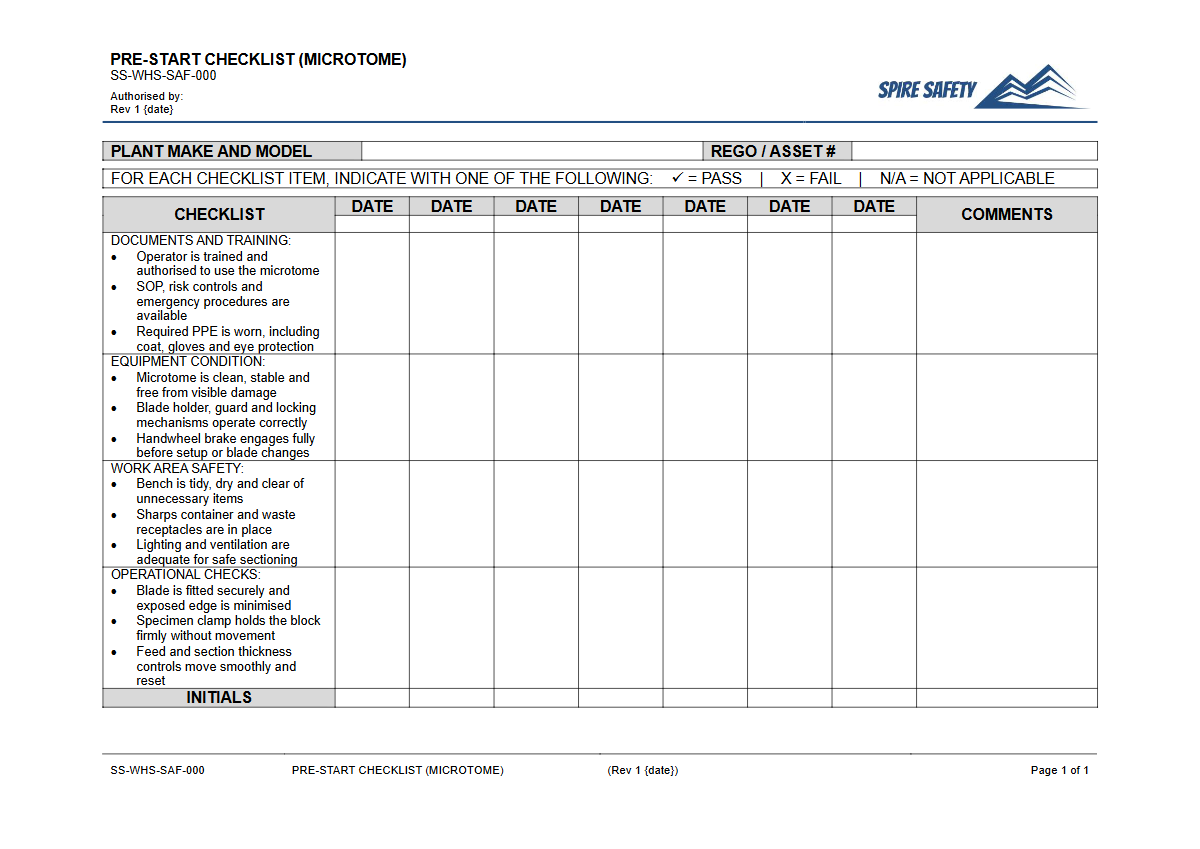
This Free Pre-Start Checklist (Microtome) Template provides a structured framework for operators to conduct consistent and thorough safety inspections before each use. By identifying potential issues such as blade damage, insecure specimen clamps, or malfunctioning guards, this checklist helps prevent injuries and ensures the equipment is in safe working order.
Formalising these checks helps create a documented record of due diligence, demonstrating a proactive approach to managing laboratory risks. Integrating such procedures is a fundamental component of effective WHS management systems, reinforcing a safety-first culture among all personnel.
The checklist guides users to systematically verify critical safety components, reducing the likelihood of incidents caused by equipment failure or oversight.
Video walkthrough
How to use the Free Pre-Start Checklist (Microtome) Template
This resource is available as an editable DOCX file and a print-ready PDF. To use it effectively, download the template and integrate it into your laboratory's standard operating procedures.
The checklist items cover common safety points for microtomes, including blade condition, chuck and clamp security, guards and covers, controls, and general work area cleanliness.
It is crucial to recognise that this template is a starting point. We strongly recommend that a competent person customises this document to align with the specific make and model of your microtome, the manufacturer's instructions, the types of specimens being sectioned (e.g., those requiring special handling), and your organisation's established safety protocols.
Regular reviews and updates to the checklist will ensure it remains relevant and effective. You can reinforce these procedures with our Pre-Start Checks and Plant Maintenance Toolbox Talk Template.
When to use the Pre-Start Checklist
A microtome pre-start check should be completed before the first use on any given day or at the beginning of each operator's shift. For lengthy or continuous sectioning tasks, it may also be prudent to conduct brief checks during natural pauses in work.
The goal is to make the inspection a non-negotiable, routine behaviour that becomes second nature for every operator. This consistency ensures that any faults that develop between shifts or overnight are identified before the equipment is put into operation.
Who should use the Pre-Start Checklist
The checklist should be completed by the person who will be operating the microtome. This must be an individual who has been properly trained and deemed competent in the safe use of the specific equipment.
They must understand the hazards involved, be able to identify faults, and know the correct procedure to follow if a defect is found (e.g., tagging the equipment out of service and reporting it to a supervisor). Documenting these checks provides a clear line of accountability and serves as a record during safety reviews or WHS compliance auditing.
The principles of pre-start inspections apply to a wide range of complex and potentially hazardous equipment. For other automated or precision machinery in your facility, you might find our Free Pre-Start Checklist (CNC Router) Template a useful reference for developing similar safety procedures.
The core concept remains the same: verify safety before you start.
While microtomes are common in biological and medical labs, other modern fabrication tools also require rigorous safety checks. For facilities that utilise additive manufacturing, our free checklist for 3D printers offers another example of a specialised pre-start document.
By establishing consistent safety verification processes across all equipment, you build a more resilient safety culture.
This document is just one of many tools designed to support your organisation's health and safety efforts. We encourage you to explore our complete free WHS resources library for a wide range of templates, forms, and guides to help you manage workplace risks effectively.
Common mistakes
Common mistakes to avoid
- Leaving the blade exposed and unlocked when the microtome is not in active use.
- Failing to ensure the specimen block is securely clamped before starting to section.
- Using a dull, nicked, or damaged blade, which can lead to poor section quality and requires excessive force.
- Neglecting to wear appropriate Personal Protective Equipment (PPE), such as cut-resistant gloves and safety glasses.
Legal references
Legal considerations
The following legal requirements may be relevant to this type of work.
- Work Health and Safety Act (Harmonised) — Provides the primary duties for protecting workers and other people from work health and safety risks.
- Work Health and Safety Regulations (Harmonised) — Sets out requirements supporting the management of workplace hazards and risks.
The following codes may be relevant to this type of work.
- Managing WHS Risks Code of Practice — Provides practical guidance on identifying hazards, assessing risks and applying effective controls.
- Work Health and Safety Consultation, Cooperation and Coordination Code of Practice — Provides practical guidance on consulting workers and coordinating with other duty holders.
- Managing the Work Environment and Facilities Code of Practice — Provides practical guidance on safe work environments, workplace facilities and related controls.
Did you know
Blade Sharpness
Microtome blades are among the sharpest man-made objects, with cutting edges that can be just a few nanometres thick. This is significantly sharper than a surgical scalpel or a razor blade, highlighting the extreme caution required during handling.
FAQ
Frequently asked questions
01What are the main hazards of using a microtome?
02How often should a microtome pre-start check be performed?
03Can this template be used for all types of microtomes?
04Who is responsible for completing the microtome pre-start checklist?
Share this resource
Free Pre-Start Checklist (Microtome) Template
Browse Categories
How To Use It
- 1Download and open in Word or PDF.
- 2Replace the placeholders with your business details.
- 3Get it reviewed by a WHS specialist before rollout.
Need it customised?
Our WHS consultants can adapt this template to your site, run a gap analysis, or audit what you already have in place.
Book a Free Consultation WHS consulting servicesor call 1300 156 382