
Free Pre-Start Checklist (Microwave) Template
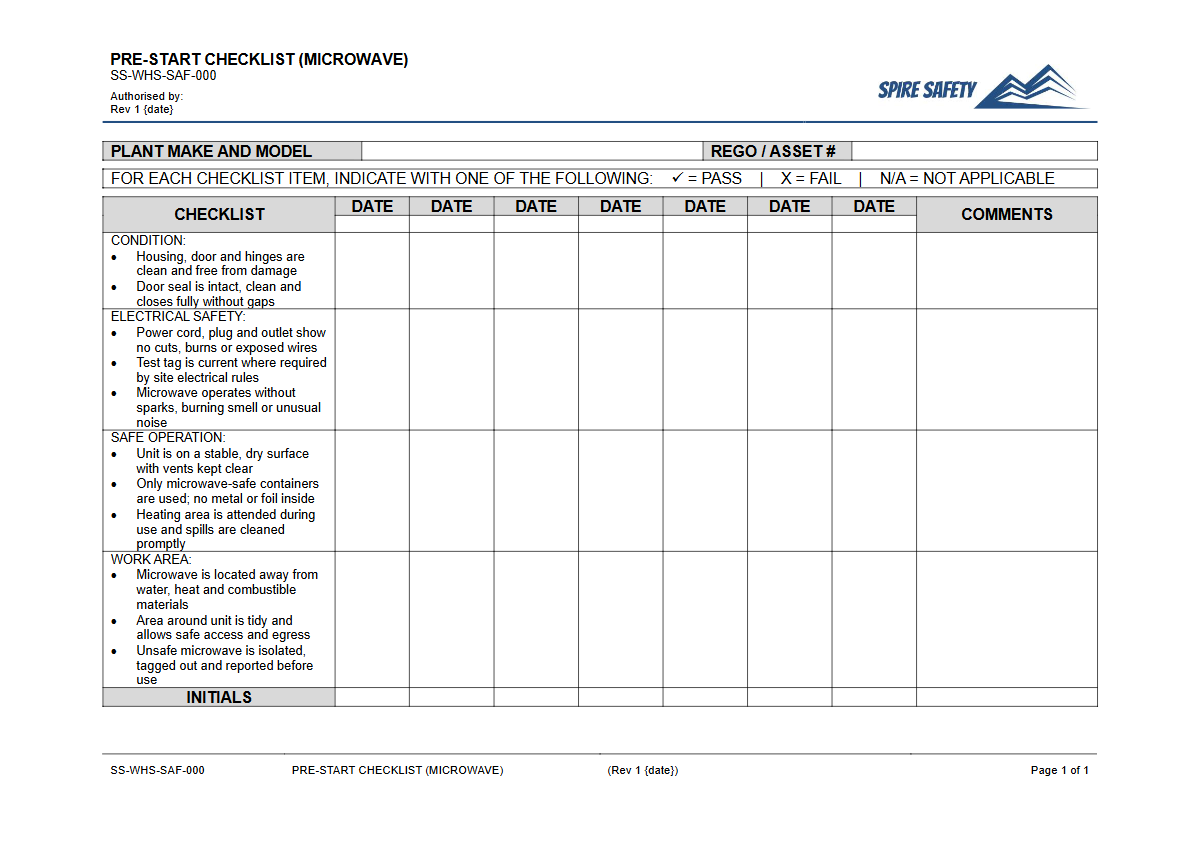
Download our free Pre-Start Checklist (Microwave) Template. This user-friendly DOCX and PDF helps formalise safety checks for workplace microwaves.
Free Pre-Start Checklist (Microwave) Template
DOCX • 125 KB + PDF
Updated Oct 2026
No signup required
Purpose of the Free Pre-Start Checklist (Microwave) Template
Even simple workplace appliances like microwaves carry inherent risks. This Free Pre-Start Checklist (Microwave) Template provides a structured starting point for organisations to formalise their safety inspection process.
Regular checks help identify potential hazards before they cause harm, such as electrical faults, radiation leaks from damaged seals, or hygiene issues. By documenting these inspections, a Person Conducting a Business or Undertaking (PCBU) can demonstrate proactive risk management and a commitment to maintaining a safe working environment for all staff.
Implementing pre-start checks is a fundamental aspect of managing workplace safety. It encourages a safety-conscious culture where workers are actively involved in identifying and controlling risks.
Consistent use of this checklist helps ensure the appliance remains in good working order, reducing the likelihood of incidents and equipment downtime. These routine checks form an important part of any discussion around equipment safety, which can be further reinforced with resources like a Pre-Start Checks and Plant Maintenance Toolbox Talk.
Video walkthrough
How to use the Free Pre-Start Checklist (Microwave) Template
This template is designed for ease of use and customisation. First, download the document in your preferred format (DOCX for easy editing or PDF).
Next, review and adapt the checklist items to suit the specific model of microwave used in your workplace and its environment. Items may need to be added or removed based on a site-specific risk assessment.
It is part of a broader safety framework that includes policies, procedures, and training. Integrating such tools effectively is a key component of successful WHS management systems.
Once customised, train all relevant workers on how to correctly complete the checklist. This includes understanding what each checkpoint means and the procedure to follow if a fault is identified (e.g., tag out and report).
The completed checklists should be stored as a record of due diligence.
A Note on Customisation
This document is a template, not a finished product. To be effective, you must customise it to reflect the specific hazards and control measures relevant to your workplace, equipment, and operational context.
We are not liable for any incidents that may occur from the use of this template; the responsibility for providing a safe workplace remains with the PCBU.
While a microwave is a common appliance, other office equipment can present more complex risks. For example, workplaces using additive manufacturing technology should consider implementing a specific Pre-Start Checklist for 3D Printers to manage their unique electrical, mechanical, and chemical hazards.
When to use it
A microwave pre-start checklist should be completed before the first use each day or at the beginning of each shift in a 24/7 operation. This frequency ensures that any damage or faults that may have occurred overnight or during a previous shift are identified before the appliance is used again.
This routine check is a quick visual and functional inspection, not a substitute for scheduled electrical testing and tagging or professional maintenance and repairs.
Integrating this simple check into daily opening procedures helps normalise safety behaviour. It can be a standing item discussed during daily team briefings, which can be formalised using a Free Pre-Start Meeting Template to ensure all relevant operational and safety points are covered before work commences.
Who should use it
Any worker who uses the microwave can be tasked with completing the daily pre-start checklist. Alternatively, a specific person can be assigned this responsibility, such as a team leader, office manager, or a designated health and safety representative (HSR).
The key is that the person completing the check is trained and competent to do so. They must understand the items on the checklist and know the correct procedure for reporting faults and removing the equipment from service.
Periodically, management should review the completed checklists to identify recurring issues or patterns of non-compliance. This review process ensures the system is working effectively and can be a valuable input for a more formal WHS compliance auditing program.
This template is just one of many tools available; browse our complete free WHS resources library for more templates to support your safety management system.
Common mistakes
Common mistakes to avoid
- Using the template 'as-is' without customising it for the specific microwave model and workplace risks.
- Failing to remove a faulty microwave from service immediately after a defect is identified.
- Workers completing the checklist without performing a thorough physical and visual inspection ('pencil-whipping').
- Overlooking cleanliness, allowing food residue to accumulate and become a hygiene or fire hazard.
Legal references
Legal considerations
The following legal requirements may be relevant to this type of work.
- Work Health and Safety Act (Harmonised) — Provides the primary duties for protecting workers and other people from work health and safety risks.
- Work Health and Safety Regulations (Harmonised) — Sets out requirements supporting the management of workplace hazards and risks.
The following codes may be relevant to this type of work.
- Managing WHS Risks Code of Practice — Provides practical guidance on identifying hazards, assessing risks and applying effective controls.
- Work Health and Safety Consultation, Cooperation and Coordination Code of Practice — Provides practical guidance on consulting workers and coordinating with other duty holders.
- Managing the Work Environment and Facilities Code of Practice — Provides practical guidance on safe work environments, workplace facilities and related controls.
Did you know
Door Seal Integrity
A microwave's door and seal are the primary safety features preventing microwave radiation leakage. Any visible damage, such as cracks or gaps in the seal, means the appliance should be immediately removed from service.
Hidden Fire Hazard
Built-up food splatters and grease inside a microwave are not just a hygiene issue. These residues can overheat and carbonise, creating a potential ignition source and fire hazard within the appliance.
FAQ
Frequently asked questions
01Why is a pre-start check necessary for a simple kitchen microwave?
02How often should microwave pre-start safety checks be performed?
03Who is responsible for completing the microwave checklist in an office?
04Can I use this template for a commercial or industrial microwave?
Share this resource
Free Pre-Start Checklist (Microwave) Template
Browse Categories
How To Use It
- 1Download and open in Word or PDF.
- 2Replace the placeholders with your business details.
- 3Get it reviewed by a WHS specialist before rollout.
Need it customised?
Our WHS consultants can adapt this template to your site, run a gap analysis, or audit what you already have in place.
Book a Free Consultation WHS consulting servicesor call 1300 156 382