
Free Pre-Start Checklist (Meat Grinder) Template
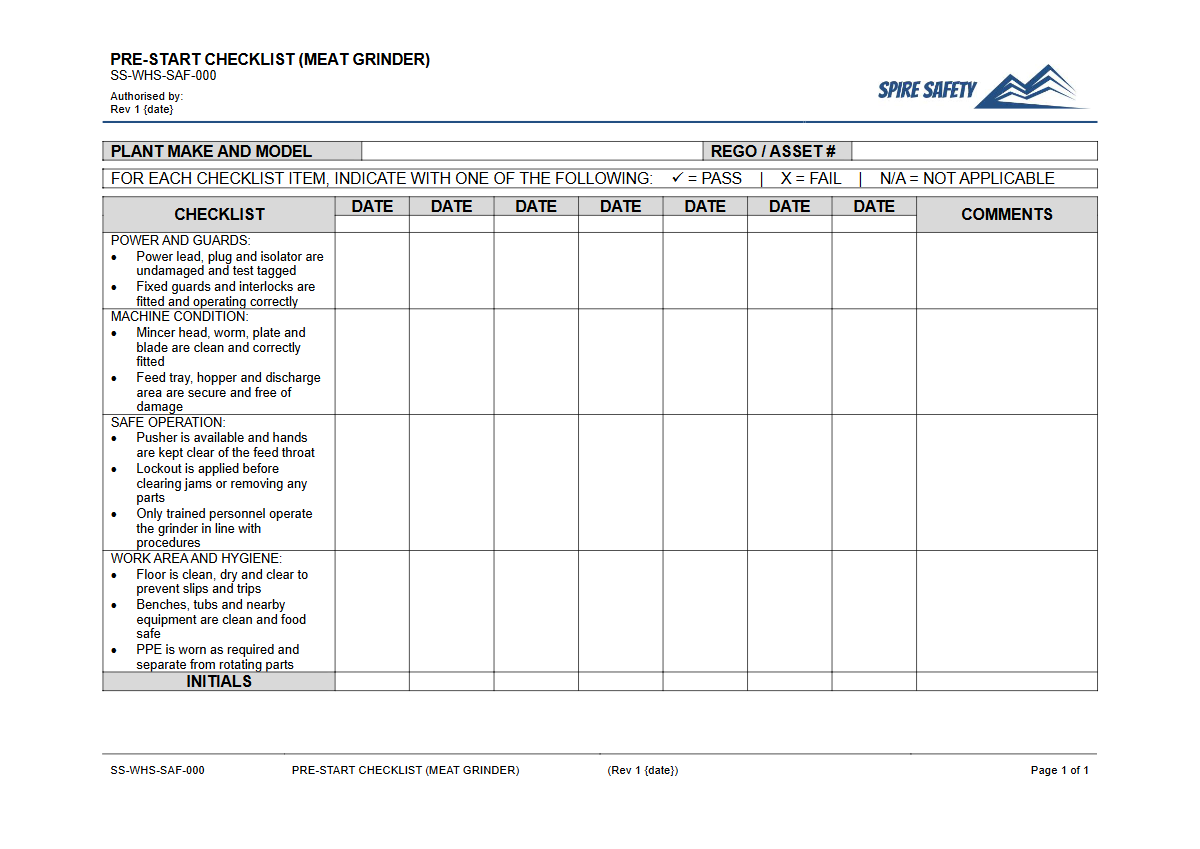
Download our free Pre-Start Checklist (Meat Grinder) Template. This structured DOCX & PDF resource helps formalise safety checks for meat grinders.
Free Pre-Start Checklist (Meat Grinder) Template
DOCX • 125 KB + PDF
Updated Oct 2026
No signup required
Purpose of the Free Pre-Start Checklist (Meat Grinder) Template
Industrial meat grinders are powerful pieces of equipment essential in butcheries, commercial kitchens, and food processing facilities. However, they also present severe risks, including amputation, laceration, and entanglement.
Using our Free Pre-Start Checklist (Meat Grinder) Template provides a systematic way to inspect the equipment before each use, helping to identify and control these hazards before they cause harm. This structured approach is a key component of a proactive safety culture and helps organisations demonstrate due diligence in managing workplace risks.
Formalising these daily checks helps to ensure that critical safety features like guards, interlocks, and emergency stops are functional. It creates a documented record of inspection, which can be vital for maintenance scheduling, incident investigations, and demonstrating compliance.
Integrating such procedures into your daily operations is a cornerstone of effective WHS management systems, moving safety from an afterthought to a planned, integral part of the workflow.
Video walkthrough
How to use the Free Pre-Start Checklist (Meat Grinder) Template
This Pre-Start Checklist is provided as a downloadable DOCX and PDF file. The DOCX version is fully editable, allowing you to tailor it to your specific workplace needs.
The PDF is ideal for printing and immediate use once you have confirmed it suits your requirements.
To effectively implement the checklist, follow these steps:
- Download: Choose the DOCX format for customisation.
- Customise: Review the checklist against the specific make and model of meat grinder you use. Add, remove, or modify checks to ensure they are relevant. Consult with operators and maintenance staff during this process.
- Approve: Finalise the checklist and have it approved as a formal workplace document.
- Train: Ensure all operators are trained not just on how to use the meat grinder, but also on how to properly complete the pre-start inspection. Competency can be formally assessed using tools like our Verification of Competency (Die Grinder) Template as a structural guide for different equipment.
- Implement: Integrate the checklist into your daily start-up procedure. Store completed checklists for a set period as part of your safety records.
Important: This document is a template and serves as a starting point. It is not a complete, out-of-the-box solution.
We strongly advise that you customise this checklist to reflect the specific equipment, risks, and control measures present in your unique work environment. Your final document should align with the manufacturer's instructions and your own risk assessments.
Key Items to Check on a Meat Grinder
A thorough inspection should cover several critical areas to ensure the machine is safe to operate. While your customised list will be more detailed, key points include:
- Guarding: Ensure the feed throat guard (plunger guard) is in place, secure, and undamaged. The outlet guard should also be present and intact.
- Interlocks: Test any safety interlocks that prevent the machine from operating if guards are removed or the assembly is incorrect.
- Emergency Stop: Verify the E-stop button is accessible, clearly marked, and functions correctly, immediately cutting power to the machine.
- Operating Controls: Check that start/stop buttons are working as intended and are not damaged.
- Machine Components: Inspect the auger (worm), blade, and plate for damage, wear, or incorrect assembly. Ensure the locking ring is tight.
- Cleanliness: The machine should be clean and properly sanitised before use to prevent both biological hazards and mechanical issues.
- Electrical Safety: Check the power cord and plug for fraying, cuts, or other damage. Ensure it is not a trip hazard.
- Stability: Confirm the machine is stable on its work surface and does not wobble or move during operation.
These checks should be part of a broader safety framework that includes documented procedures for safe operation, cleaning, and maintenance, similar in principle to a Bench Grinder SOP (Safe Operating Procedure).
When to use it
A pre-start check must be completed before the meat grinder is used for the first time each day or at the beginning of every shift. This routine ensures the equipment's safety status is verified before work commences.
It should also be performed after any cleaning, maintenance, or adjustment to confirm the machine has been reassembled correctly and is safe to return to service. Reinforcing the importance of daily checks can be achieved through regular safety communications, such as a Pre-Start Checks and Plant Maintenance Toolbox Talk.
Who should use it
The pre-start checklist should be completed by the person operating the equipment. This must be a worker who is trained, competent, and authorised to use the specific meat grinder.
Supervisors or managers should periodically review completed checklists to ensure they are being filled out correctly and to identify any recurring faults that may indicate a need for maintenance or operator retraining. The information gathered is also valuable input for periodic WHS compliance auditing to verify that safety procedures are being followed effectively. For more helpful documents, browse our complete free WHS resources library.
Common mistakes
Common mistakes to avoid
- Using a generic checklist without customising it for the specific make and model.
- Operators 'pencil-whipping' the form without physically performing each check.
- Failing to immediately remove faulty or damaged equipment from service and tag it out.
- Neglecting to test dynamic safety functions like the emergency stop and interlocks.
Legal references
Legal considerations
The following legal requirements may be relevant to this type of work.
- Work Health and Safety Act (Harmonised) — Provides the primary duties for protecting workers and other people from work health and safety risks.
- Work Health and Safety Regulations (Harmonised) — Sets out requirements supporting the management of workplace hazards and risks.
The following codes may be relevant to this type of work.
- Managing WHS Risks Code of Practice — Provides practical guidance on identifying hazards, assessing risks and applying effective controls.
- Work Health and Safety Consultation, Cooperation and Coordination Code of Practice — Provides practical guidance on consulting workers and coordinating with other duty holders.
- Managing the Work Environment and Facilities Code of Practice — Provides practical guidance on safe work environments, workplace facilities and related controls.
Did you know
Guarding is Critical
The majority of severe injuries involving meat grinders occur when guards are missing, have been modified, or are bypassed. The small opening of a proper guard is designed to prevent hands from reaching the internal moving parts.
Lockout-Tagout for Cleaning
Cleaning a meat grinder is one of the highest-risk activities associated with the machine. A strict lockout-tagout (LOTO) procedure, where the equipment is de-energised and cannot be accidentally restarted, is essential to prevent injury during cleaning.
FAQ
Frequently asked questions
01What is the main risk of using a meat grinder?
02How often should a meat grinder pre-start check be done?
03Is a pre-start checklist a legal requirement in Australia?
04Who is responsible for taking a faulty meat grinder out of service?
Share this resource
Free Pre-Start Checklist (Meat Grinder) Template
Browse Categories
How To Use It
- 1Download and open in Word or PDF.
- 2Replace the placeholders with your business details.
- 3Get it reviewed by a WHS specialist before rollout.
Need it customised?
Our WHS consultants can adapt this template to your site, run a gap analysis, or audit what you already have in place.
Book a Free Consultation WHS consulting servicesor call 1300 156 382