
Free Pre-Start Checklist (Material Hoist) Template
Download our free Pre-Start Checklist (Material Hoist) Template. This structured DOCX & PDF resource helps formalise safety checks. Get started now.
Free Pre-Start Checklist (Material Hoist) Template
DOCX • 125 KB + PDF
Updated Oct 2026
No signup required
Purpose of the Free Pre-Start Checklist (Material Hoist) Template
Effectively managing high-risk plant like material hoists is a critical part of workplace safety, particularly in construction and industrial settings. This Free Pre-Start Checklist (Material Hoist) Template provides a structured starting point for formalising daily inspections.
Using a checklist helps operators methodically assess the equipment before use, identifying potential faults, damage, or operational issues that could lead to catastrophic failure, injury, or costly downtime. Regular, documented checks are a practical way to demonstrate due diligence and ensure the hoist remains in safe working order.
Implementing this checklist helps standardise safety procedures across all operators and shifts. It creates a clear, auditable record that inspections are being completed correctly and on schedule.
These records are an essential component of your broader safety framework, supporting proactive maintenance scheduling and contributing to a robust WHS management system. By catching small problems early, you prevent them from escalating into major incidents.
Video walkthrough
How to use the Free Pre-Start Checklist (Material Hoist) Template
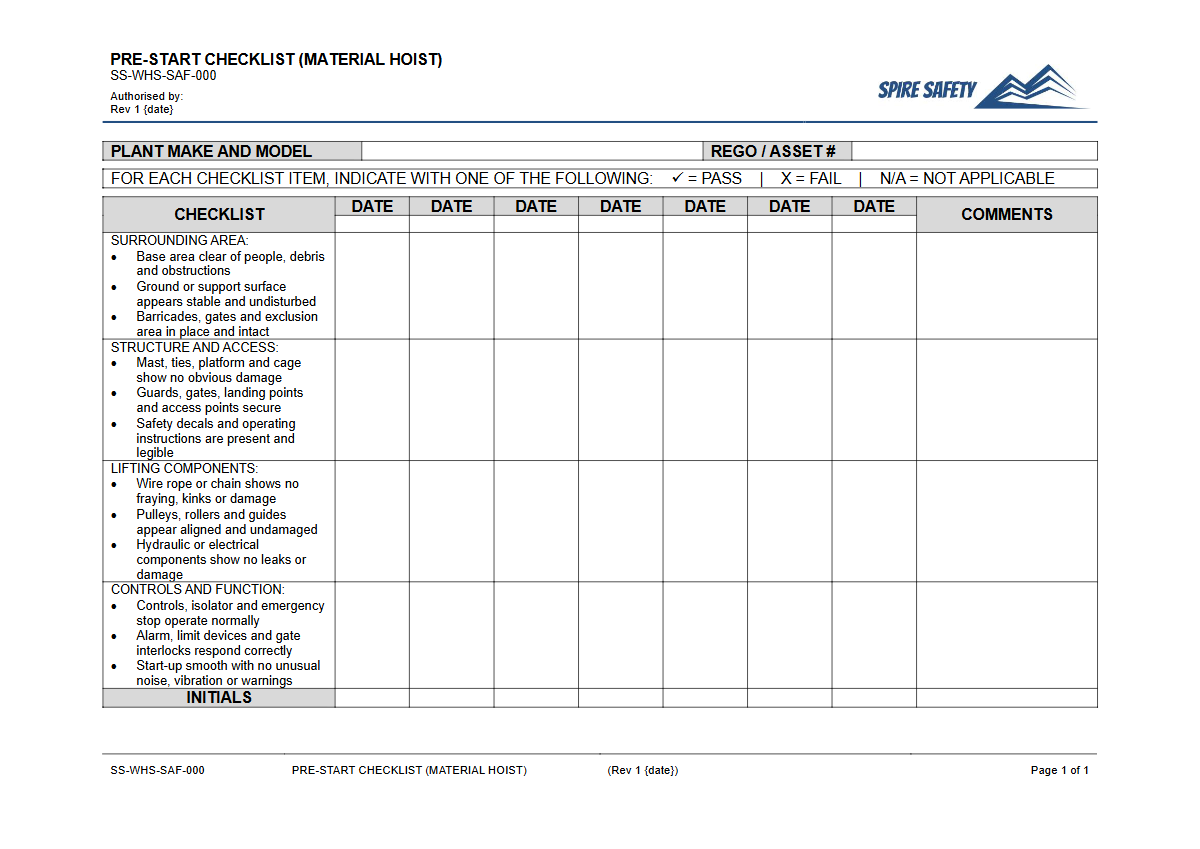
This resource is available as a DOCX file, which can be easily edited in Microsoft Word or other word processors, and a PDF for straightforward printing. The checklist is divided into logical sections covering the hoist's key components: structural integrity, mechanical systems, controls, and safety features.
Operators should work through each item, marking it as satisfactory or identifying a fault. Any identified defect must be reported immediately according to your site's procedures, and the hoist should be isolated from use until it is inspected by a competent person and cleared for service.
Important: This is a generic template aligned with Australian WHS principles and must be customised for your specific circumstances. A competent person familiar with your equipment should review and adapt the checklist.
We have provided a solid foundation, but you must ensure the final document reflects the unique make, model, configuration, and operating environment of your material hoist. Items may need to be added, removed, or rephrased to be effective. For other types of lifting equipment, you might need a different starting point, like our Free Pre-Start Checklist (Electric Hoist) Template.
When to use this Pre-Start Checklist
A material hoist pre-start inspection should be conducted at a minimum:
- Before the first use at the start of each day or shift.
- After the hoist has been erected, relocated, or reconfigured on site.
- Following any period of inactivity or storage.
- After any maintenance, repair, or adjustment has been performed.
This frequency ensures that the hoist's condition is verified before it is used to lift materials, protecting workers both on the hoist and in the vicinity. Consistent daily checks are the first line of defence against equipment failure.
Who should use it
The pre-start checklist should be completed by a person who is trained, licensed (where required), and deemed competent to operate the specific material hoist. The operator has the most hands-on interaction with the equipment and is best placed to notice subtle changes in its performance or condition.
Supervisors and site managers also have a responsibility to ensure these checks are being carried out correctly and that any reported faults are actioned appropriately. They must provide operators with adequate training and resources to complete inspections effectively.
Completed checklists should be retained as a record of your safety activities. These documents can be reviewed periodically by safety committees and are a key piece of evidence examined during a WHS compliance audit to verify that safety procedures are being followed. While this checklist covers material hoists, other specialised plant requires its own specific checks, such as those found in our Pre-Start Checklist for Floor Saws.
Key Inspection Areas for Material Hoists
A thorough inspection covers several critical systems. Your customised checklist should include specific points for:
- Base and Anchorage: Check that the hoist base is secure, on firm and level ground, and that all anchor points and ties to the building structure are tight and free from damage.
- Tower and Structure: Visually inspect mast sections, bracing, bolts, and welds for signs of damage, corrosion, or looseness. Ensure all required guardrailing and gates are in place.
- Carriage/Platform: Inspect the platform floor, gates, and locking mechanisms. Ensure landing gates and locks function correctly and that capacity plates are legible.
- Drive System and Ropes: Check the motor, gearbox, and braking systems for leaks or unusual noises. Visually inspect wire ropes for signs of fraying, kinking, or corrosion.
- Controls and Safety Devices: Test all operating controls, including the emergency stop. Verify the function of upper and lower limit switches, the final limit switch, and any audible or visual alarms. For different elevated work, such as with fixed installations, our template for ceiling hoists provides a different set of considerations.
By formalising your daily checks with this template, you help create a safer work environment and improve the reliability of your equipment. For more templates covering a wide range of plant and equipment, browse our complete free WHS resources library.
Common mistakes
Common mistakes to avoid
- Using a generic checklist that doesn't match the specific hoist model.
- 'Pencil-whipping' the form without physically conducting the checks.
- Failing to remove a faulty hoist from service by not locking it out and tagging it.
- Neglecting to check structural ties and anchorage points to the building.
Legal references
Legal considerations
The following legal requirements may be relevant to this type of work.
- Work Health and Safety Act (Harmonised) — Provides the primary duties for protecting workers and other people from work health and safety risks.
- Work Health and Safety Regulations (Harmonised) — Sets out requirements supporting the management of workplace hazards and risks.
The following codes may be relevant to this type of work.
- Managing WHS Risks Code of Practice — Provides practical guidance on identifying hazards, assessing risks and applying effective controls.
- Work Health and Safety Consultation, Cooperation and Coordination Code of Practice — Provides practical guidance on consulting workers and coordinating with other duty holders.
- Managing the Work Environment and Facilities Code of Practice — Provides practical guidance on safe work environments, workplace facilities and related controls.
Did you know
Load Capacity is Critical
Overloading is a primary cause of hoist failure. Australian Standard AS 1418 requires that the Safe Working Load (SWL) or rated capacity be clearly marked on the hoist car and never exceeded.
The Importance of Limit Switches
The upper, lower, and final limit switches are critical safety devices that prevent the hoist car from travelling beyond its intended operational range. A failure in these systems can lead to catastrophic structural or mechanical damage.
FAQ
Frequently asked questions
01What is the main purpose of a material hoist pre-start check?
02How often should a material hoist be inspected?
03Who is responsible for completing a material hoist pre-start checklist?
04Can this template be used for a personnel hoist (builder's hoist)?
Share this resource
Free Pre-Start Checklist (Material Hoist) Template
Browse Categories
How To Use It
- 1Download and open in Word or PDF.
- 2Replace the placeholders with your business details.
- 3Get it reviewed by a WHS specialist before rollout.
Need it customised?
Our WHS consultants can adapt this template to your site, run a gap analysis, or audit what you already have in place.
Book a Free Consultation WHS consulting servicesor call 1300 156 382