
Free Pre-Start Checklist (Mast Climber) Template
Download our free Pre-Start Checklist (Mast Climber) Template. This DOCX & PDF resource helps formalise safety checks and identify hazards. Get started today.
Free Pre-Start Checklist (Mast Climber) Template
DOCX • 125 KB + PDF
Updated Oct 2026
No signup required
Purpose of the Free Pre-Start Checklist (Mast Climber) Template
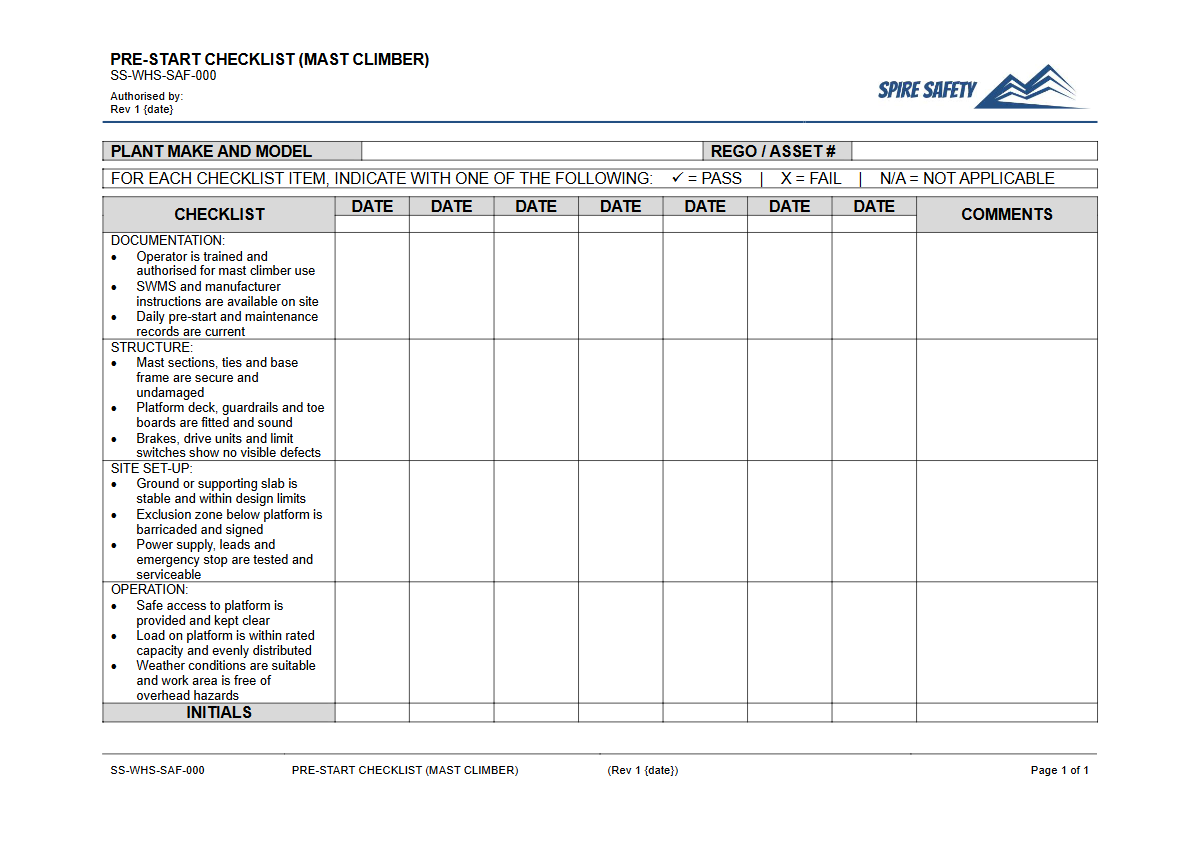
This free Pre-Start Checklist (Mast Climber) Template provides a structured framework for operators to conduct consistent and thorough safety inspections before each use. Mast Climbing Work Platforms (MCWPs) are high-risk plant, and a failure in a critical component can have catastrophic consequences.
Using a formal checklist helps systematically identify potential hazards, mechanical faults, or environmental risks before work commences, significantly reducing the likelihood of incidents related to equipment failure.
Regularly completing these checks is a critical control measure for managing the risks of falls from height, structural collapse, and other serious hazards associated with mast climber operation. The document serves as a tangible record of due diligence, demonstrating that a Person Conducting a Business or Undertaking (PCBU) has taken steps to ensure the equipment is safe for use.
A consistent pre-start inspection process can be reinforced with regular safety discussions, such as those guided by a Pre-Start Checks and Plant Maintenance Toolbox Talk, to embed a culture of safety.
Video walkthrough
How to use the Free Pre-Start Checklist (Mast Climber) Template
To implement this resource, download the DOCX or PDF file and integrate it into your daily operational procedures. The template is designed as a foundational document that requires site-specific adjustments to be effective.
It should be used as a guide for visual and functional checks of the mast climber's key systems.
The inspection should cover critical areas such as:
- Structural components (masts, ties, platform, guardrails)
- Drive systems and brakes
- Power supply and cables
- Emergency and operational controls (including limit switches)
- Safety gear and fall arrest systems
- Ground conditions and foundations
Important: This template is a starting point. It is essential that you customise this document to suit the specific make and model of your mast climber, the unique site conditions, and your organisation's operational procedures.
We cannot guarantee its suitability for your specific circumstances. Always consult the manufacturer's operation manual for model-specific inspection criteria.
Integrating this process into your comprehensive WHS management system ensures it is supported by appropriate training, supervision, and record-keeping protocols.
When to use it
A pre-start checklist for a mast climber should be completed before the equipment is used for the first time on any given day or at the beginning of each shift. This frequency ensures that any damage or issues that may have occurred overnight, during a previous shift, or due to environmental changes are identified before workers are exposed to risk.
The checklist should also be completed after the mast climber has been erected, altered, repaired, or relocated to verify its integrity and correct function.
These daily checks are often discussed during morning briefings to ensure all team members are aware of the equipment's status. Using a free Pre-Start Meeting Template can help formalise this communication process, ensuring safety issues are clearly documented and addressed before work begins.
Consistency is crucial; the checklist should be a non-negotiable part of the daily routine for all operators.
Who should use it
The pre-start inspection must be conducted by a person who is competent to operate the specific class of mast climber. This typically means the licensed operator assigned to the equipment for that shift.
The operator possesses the hands-on knowledge to recognise abnormalities in the machine's appearance, sound, and function. They are the first line of defence against equipment-related incidents.
Supervisors and site managers also have a role in overseeing the process. They are responsible for ensuring that operators are trained, competent, and diligently performing the checks.
They must also establish a clear procedure for reporting and rectifying any defects found during the inspection, ensuring unsafe equipment is immediately tagged out and withdrawn from service. Periodically reviewing completed checklists is a key activity in WHS compliance auditing to verify that safety procedures are being followed correctly in the field.
For complex high-risk activities, it may be beneficial to engage external expertise. Seeking advice from a WHS consulting firm can help ensure your procedures for high-risk plant are robust, practical, and aligned with industry best practice.
Explore our free WHS resources library for more templates and guides to support your safety management efforts.
Common mistakes
Common mistakes to avoid
- Failing to customise the checklist for the specific make, model, and configuration of the mast climber.
- "Pencil-whipping" the form without physically performing each check item.
- Neglecting to remove the equipment from service immediately after a critical fault is identified.
- Performing the check without consulting the manufacturer's operation manual for specific requirements.
Legal references
Legal considerations
The following legal requirements may be relevant to this type of work.
- Work Health and Safety Act (Harmonised) — Provides the primary duties for protecting workers and other people from work health and safety risks.
- Work Health and Safety Regulations (Harmonised) — Sets out requirements supporting the management of workplace hazards and risks.
The following codes may be relevant to this type of work.
- Managing WHS Risks Code of Practice — Provides practical guidance on identifying hazards, assessing risks and applying effective controls.
- Work Health and Safety Consultation, Cooperation and Coordination Code of Practice — Provides practical guidance on consulting workers and coordinating with other duty holders.
- Managing the Work Environment and Facilities Code of Practice — Provides practical guidance on safe work environments, workplace facilities and related controls.
Did you know
A Leading Cause of Fatalities
According to Safe Work Australia, falls from height are a leading cause of fatalities in the construction industry. Rigorous pre-start inspections of equipment like mast climbers are a critical control measure to prevent these incidents.
FAQ
Frequently asked questions
01What should be included in a mast climber pre-start check?
02How often should a mast climber pre-start inspection be done?
03Is this pre-start checklist template compliant with Australian WHS laws?
04Who is responsible for completing the mast climber pre-start checklist?
Share this resource
Free Pre-Start Checklist (Mast Climber) Template
Browse Categories
How To Use It
- 1Download and open in Word or PDF.
- 2Replace the placeholders with your business details.
- 3Get it reviewed by a WHS specialist before rollout.
Need it customised?
Our WHS consultants can adapt this template to your site, run a gap analysis, or audit what you already have in place.
Book a Free Consultation WHS consulting servicesor call 1300 156 382