
Free Pre-Start Checklist (Manlift) Template
Download our free Pre-Start Checklist (Manlift) Template in DOCX & PDF. A structured starting point for daily equipment inspections and WHS risk management.
Free Pre-Start Checklist (Manlift) Template
DOCX • 125 KB + PDF
Updated Oct 2026
No signup required
Purpose of the Free Pre-Start Checklist (Manlift) Template
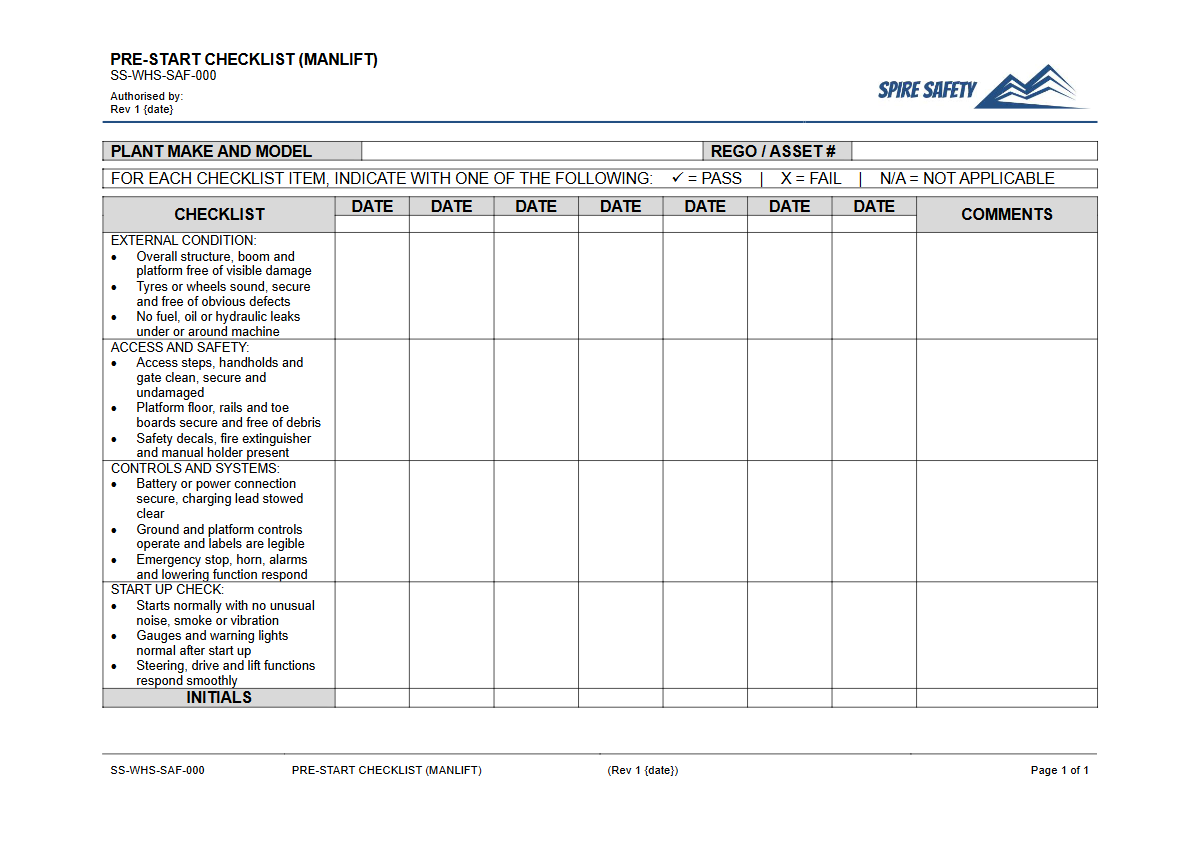
A manlift, or Mobile Elevating Work Platform (EWP), introduces significant safety risks if not properly maintained and inspected. This Free Pre-Start Checklist (Manlift) Template provides a structured framework for operators to conduct thorough, documented inspections before use.
Regular pre-start checks are a fundamental component of workplace safety, helping to identify potential faults, damage, or wear and tear that could lead to equipment failure, property damage, or serious injury. Integrating such checks is a key part of effective WHS management systems, demonstrating proactive risk management.
Using this checklist helps an organisation fulfil its primary duty of care under Australian WHS legislation by ensuring plant is inspected and safe to operate. It formalises the inspection process, creating a record that can be reviewed by supervisors and used to track the condition of the asset over time.
This systematic approach supports a safer work environment for everyone on site, from the operator to personnel working in the vicinity.
Video walkthrough
How to use the Free Pre-Start Checklist (Manlift) Template
This resource is available as a fully editable DOCX file and a print-ready PDF. The checklist is designed as a comprehensive starting point for developing a site-specific inspection procedure.
Operators should be trained to methodically work through each item on the list, physically verifying the condition of each component before starting work. The process ensures that nothing is overlooked and that the equipment is in a safe and serviceable state for the upcoming task.
Please note: This template is a general guide. We strongly recommend you customise it to reflect the specific make, model, and configuration of your manlift, as well as your site-specific hazards and operational procedures.
Always consult the manufacturer’s operating manual for specific inspection requirements. Similar principles of customisation apply when creating checks for other site equipment, such as when using a Pre-Start Checklist for Floor Saws.
Key Inspection Areas
A thorough manlift inspection should cover several critical areas to ensure its operational integrity. While your customised checklist will be more detailed, key sections typically include:
- Structural Integrity: Inspecting the platform, guardrails, chassis, and boom sections for cracks, bends, corrosion, or other damage.
- Operational Controls: Testing all functions from both ground and platform controls, including boom lift/lower, extension/retraction, and rotation.
- Safety and Emergency Systems: Verifying the function of emergency stop buttons, audible alarms, warning lights, and the emergency lowering system.
- Hydraulic and Electrical Systems: Checking for leaks in hoses and fittings, ensuring fluid levels are correct, and inspecting wiring for damage.
- Tyres, Wheels, and Stabilisers: Checking tyre pressure and condition, and ensuring outriggers or stabilisers deploy correctly and are free from damage.
- General Items: Confirming safety decals are legible, the operator's manual is present, and the logbook is up to date.
These checks are vital for all heavy machinery, forming the basis of documents like our Pre-Start Checklist (Forwarder) Template which addresses similar safety principles.
When to use it
A manlift pre-start checklist must be completed before the first use of the equipment on every shift. If multiple operators use the same manlift during a single shift, a handover process should be in place to communicate its status, but a new pre-start is best practice.
The checklist should also be used after any event that may have affected the equipment’s condition, such as a repair, a suspected impact, or after it has been idle for an extended period. Regular completion and review of these records are often examined during a WHS compliance auditing process to verify procedural adherence.
Who should use it
The pre-start inspection must be carried out by a person who is trained, competent, and holds the relevant High Risk Work Licence (where applicable for the specific type of EWP). This operator is responsible for confirming the manlift is safe before they use it.
Supervisors and managers also have a role in ensuring the checks are being completed correctly and consistently. They should periodically review completed checklists to identify recurring faults, schedule maintenance, and ensure operators are diligent in their inspections. This responsibility extends to all plant on site, whether it's a manlift or a smaller piece of equipment covered by our Pre-Start Checklist (Bin Lifter) Template.
By implementing a robust pre-start inspection process, you create a safer workplace and a more reliable fleet of equipment. Feel free to browse our entire free WHS resources library for more templates to support your safety management system.
Common mistakes
Common mistakes to avoid
- Failing to check emergency controls like the emergency lowering system.
- Ignoring minor hydraulic fluid leaks, which can signal a more serious impending failure.
- Signing off the checklist without physically inspecting every item ('pencil whipping').
- Using a generic checklist that is not specific to the manlift's make, model, and features.
Legal references
Legal considerations
The following legal requirements may be relevant to this type of work.
- Work Health and Safety Act (Harmonised) — Provides the primary duties for protecting workers and other people from work health and safety risks.
- Work Health and Safety Regulations (Harmonised) — Sets out requirements supporting the management of workplace hazards and risks.
The following codes may be relevant to this type of work.
- Managing WHS Risks Code of Practice — Provides practical guidance on identifying hazards, assessing risks and applying effective controls.
- Work Health and Safety Consultation, Cooperation and Coordination Code of Practice — Provides practical guidance on consulting workers and coordinating with other duty holders.
- Managing the Work Environment and Facilities Code of Practice — Provides practical guidance on safe work environments, workplace facilities and related controls.
Did you know
EWP Licensing
Manlifts are a type of Elevating Work Platform (EWP). Operators in Australia must hold a High Risk Work Licence (class WP) for boom-type EWPs with a boom length of 11 metres or more.
Leading Cause of Incidents
Falls from height are a leading cause of serious injury and death in Australian workplaces. Thorough equipment pre-start checks are a critical control measure to prevent mechanical failures that can lead to such falls.
FAQ
Frequently asked questions
01What is a manlift pre-start checklist?
02Is it a legal requirement to do a pre-start check on a manlift?
03Who is responsible for completing the manlift checklist?
04What should happen if a fault is found during a manlift pre-start inspection?
Share this resource
Free Pre-Start Checklist (Manlift) Template
Browse Categories
How To Use It
- 1Download and open in Word or PDF.
- 2Replace the placeholders with your business details.
- 3Get it reviewed by a WHS specialist before rollout.
Need it customised?
Our WHS consultants can adapt this template to your site, run a gap analysis, or audit what you already have in place.
Book a Free Consultation WHS consulting servicesor call 1300 156 382