
Free Pre-Start Checklist (Log Grab) Template
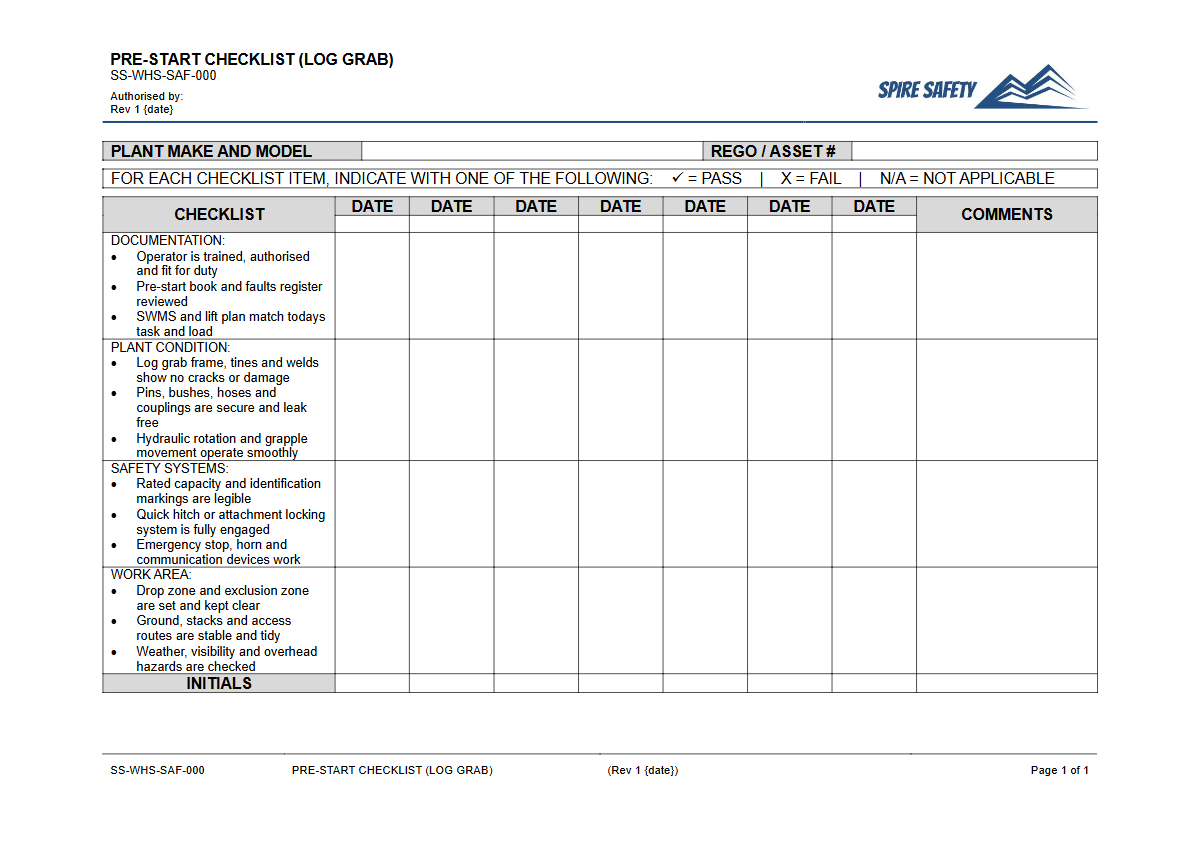
Download our Free Pre-Start Checklist (Log Grab) Template. This structured DOCX and PDF resource helps formalise safety inspections before operating log grabs.
Free Pre-Start Checklist (Log Grab) Template
DOCX • 125 KB + PDF
Updated Oct 2026
No signup required
Purpose of the Free Pre-Start Checklist (Log Grab) Template
Using heavy machinery like a log grab requires stringent safety protocols to prevent serious incidents. Our Free Pre-Start Checklist (Log Grab) Template provides a structured starting point for formalising daily equipment inspections.
This checklist is designed to help operators systematically identify potential hazards or faults with the log grab attachment and its host machine before commencing work. Regular pre-start checks are a fundamental part of proactive safety management in industries such as forestry, land clearing, and waste management.
By conducting these checks, your organisation can significantly reduce the risk of equipment failure, which could lead to dropped loads, hydraulic system failures, or other catastrophic events. This document assists in meeting your duty of care under Australian WHS laws by providing a clear record of due diligence.
It promotes a safety-first culture by empowering operators to take ownership of their equipment's condition and ensuring that only safe machinery is used on site. Integrating this checklist into your daily operations is a critical step in building a robust WHS management system.
Video walkthrough
How to use the Free Pre-Start Checklist (Log Grab) Template
This resource is available for download in both DOCX and PDF formats. The DOCX file is fully editable, allowing you to tailor it to your specific operational needs.
The PDF version is ready for immediate printing and use.
Important Customisation Note
This document is a template and must be customised to be effective. You should adapt it to suit the specific make and model of your log grab, the host machine (e.g., excavator, forwarder), and the unique risks present in your workplace.
We recommend consulting with equipment operators, maintenance personnel, and supervisors during the customisation process. Spire Safety is not liable for any incidents resulting from the use of this template.
Steps for Implementation:
- Download: Choose the DOCX format for customisation or the PDF for immediate use.
- Customise: Open the DOCX file and add, remove, or modify checklist items. Include details like the specific machine ID, attachment type, and relevant hydraulic, structural, and control system checks.
- Consult: Review the draft checklist with your team to ensure it is practical, comprehensive, and easy to understand.
- Train: Ensure all operators are trained on how and when to complete the checklist, and what to do if a fault is identified. For assistance developing and implementing safety procedures, our WHS consulting team can provide expert guidance.
- Implement: Integrate the finalised checklist into your daily pre-start routine.
When to use it
The Pre-Start Checklist for a log grab must be completed before the equipment is used for the first time each day or at the beginning of every shift. This ensures that any damage or faults that may have occurred since its last use are identified and addressed before the machine becomes operational.
This routine is crucial for maintaining a safe working environment and preventing unexpected equipment failures during high-risk tasks like lifting and moving heavy logs.
Consistency is key. Making pre-start inspections a non-negotiable part of the daily workflow helps embed safety-conscious behaviour. To further reinforce these practices, you can use the topic as a basis for regular safety meetings, supported by resources like a Pre-Start Checks and Plant Maintenance Toolbox Talk.
Who should use it
The checklist is designed to be completed by the person operating the equipment. The operator must be deemed competent, holding the necessary licences and having received adequate training on the specific machinery and log grab attachment.
Their hands-on familiarity with the equipment makes them the ideal person to spot subtle changes in condition or performance.
Supervisors and managers also have a critical role. They are responsible for ensuring operators are completing the checks correctly and consistently.
They must also establish a clear process for reporting defects and ensuring that equipment is tagged out and repaired before being returned to service. The effectiveness of this entire process can be verified through periodic workplace inspections or a formal WHS compliance auditing program.
This checklist can be used in conjunction with other daily safety planning documents. For instance, findings from the pre-start check can be discussed in daily team briefings, which can be documented using a Free Pre-Start Meeting Template to ensure all team members are aware of equipment status. If you need more tools to manage your workplace safety, explore our complete free WHS resources library.
Common mistakes
Common mistakes to avoid
- "Pencil-whipping" the form without physically inspecting the equipment.
- Using a generic heavy vehicle checklist that doesn't cover log grab-specific items like tines, rotators, and hydraulic connections.
- Completing the check but failing to report or take action on identified defects.
- Poor record-keeping, such as losing completed checklists or not filing them systematically for auditing purposes.
Legal references
Legal considerations
The following legal requirements may be relevant to this type of work.
- Work Health and Safety Act (Harmonised) — Provides the primary duties for protecting workers and other people from work health and safety risks.
- Work Health and Safety Regulations (Harmonised) — Sets out requirements supporting the management of workplace hazards and risks.
The following codes may be relevant to this type of work.
- Managing WHS Risks Code of Practice — Provides practical guidance on identifying hazards, assessing risks and applying effective controls.
- Work Health and Safety Consultation, Cooperation and Coordination Code of Practice — Provides practical guidance on consulting workers and coordinating with other duty holders.
- Managing the Work Environment and Facilities Code of Practice — Provides practical guidance on safe work environments, workplace facilities and related controls.
Did you know
Hydraulic Failure Risk
Hydraulic hose failures are a leading cause of incidents involving attachments like log grabs. A pinhole leak in a high-pressure line can inject fluid under the skin, causing severe and life-threatening injuries, making hydraulic checks a critical part of any pre-start.
Dropped Load Prevention
The structural integrity of the grab's tines and pivot points is essential for preventing dropped loads. Regular checks for cracks, wear, or deformation are a simple but effective way to mitigate one of the biggest risks associated with this equipment.
FAQ
Frequently asked questions
01What is the difference between a log grab pre-start check and regular maintenance?
02How often should log grab pre-start checks be performed?
03Who is responsible for ensuring log grab pre-start checks are done?
04Can I use a digital app for pre-start checklists instead of paper?
Share this resource
Free Pre-Start Checklist (Log Grab) Template
Browse Categories
How To Use It
- 1Download and open in Word or PDF.
- 2Replace the placeholders with your business details.
- 3Get it reviewed by a WHS specialist before rollout.
Need it customised?
Our WHS consultants can adapt this template to your site, run a gap analysis, or audit what you already have in place.
Book a Free Consultation WHS consulting servicesor call 1300 156 382