
Free Pre-Start Checklist (Log Loader) Template
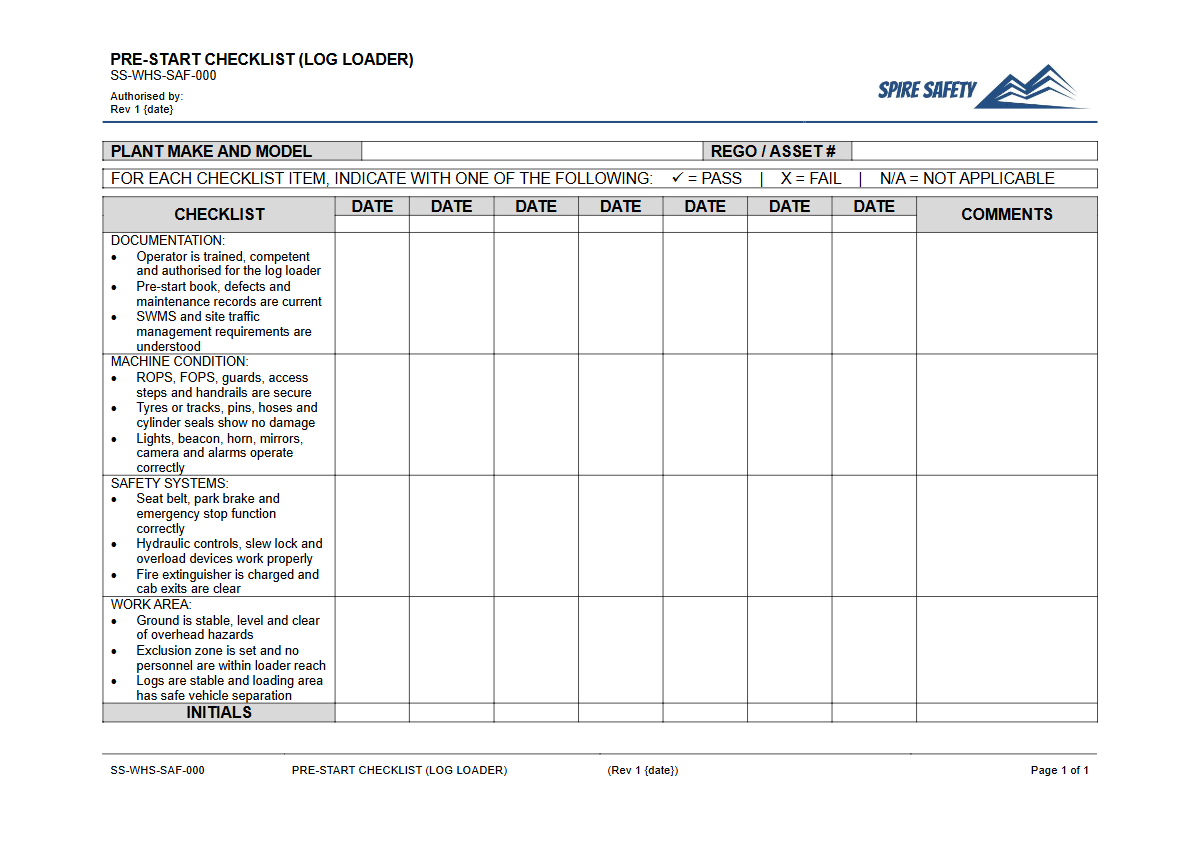
Formalise your log loader safety checks with our free Pre-Start Checklist template. This structured DOCX and PDF helps identify hazards before operation.
Free Pre-Start Checklist (Log Loader) Template
DOCX • 125 KB + PDF
Updated Oct 2026
No signup required
Purpose of the Free Pre-Start Checklist (Log Loader) Template
Operating heavy machinery like a log loader introduces significant risks. A systematic inspection before each use is a fundamental safety control.
This free Pre-Start Checklist (Log Loader) Template provides a structured framework for operators to conduct thorough, documented inspections of the equipment before commencing work.
Using this template helps your organisation formalise its safety procedures. It assists in identifying potential defects, damage, or fluid leaks before they can lead to an incident.
A completed checklist serves as a tangible record of due diligence, demonstrating a commitment to proactive risk management. It also supports maintenance scheduling by highlighting recurring issues or components requiring attention.
To reinforce these daily habits, consider incorporating regular training sessions, such as a Pre-Start Checks and Plant Maintenance Toolbox Talk, into your safety program.
Video walkthrough
How to use the Free Pre-Start Checklist (Log Loader) Template
This template is provided as a starting point in both DOCX and PDF formats. Download the file and integrate it into your operational procedures by following these steps:
- Customise: Review and modify the checklist to match the specific make, model, and configuration of the log loaders used at your workplace. Add or remove items to ensure every critical component is covered.
- Train: Ensure all operators are trained on how to use the checklist correctly. This includes understanding what to look for during each check and the process for reporting any faults.
- Implement: Make the checklist a non-negotiable part of the daily routine. Operators must complete it before starting the log loader for their shift.
- Review: Supervisors should regularly review completed checklists to monitor for trends, supports your compliance efforts, and sign off on any corrective actions taken.
Important: This is a template only. To be effective, you must customise it to reflect the unique hazards and control measures of your specific workplace and equipment.
This document should form part of your broader WHS management systems, not exist in isolation.
What to Check on a Log Loader
While your customised checklist will be specific to your machinery, a comprehensive Pre-Start Checklist for a log loader should generally cover the following areas:
General & Access
- Walk-around inspection for fluid leaks or obvious damage
- Condition of steps, ladders, and grab rails
- Cleanliness of operator cabin windows and mirrors
- Fire extinguisher presence, pressure, and date
Operator Cabin & Controls
- Seatbelt and seat condition
- Function of all controls, gauges, and warning lights
- Horn and reversing alarm/beeper
- Heating, ventilation, and air conditioning (HVAC)
- Steering and braking systems
Engine & Mechanical
- Engine oil, coolant, and hydraulic fluid levels
- Tyre condition and pressure, or track tension and condition
- Guards and covers are secure and in place
- Battery and electrical connections
Attachments & Hydraulics
- Condition of the log grapple, forks, or other attachments
- Hydraulic hoses, cylinders, and connections for leaks or wear
- Function of boom, swing, and attachment controls
- Condition of any locking pins or quick-hitch mechanisms
For more detailed guidance on codifying machinery-specific tasks, reviewing a Front End Loader SOP (Safe Operating Procedure) can provide a useful structural reference for similar types of heavy equipment.
When to use the Pre-Start Checklist
A pre-start inspection must be completed before the log loader is used at the beginning of each shift or day of operation. If multiple operators use the same machine during a single shift, a handover process should include a review of the machine's condition, though a full new pre-start check may also be required depending on your site's procedures.
The checklist should also be completed if the machine has been idle for an extended period.
Who should use the Pre-Start Checklist
The checklist must be completed by a person who is competent to operate the log loader. This means they have received the necessary information, instruction, training, and supervision.
Verifying operator competency is a critical step; for related machinery, a Front End Loader VOC (Verification of Competency) template can be a useful tool for formalising this process. The completed checklist should then be reviewed by a supervisor or manager who can authorise any necessary repairs or take the machine out of service if it is deemed unsafe.
Ultimately, this document is a tool to support your risk assessment process, which may also be formalised in documents like a Safe Work Method Statement for backhoe loader operation, ensuring high-risk work is carefully planned and controlled. The effectiveness of your entire safety framework can be verified through periodic WHS compliance auditing. Explore our free WHS resources library for more templates to support your safety management system.
Common mistakes
Common mistakes to avoid
- "Pencil-whipping" the checklist without physically inspecting each item.
- Failing to immediately report and tag out equipment with identified safety defects.
- Using a generic checklist that doesn't cover the specific features of the log loader model.
- Neglecting to train new or inexperienced operators on the correct inspection procedure.
Legal references
Legal considerations
The following legal requirements may be relevant to this type of work.
- Work Health and Safety Act (Harmonised) — Provides the primary duties for protecting workers and other people from work health and safety risks.
- Work Health and Safety Regulations (Harmonised) — Sets out requirements supporting the management of workplace hazards and risks.
The following codes may be relevant to this type of work.
- Managing WHS Risks Code of Practice — Provides practical guidance on identifying hazards, assessing risks and applying effective controls.
- Work Health and Safety Consultation, Cooperation and Coordination Code of Practice — Provides practical guidance on consulting workers and coordinating with other duty holders.
- Managing the Work Environment and Facilities Code of Practice — Provides practical guidance on safe work environments, workplace facilities and related controls.
Did you know
Hydraulic System Risks
Hydraulic system failures are a leading cause of incidents involving heavy plant like log loaders. A single pinhole leak in a high-pressure hose can release fluid with enough force to penetrate skin, causing severe injury.
FAQ
Frequently asked questions
01What is the purpose of a log loader pre-start checklist?
02How often should a log loader pre-start check be completed?
03Who is responsible for completing the log loader pre-start checklist?
04Can I use this template for a front-end loader or skid steer?
Share this resource
Free Pre-Start Checklist (Log Loader) Template
Browse Categories
How To Use It
- 1Download and open in Word or PDF.
- 2Replace the placeholders with your business details.
- 3Get it reviewed by a WHS specialist before rollout.
Need it customised?
Our WHS consultants can adapt this template to your site, run a gap analysis, or audit what you already have in place.
Book a Free Consultation WHS consulting servicesor call 1300 156 382