
Safe Work Method Statement (Backhoe Loader Operation) Template
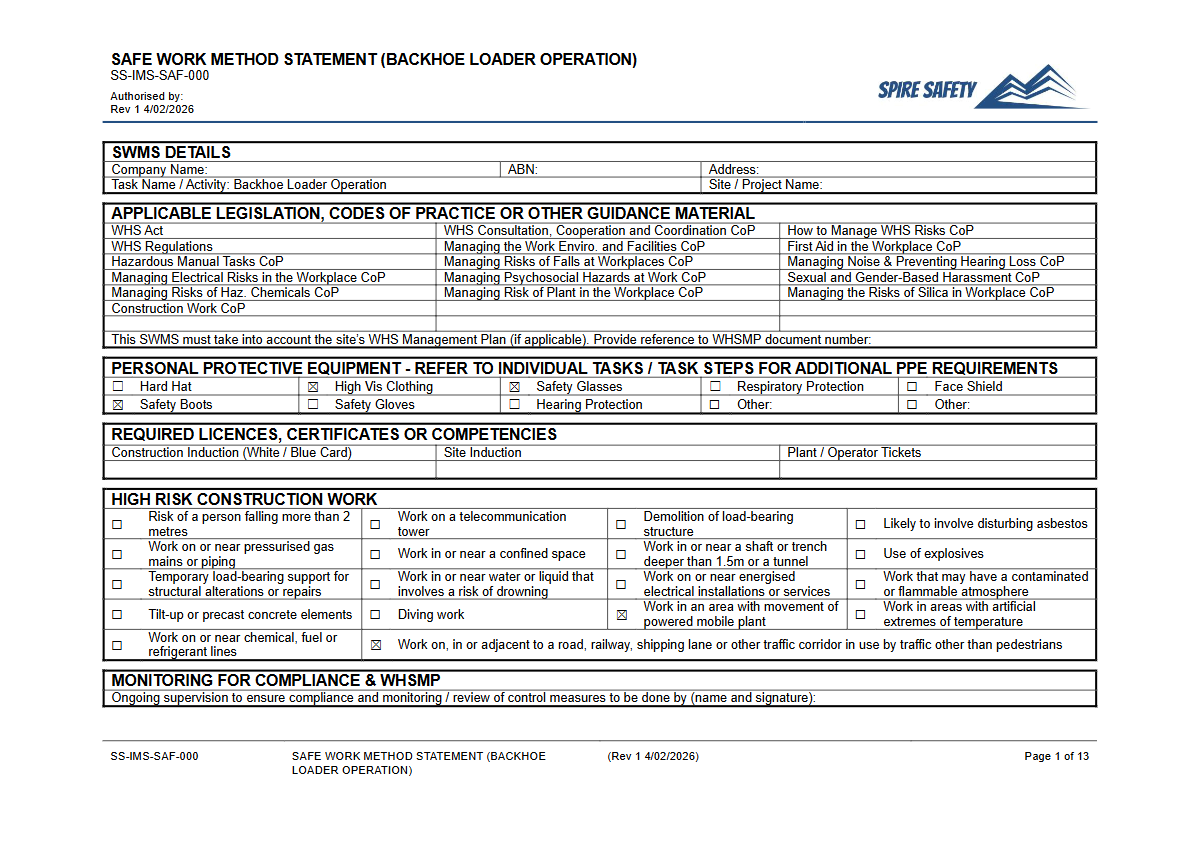
Download your free Safe Work Method Statement (SWMS) for backhoe loader operation. A structured starting point for managing WHS risks. Get your template now.
Safe Work Method Statement (Backhoe Loader Operation) Template
DOCX • 165 KB + PDF
Updated Oct 2026
No signup required
Purpose of the Safe Work Method Statement (Backhoe Loader Operation) Template
This free Safe Work Method Statement (SWMS) for backhoe loader operation provides a structured starting point for identifying hazards and controlling risks associated with using backhoe loaders on site. Backhoe loaders are versatile pieces of plant, but their operation involves significant risks, including rollovers, collisions, and excavations.
This template assists workplaces in systematically documenting how these risks will be managed to ensure the health and safety of workers and others who may be affected.
Video walkthrough
How to use the Safe Work Method Statement (Backhoe Loader Operation) Template
Our Safe Work Method Statement (Backhoe Loader Operation) template is provided as a Microsoft Word (DOCX) document, allowing for easy customisation. To effectively use it, you must adapt it to the specific conditions of your worksite, the make and model of the backhoe loader, the environment, and the tasks being performed.
This involves reviewing the pre-filled sections, adding site-specific hazards and control measures, and detailing responsibilities. It is crucial to remember that this is a template; it must be customised to your workplace's unique risks and operational procedures to be effective and aligned with Australian WHS practice.
For expert assistance in developing your WHS documentation or WHS management systems, consider our consulting services.
What to include when customising:
- Specific details of the backhoe loader being used (e.g., make, model, attachments).
- Site-specific environmental conditions (e.g., ground stability, overhead services).
- Detailed task breakdown for all phases of backhoe operation.
- Emergency procedures relevant to your worksite.
- Designated personnel responsible for implementing and monitoring control measures.
When to use it
A Safe Work Method Statement for backhoe loader operation should be developed and implemented whenever a backhoe loader is used for high-risk construction work, as defined by WHS Regulations. This includes tasks such as excavation, trenching, lifting heavy loads, or working near overhead power lines.
It must be reviewed and updated if there are changes to the work environment, equipment, or work procedures, or following any incidents.
Who should use it
This template is designed for persons conducting a business or undertaking (PCBUs), supervisors, safety officers, and contractors involved in construction or other industries where backhoe loaders are operated. While anyone can utilise this resource, the ultimate responsibility for ensuring work is carried out safely rests with the PCBU.
Workers involved in the operation of backhoe loaders should also be familiar with the contents of the SWMS and follow its instructions.
What records should be kept?
Maintaining accurate and accessible records is a critical component of effective WHS management. When using this Safe Work Method Statement (backhoe loader operation) template, ensure you keep records of:
- The completed and signed SWMS itself.
- Evidence of worker consultation during the development and review of the SWMS.
- Records of training and instruction provided to workers on the SWMS.
- Any amendments or revisions made to the SWMS, along with the reasons for change.
- Records of SWMS reviews, including dates and outcomes.
For more free WHS resources library, explore our extensive collection.
Common mistakes
Common mistakes to avoid
- Not customising the template to specific site conditions and tasks.
- Failing to consult with workers who perform the high-risk work when developing or reviewing the SWMS.
- Not reviewing or updating the SWMS when conditions, equipment, or procedures change.
- Treating the SWMS as a static document rather than a living tool for managing safety.
Legal references
Legal considerations
The following legal requirements may be relevant to this type of work.
- Work Health and Safety Act (Harmonised) — Provides the primary duties for protecting workers and other people from work health and safety risks.
- Work Health and Safety Regulations (Harmonised) — Sets out requirements supporting the management of workplace hazards and risks.
The following codes may be relevant to this type of work.
- Managing WHS Risks Code of Practice — Provides practical guidance on identifying hazards, assessing risks and applying effective controls.
- Work Health and Safety Consultation, Cooperation and Coordination Code of Practice — Provides practical guidance on consulting workers and coordinating with other duty holders.
- Managing the Work Environment and Facilities Code of Practice — Provides practical guidance on safe work environments, workplace facilities and related controls.
Did you know
Historical Context of Backhoe Loaders
The first successful backhoe loader was introduced in 1957 by J.C. Bamford Excavators Ltd. (JCB), combining a tractor, front loader, and backhoe into one versatile machine that revolutionised construction and earthmoving tasks.
Noise Exposure Risk
Operating heavy machinery like a backhoe loader can expose workers to significant noise levels, often exceeding safe limits, necessitating hearing protection and hearing risk management strategies.
FAQ
Frequently asked questions
01What is the primary purpose of a Safe Work Method Statement (SWMS)?
02Is this backhoe loader SWMS template WHS-aligned?
03How often should a SWMS be reviewed?
04Can workers refuse to do work if a SWMS isn't in place?
Share this resource
Safe Work Method Statement (Backhoe Loader Operation) Template
Browse Categories
How To Use It
- 1Download and open in Word or PDF.
- 2Replace the placeholders with your business details.
- 3Get it reviewed by a WHS specialist before rollout.
Need it customised?
Our WHS consultants can adapt this template to your site, run a gap analysis, or audit what you already have in place.
Book a Free Consultation WHS consulting servicesor call 1300 156 382
Related templates
- Safe Work Method Statement (Body Truck Operation) Template
- Safe Work Method Statement (Bulldozer Operation) Template
- Safe Work Method Statement (Concrete Truck Operation) Template
- Safe Work Method Statement (Elevated Work Platform Operation) Template
- Safe Work Method Statement (Excavator Operation) Template
- Safe Work Method Statement (Float or Low Loader Operation) Template