
Safe Work Method Statement (Excavator Operation) Template
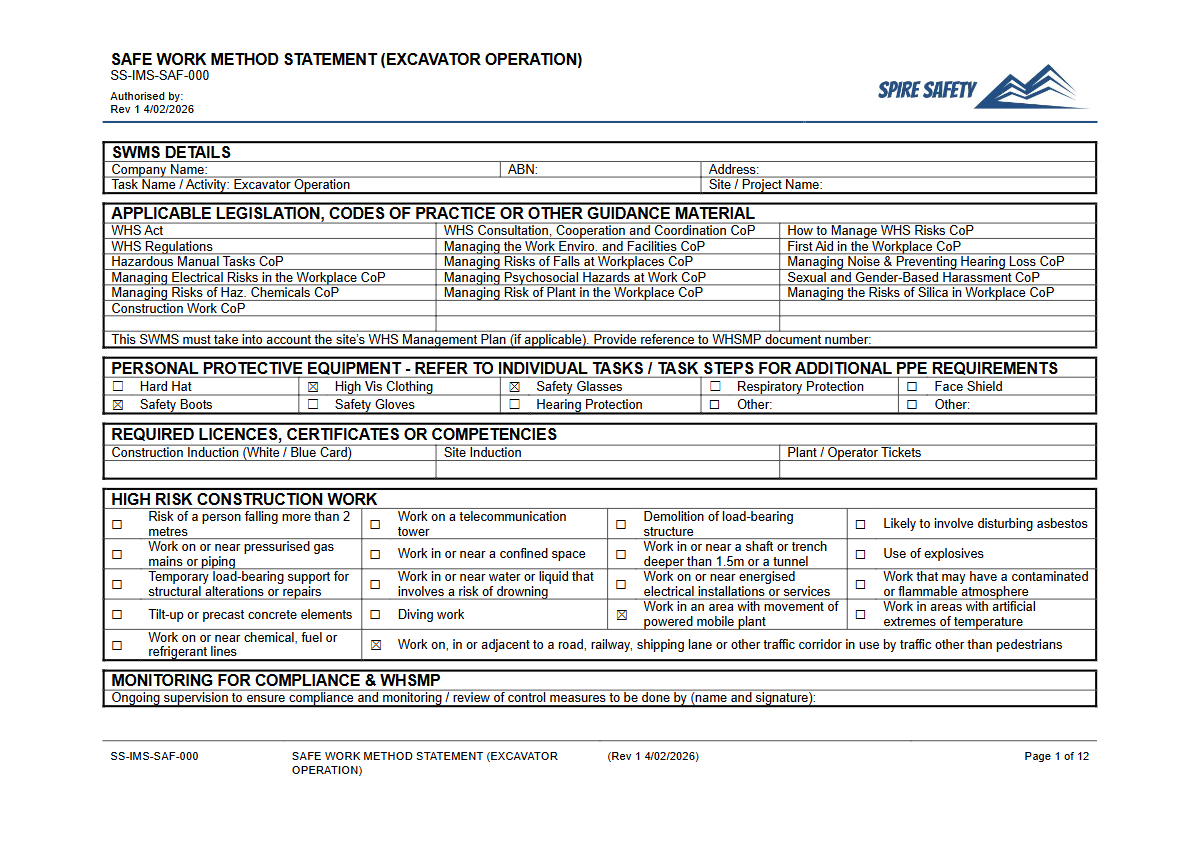
Download our free Safe Work Method Statement (SWMS) template for excavator operation, aligned with Australian WHS practices. Get your copy today!
Safe Work Method Statement (Excavator Operation) Template
DOCX • 161 KB + PDF
Updated Oct 2026
No signup required
Purpose of the Safe Work Method Statement (Excavator Operation) Template
This free WHS resource provides a structured Safe Work Method Statement (SWMS) template specifically designed for excavator operation. A SWMS is a critical planning document that outlines high-risk construction work activities, the hazards involved, and the control measures to be implemented to manage those hazards.
This template helps organisations and workers systematically identify, assess, and control risks associated with operating excavators on site, contributing to a safer work environment.
Using a pre-formatted template like this can streamline your WHS planning processes, ensuring key safety considerations for excavator work are addressed. It is based on the model WHS framework and is a valuable starting point for developing site-specific safety documentation.
Video walkthrough
How to use the Safe Work Method Statement (Excavator Operation) Template
Our Safe Work Method Statement (Excavator Operation) Template is provided in both DOCX and PDF formats for your convenience. The DOCX version is fully editable, allowing you to tailor the content to your specific operational needs and site conditions.
It includes sections for detailing the scope of work, personnel responsibilities, risk assessments for various stages of excavator operation, and control measures. Please note: This template must be customised to your workplace, specific tasks, and risk profile. It is a guide and does not replace the requirement for a thorough, site-specific risk assessment and SWMS development led by competent persons.
We recommend involving all relevant workers, including the excavator operators themselves, in the customisation process. This ensures the SWMS accurately reflects the work as it will be performed and promotes a strong safety culture.
Developing your SWMS
A well-developed SWMS should clearly describe:
- The specific high-risk construction work being carried out.
- The hazards associated with that work.
- The risks arising from those hazards.
- The control measures to be put in place to manage the risks.
- How the control measures will be implemented, monitored, and reviewed.
- The person responsible for implementing and monitoring each control measure.
For complex projects or if you require assistance in developing comprehensive WHS management systems including SWMS, consider engaging WHS consulting experts.
When to use it
This template should be used before any high-risk construction work involving excavators commences. It is essential for planning and documenting the safe execution of tasks such as digging, trenching, loading, and material handling using an excavator.
A SWMS must be reviewed and updated if there are changes to the work environment, equipment, or work procedures, or if new risks are identified.
Who should use it
This template is ideal for:
- Construction companies and contractors.
- Site supervisors and project managers.
- WHS officers and safety managers.
- Excavator operators and work teams, as part of their pre-work planning and review.
- Anyone responsible for planning and overseeing high-risk construction work involving excavators.
Common mistakes
Common mistakes to avoid
- Not involving workers who carry out the high-risk work in the SWMS development.
- Using a generic SWMS without customising it to site-specific conditions and tasks.
- Failing to review and update the SWMS when work conditions change or new risks emerge.
- Not ensuring all workers understand and have access to the SWMS before starting work.
Legal references
Legal considerations
The following legal requirements may be relevant to this type of work.
- Work Health and Safety Act (Harmonised) — Provides the primary duties for protecting workers and other people from work health and safety risks.
- Work Health and Safety Regulations (Harmonised) — Sets out requirements supporting the management of workplace hazards and risks.
The following codes may be relevant to this type of work.
- Managing WHS Risks Code of Practice — Provides practical guidance on identifying hazards, assessing risks and applying effective controls.
- Work Health and Safety Consultation, Cooperation and Coordination Code of Practice — Provides practical guidance on consulting workers and coordinating with other duty holders.
- Managing the Work Environment and Facilities Code of Practice — Provides practical guidance on safe work environments, workplace facilities and related controls.
Did you know
Excavator Incident Data
Excavators are involved in a significant number of incidents on construction sites each year, ranging from rollovers and collisions to trench collapses, highlighting the importance of robust safety planning.
Model WHS Laws
All Australian states and territories (except Victoria) have adopted the model WHS laws, which include specific requirements for Safe Work Method Statements for high-risk construction work.
FAQ
Frequently asked questions
01What is a Safe Work Method Statement (SWMS)?
02Is a SWMS legally required for all work involving excavators?
03How often should a SWMS for excavator operation be reviewed?
04Can I use this template without any customisation?
Share this resource
Safe Work Method Statement (Excavator Operation) Template
Browse Categories
How To Use It
- 1Download and open in Word or PDF.
- 2Replace the placeholders with your business details.
- 3Get it reviewed by a WHS specialist before rollout.
Need it customised?
Our WHS consultants can adapt this template to your site, run a gap analysis, or audit what you already have in place.
Book a Free Consultation WHS consulting servicesor call 1300 156 382
Related templates
- Safe Work Method Statement (Float or Low Loader Operation) Template
- Safe Work Method Statement (Fuel Truck Operation) Template
- Safe Work Method Statement (Light Vehicle Operation) Template
- Safe Work Method Statement (Mobile Crane Operation) Template
- Safe Work Method Statement (Motor Grader Operation) Template
- Safe Work Method Statement (Multi-Tyre Roller Operation) Template