
Safe Work Method Statement (Fuel Truck Operation) Template
Download your free Safe Work Method Statement (Fuel Truck Operation) Template. A structured starting point for managing fuel truck risks. Get your copy today!
Safe Work Method Statement (Fuel Truck Operation) Template
DOCX • 164 KB + PDF
Updated Oct 2026
No signup required
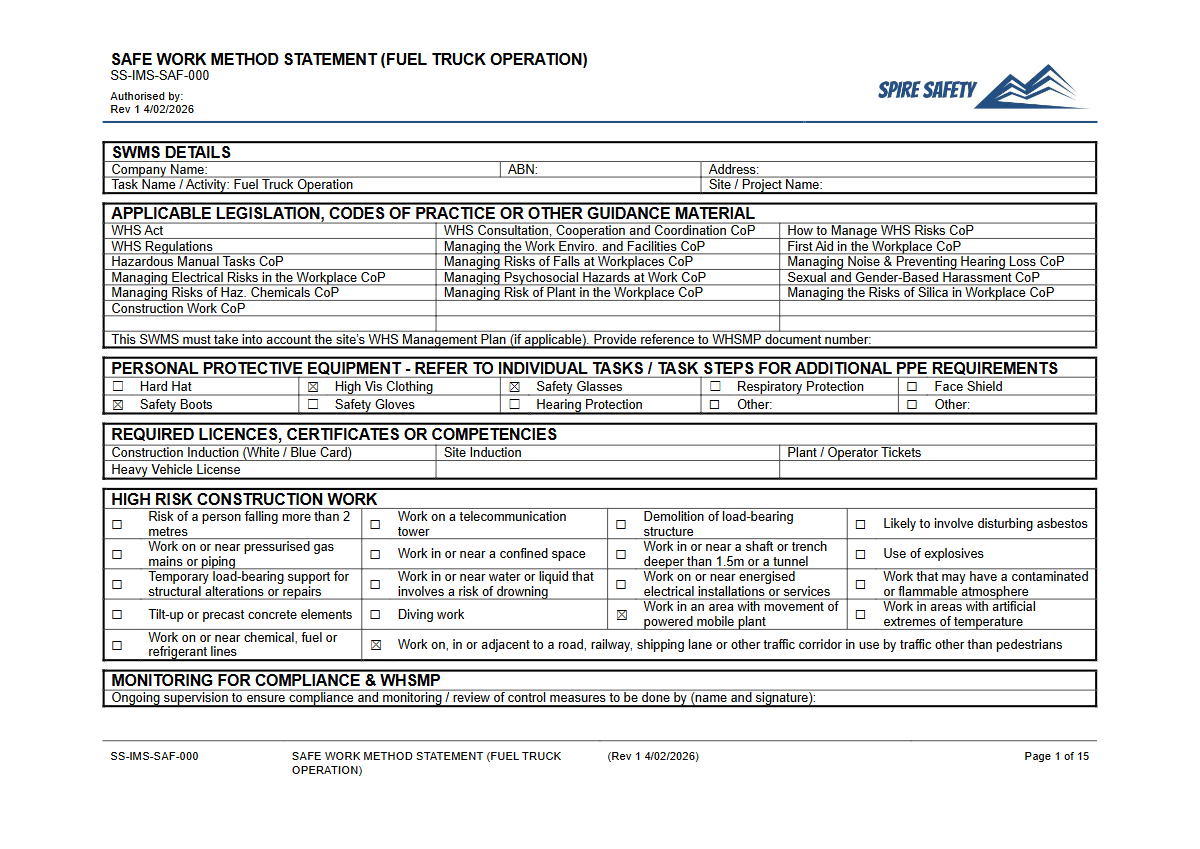
Purpose of the Safe Work Method Statement (Fuel Truck Operation) Template
Operating fuel trucks involves significant hazards, from flammable liquids to heavy vehicle movement. Our free Safe Work Method Statement (Fuel Truck Operation) Template provides a structured starting point for identifying potential risks and outlining control measures to ensure safety.
This template helps organisations develop a systematic approach to managing the health and safety of workers involved in fuel transportation, delivery, and associated tasks.
A well-prepared Safe Work Method Statement (SWMS) is a crucial document for high-risk construction work and other activities where specific hazards are present. It details the work activities in a logical sequence, identifies the hazards associated with each step, assesses the risks, and specifies the control measures to be implemented.
This particular template is aligned with Australian WHS practice and provides a clear framework to document your safety procedures for fuel truck operations.
Video walkthrough
How to use the Safe Work Method Statement (Fuel Truck Operation) Template
This free Safe Work Method Statement (Fuel Truck Operation) Template is provided in an editable DOCX format, making it easy to adapt for your specific workplace needs. Download the template and customise it by:
- Reviewing each section carefully and adding details relevant to your specific fuel truck operations, including the types of fuel, vehicles, and delivery locations.
- Identifying all specific hazards present in your work environment, beyond those listed in the template, such as unique site conditions or specific equipment.
- Specifying the control measures your organisation will implement to eliminate or minimise identified risks. Remember to apply the hierarchy of control.
- Outlining emergency procedures and communication protocols applicable to fuel spills, fires, or other incidents during fuel truck operations.
- Ensuring all workers involved in fuel truck operations are consulted during the customisation process and understand the SWMS.
Please note: This template is a general guide and must be customised to your specific workplace, equipment, processes, and legislative requirements. It is a starting point, and I cannot guarantee its suitability for all situations without your input.
When to use it
A Safe Work Method Statement for fuel truck operations should be developed and implemented whenever these activities are undertaken, especially if they are classified as high-risk construction work or involve other high-risk tasks. It is required before commencing any work where the risk of serious injury or death is high. This includes tasks such as:
- Loading and unloading fuel at depots or client sites.
- Transporting flammable liquids.
- Refuelling plant and equipment in various environments.
- Maintenance and inspection of fuel trucks and associated equipment.
- Any activities involving potential exposure to hazardous chemicals or ignition sources.
Who should use it
This Safe Work Method Statement template is valuable for anyone responsible for WHS within an organisation that involves fuel truck operations. This includes:
- WHS Managers and Officers.
- Supervisors and Team Leaders overseeing fuel truck drivers and operators.
- Project Managers on sites where fuel is delivered or distributed.
- Business Owners and Directors with responsibilities for WHS compliance.
- Fuel truck operators and drivers for familiarisation with safety procedures.
Developing robust WHS management systems is key to maintaining workplace safety. This template contributes to that goal by assisting in the documentation of safe practices for specific high-risk tasks. For further support in developing your WHS documentation or WHS consulting needs, consider exploring our other resources and services at Spire Safety.
Common mistakes
Common mistakes to avoid
- Using a generic SWMS without customising it for specific site conditions or tasks.
- Failing to adequately consult workers who perform the fuel truck operation tasks.
- Not reviewing the SWMS when changes occur or after incidents, making it outdated and ineffective.
- Treating the SWMS as a paperwork exercise rather than an active safety management tool.
Legal references
Legal considerations
The following legal requirements may be relevant to this type of work.
- Work Health and Safety Act (Harmonised) — Provides the primary duties for protecting workers and other people from work health and safety risks.
- Work Health and Safety Regulations (Harmonised) — Sets out requirements supporting the management of workplace hazards and risks.
The following codes may be relevant to this type of work.
- Managing WHS Risks Code of Practice — Provides practical guidance on identifying hazards, assessing risks and applying effective controls.
- Work Health and Safety Consultation, Cooperation and Coordination Code of Practice — Provides practical guidance on consulting workers and coordinating with other duty holders.
- Managing the Work Environment and Facilities Code of Practice — Provides practical guidance on safe work environments, workplace facilities and related controls.
Did you know
Flammable Liquids
Petrol and diesel are classified as Class 3 Flammable Liquids under the Australian Dangerous Goods Code, requiring stringent handling and storage protocols due to their fire and explosion risks.
Daily Checks Importance
Regular pre-start checks on fuel trucks are critical for identifying potential mechanical failures or leaks before operations commence, significantly reducing the risk of incidents on the road or at delivery sites.
FAQ
Frequently asked questions
01What is a Safe Work Method Statement (SWMS)?
02Is a SWMS legally required for fuel truck operations in Australia?
03How often should a Safe Work Method Statement be reviewed?
04Can this template supports your compliance efforts with WHS laws?
Share this resource
Safe Work Method Statement (Fuel Truck Operation) Template
Browse Categories
How To Use It
- 1Download and open in Word or PDF.
- 2Replace the placeholders with your business details.
- 3Get it reviewed by a WHS specialist before rollout.
Need it customised?
Our WHS consultants can adapt this template to your site, run a gap analysis, or audit what you already have in place.
Book a Free Consultation WHS consulting servicesor call 1300 156 382
Related templates
- Safe Work Method Statement (Light Vehicle Operation) Template
- Safe Work Method Statement (Mobile Crane Operation) Template
- Safe Work Method Statement (Motor Grader Operation) Template
- Safe Work Method Statement (Multi-Tyre Roller Operation) Template
- Safe Work Method Statement (Padfoot Roller Operation) Template
- Safe Work Method Statement (Prime Mover Operation) Template