
Safe Work Method Statement (Mobile Crane Operation) Template
Download your free Safe Work Method Statement (Mobile Crane Operation) template. A structured starting point for managing WHS risks. Get started now!
Safe Work Method Statement (Mobile Crane Operation) Template
DOCX • 165 KB + PDF
Updated Oct 2026
No signup required
Purpose of the Safe Work Method Statement (Mobile Crane Operation) Template
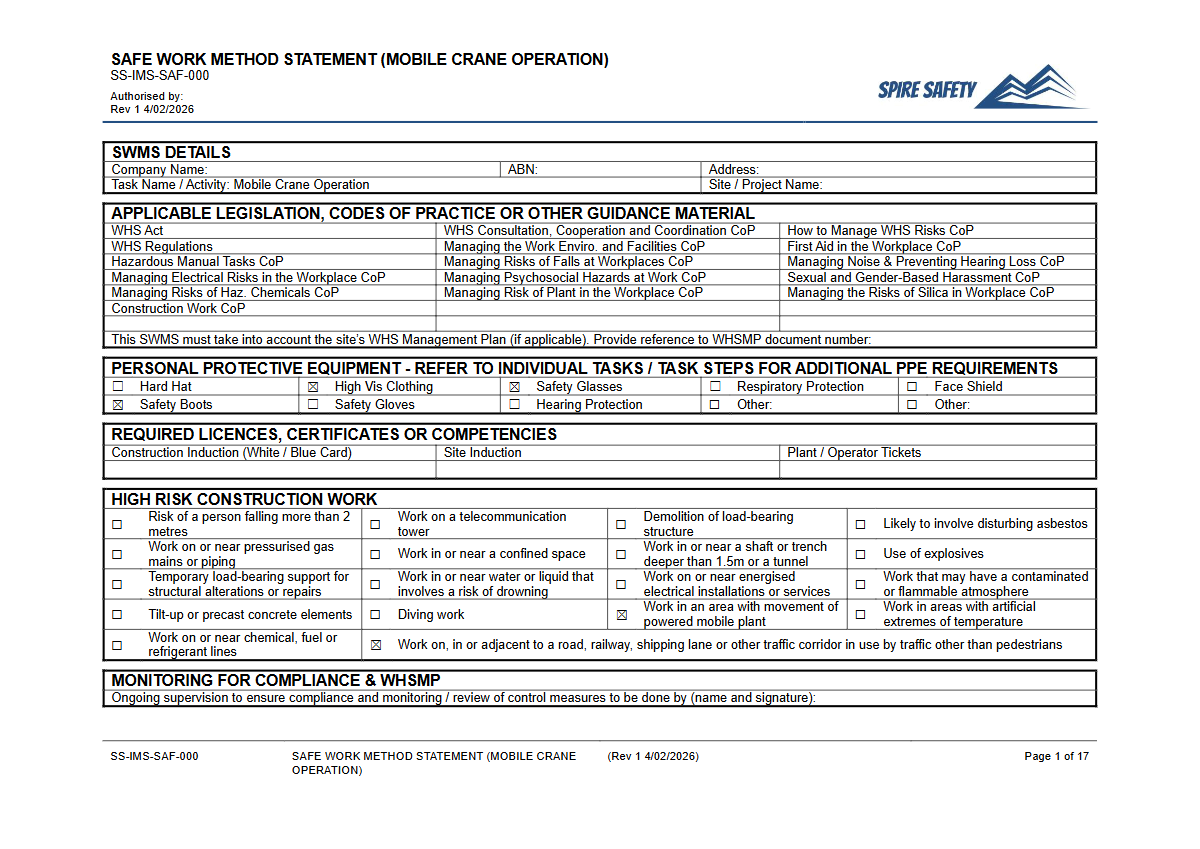
Our free Safe Work Method Statement (Mobile Crane Operation) Template is designed to provide Australian businesses with a structured starting point for identifying hazards and controlling risks associated with mobile crane operations. Mobile crane work is considered high-risk construction work (HRCW) under WHS regulations, necessitating a robust SWMS.
This template assists in documenting the step-by-step process of mobile crane use, from pre-operational checks to shutdown procedures, ensuring critical safety measures are clearly articulated. It helps organisations meet their duty to develop and implement safe work procedures, fostering a safer working environment and demonstrating a commitment to WHS management systems.
Video walkthrough
How to use the Safe Work Method Statement (Mobile Crane Operation) Template
To effectively use this Safe Work Method Statement (Mobile Crane Operation) Template, download the DOCX version and begin by thoroughly reviewing each section. This document is a guide, not a final solution, and must be customised to your specific workplace, equipment, and task requirements.
The template prompts you to detail specific hazards inherent in your mobile crane operations and to outline the control measures you will implement. This includes specifying required permits, required plant and equipment, qualifications of operators, and emergency procedures.
Ensure all workers involved in mobile crane operations are consulted during its development and fully understand its contents before commencing work. Regular reviews and updates are crucial to maintain its relevance and effectiveness, especially if work procedures or conditions change.
When to use it
A Safe Work Method Statement for mobile crane operation must be prepared before any high-risk construction work involving mobile cranes commences. This applies to all workplaces where mobile cranes are used, regardless of the project size or duration.
It's particularly important for new projects, changes in work scope, or when new equipment or personnel are introduced. It should also be reviewed and updated periodically, or immediately following an incident or near-miss.
Who should use it
This template is primarily for persons conducting a business or undertaking (PCBU) who engage in or oversee mobile crane operations. This includes construction companies, project managers, site supervisors, and WHS officers responsible for developing, implementing, and monitoring safe work procedures.
Mobile crane operators and dogmen should also be familiar with the document, as it outlines their specific responsibilities and required work methods. It serves as a valuable tool for anyone needing to establish clear and safe protocols for high-risk mobile crane activities.
Common mistakes
Common mistakes to avoid
- Not customising the template to specific site conditions and plant.
- Failing to review and update the SWMS when work procedures or conditions change.
- Not consulting workers about the SWMS during its development or before work commences.
- Treating the SWMS as a 'tick-box' exercise rather than a working safety document.
Legal references
Legal considerations
The following legal requirements may be relevant to this type of work.
- Work Health and Safety Act (Harmonised) — Provides the primary duties for protecting workers and other people from work health and safety risks.
- Work Health and Safety Regulations (Harmonised) — Sets out requirements supporting the management of workplace hazards and risks.
The following codes may be relevant to this type of work.
- Managing WHS Risks Code of Practice — Provides practical guidance on identifying hazards, assessing risks and applying effective controls.
- Work Health and Safety Consultation, Cooperation and Coordination Code of Practice — Provides practical guidance on consulting workers and coordinating with other duty holders.
- Managing the Work Environment and Facilities Code of Practice — Provides practical guidance on safe work environments, workplace facilities and related controls.
Did you know
Crane Licences
In Australia, operating a mobile crane requires a High Risk Work Licence (HRWL) with the appropriate class (e.g., C2, C6, C1, CM) to ensure operators have the necessary skills and knowledge.
Major Incident Risk
Mobile crane incidents are a leading cause of fatalities and serious injuries in construction, often due to overturns, structural failures, or contact with power lines. Robust SWMS help mitigate these critical risks.
FAQ
Frequently asked questions
01What is high-risk construction work?
02Does this template guarantee WHS compliance?
03Can I use this SWMS for other plant operations?
04What is the difference between a SWMS and a Job Safety Analysis (JSA)?
Share this resource
Safe Work Method Statement (Mobile Crane Operation) Template
Browse Categories
How To Use It
- 1Download and open in Word or PDF.
- 2Replace the placeholders with your business details.
- 3Get it reviewed by a WHS specialist before rollout.
Need it customised?
Our WHS consultants can adapt this template to your site, run a gap analysis, or audit what you already have in place.
Book a Free Consultation WHS consulting servicesor call 1300 156 382
Related templates
- Safe Work Method Statement (Motor Grader Operation) Template
- Safe Work Method Statement (Multi-Tyre Roller Operation) Template
- Safe Work Method Statement (Padfoot Roller Operation) Template
- Safe Work Method Statement (Prime Mover Operation) Template
- Safe Work Method Statement (Scissor Lift Operation) Template
- Safe Work Method Statement (Scraper Operation) Template