
Safe Work Method Statement (Motor Grader Operation) Template
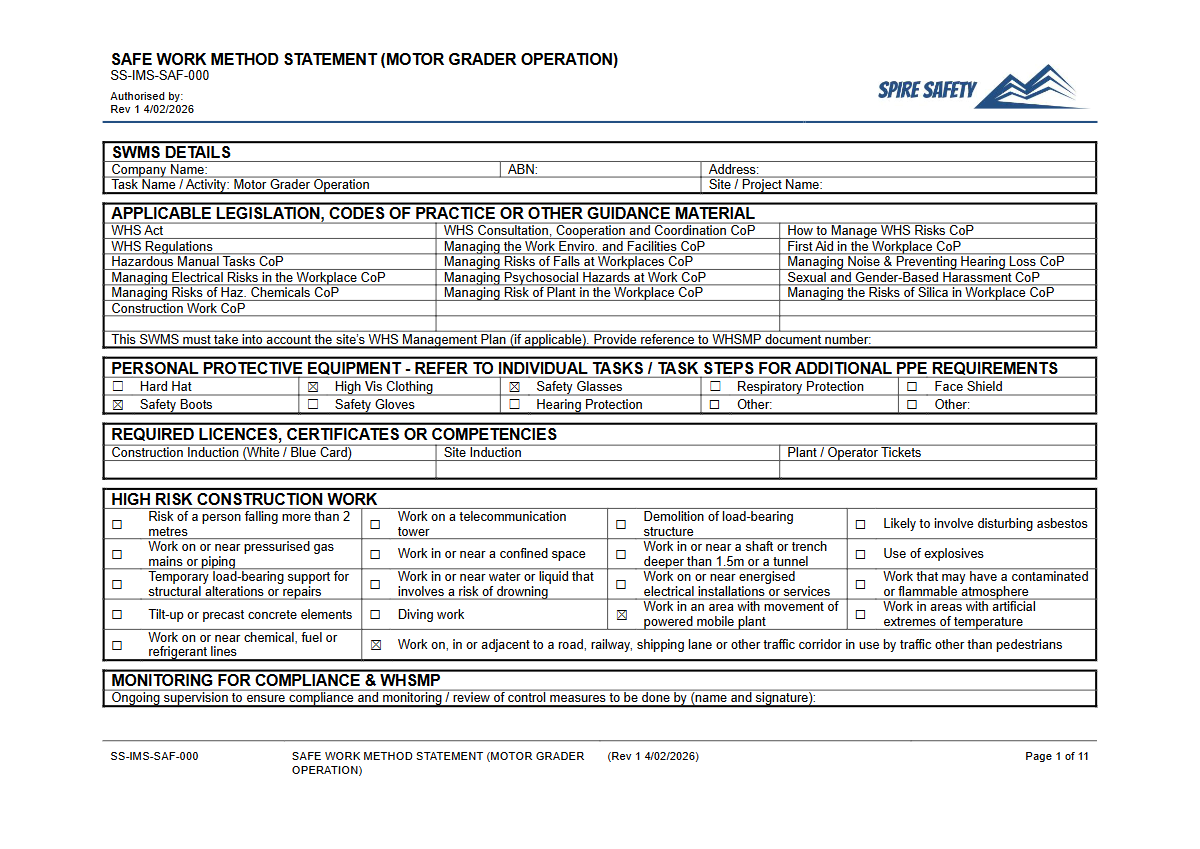
Download your free Safe Work Method Statement for Motor Grader Operation. A crucial WHS template for managing risks in construction. Get your copy now.
Safe Work Method Statement (Motor Grader Operation) Template
DOCX • 159 KB + PDF
Updated Oct 2026
No signup required
Purpose of the Safe Work Method Statement (Motor Grader Operation) Template
Our free Safe Work Method Statement (Motor Grader Operation) Template provides a structured starting point for organisations to document how they will manage health and safety risks associated with operating motor graders. Motor graders are powerful pieces of plant commonly used in civil construction, roadwork, and land grading, presenting various hazards if not operated correctly.
This document outlines the step-by-step process for identifying potential hazards, assessing risks, and implementing control measures to ensure the safety of operators and other workers on site.
Using a well-developed Safe Work Method Statement (SWMS) is a key element of effective risk management under Australian WHS laws. It promotes a systematic approach to high-risk construction work, helping to minimise incidents and injuries.
This template is designed to assist businesses in meeting their duty of care by providing a framework for safe work practices specific to motor grader operations, aligning with Australian WHS practice.
Video walkthrough
How to use the Safe Work Method Statement (Motor Grader Operation) Template
This Safe Work Method Statement (Motor Grader Operation) Template is provided in an editable DOCX format, allowing for full customisation to your specific workplace and operational requirements. To effectively use this template, you must:
- Customise to your workplace: This is a generic template and must be customised to your specific workplace, equipment, site conditions, and operational procedures. Do not use it without tailoring it.
- Identify specific hazards: Conduct a thorough site-specific risk assessment to identify all hazards related to motor grader operation at your location, including environmental factors, ground conditions, and interactions with other plant or personnel.
- Determine control measures: For each identified hazard, specify the control measures unique to your work environment. Apply the hierarchy of controls to eliminate or minimise risks as far as reasonably practicable.
- Detail responsibilities: Assign clear roles and responsibilities for implementing and monitoring control measures.
- Outline procedures: Document the step-by-step safe work procedures for all stages of motor grader operation, from pre-start checks to shutdown.
- Consult and communicate: Engage workers who will be performing the task in the development and review of the SWMS. Ensure all relevant personnel understand its contents before work commences.
- Review regularly: The SWMS should be reviewed and updated whenever there are changes to the work environment, equipment, or procedures, or immediately after any incident.
Remember, this template is a tool to support your risk management processes, not a substitute for thorough planning and consultation. For comprehensive guidance on WHS compliance and risk management specific to your business, consider external expertise such as WHS consulting.
When to use this template
This Safe Work Method Statement template should be used whenever motor grader operation is being conducted, particularly if it is classified as 'high-risk construction work' under WHS Regulations. This includes activities such as:
- Road construction and maintenance
- Land levelling and grading
- Earthmoving and excavation
- Preparation of building sites
- Backfilling and material spreading
It is essential to have this document completed and understood by all relevant workers before any operating tasks commence. It serves as a critical reference point for safe work practices throughout the project lifecycle.
Who should use this template
This template is invaluable for a range of roles and organisations involved in civil construction, infrastructure, and earthmoving. Key users include:
- PCBU (Persons Conducting a Business or Undertaking): To fulfil their primary duty of care in providing a safe working environment.
- Site Managers and Supervisors: To plan, supervise, and control work involving motor graders.
- Health and Safety Officers: To develop, implement, and monitor WHS documentation and systems.
- Motor Grader Operators: To understand and follow safe operating procedures.
- Project Managers: To ensure WHS requirements are integrated into project planning and execution.
- Contractors and Subcontractors: To demonstrate their commitment to WHS when tendering for or undertaking work involving motor graders.
Implementing robust WHS management systems can significantly streamline the creation and management of essential safety documents like this SWMS. Find more helpful documents in our free WHS resources library.
Common mistakes
Common mistakes to avoid
- Using a generic SWMS without customising it for site-specific hazards and controls.
- Failing to review and update the SWMS when changes occur to equipment, personnel, or site conditions.
- Not ensuring all workers involved understand and sign off on the SWMS before commencing work.
- Treating the SWMS as a tick-box exercise rather than a living document to proactively manage risks.
Legal references
Legal considerations
The following legal requirements may be relevant to this type of work.
- Work Health and Safety Act (Harmonised) — Provides the primary duties for protecting workers and other people from work health and safety risks.
- Work Health and Safety Regulations (Harmonised) — Sets out requirements supporting the management of workplace hazards and risks.
The following codes may be relevant to this type of work.
- Managing WHS Risks Code of Practice — Provides practical guidance on identifying hazards, assessing risks and applying effective controls.
- Work Health and Safety Consultation, Cooperation and Coordination Code of Practice — Provides practical guidance on consulting workers and coordinating with other duty holders.
- Managing the Work Environment and Facilities Code of Practice — Provides practical guidance on safe work environments, workplace facilities and related controls.
Did you know
Motor Grader Origins
The first self-propelled motor grader was developed in the early 20th century, significantly improving the efficiency of road construction and maintenance. Early graders were often pulled by horses or tractors.
Grader Blades
Motor grader blades can be rotated and angled in multiple ways, allowing for precise material spreading, ditch cutting, scarifying, and fine grading, making them versatile for various earthmoving tasks.
FAQ
Frequently asked questions
01What is a Safe Work Method Statement (SWMS)?
02When is a SWMS required for motor grader operations?
03Who is responsible for preparing a SWMS?
04Can this Motor Grader SWMS template supports your compliance efforts?
Share this resource
Safe Work Method Statement (Motor Grader Operation) Template
Browse Categories
How To Use It
- 1Download and open in Word or PDF.
- 2Replace the placeholders with your business details.
- 3Get it reviewed by a WHS specialist before rollout.
Need it customised?
Our WHS consultants can adapt this template to your site, run a gap analysis, or audit what you already have in place.
Book a Free Consultation WHS consulting servicesor call 1300 156 382
Related templates
- Safe Work Method Statement (Multi-Tyre Roller Operation) Template
- Safe Work Method Statement (Padfoot Roller Operation) Template
- Safe Work Method Statement (Prime Mover Operation) Template
- Safe Work Method Statement (Scissor Lift Operation) Template
- Safe Work Method Statement (Scraper Operation) Template
- Safe Work Method Statement (Skid Steer Loader Operation) Template