
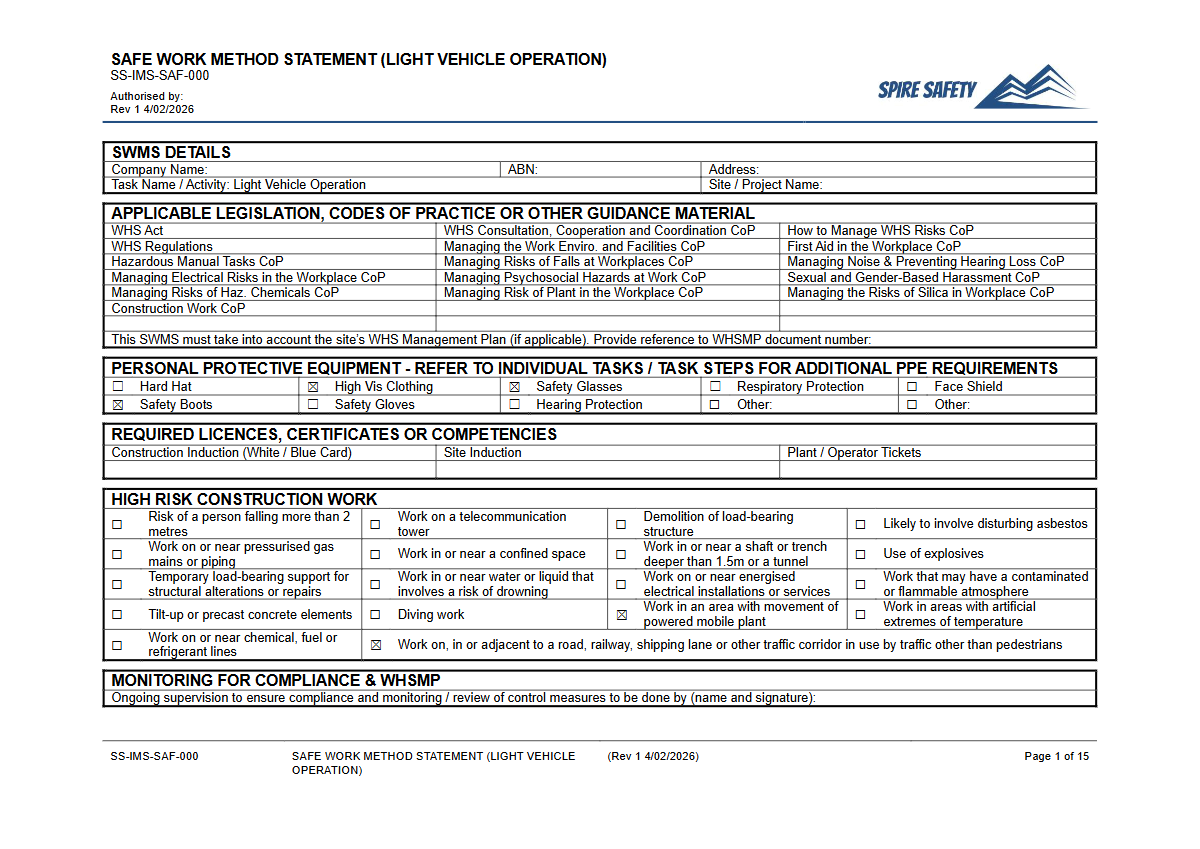
Safe Work Method Statement (Light Vehicle Operation) Template
Streamline your WHS planning for light vehicle operations with our free Safe Work Method Statement (SWMS) template. Download and customise today.
Safe Work Method Statement (Light Vehicle Operation) Template
DOCX • 164 KB + PDF
Updated Oct 2026
No signup required
Purpose of the Safe Work Method Statement (Light Vehicle Operation) Template
Our free Safe Work Method Statement (SWMS) template for light vehicle operation is designed to help Australian businesses identify, assess, and control health and safety risks associated with operating light vehicles in the workplace. This template serves as a structured starting point, guiding you through the critical steps of outlining the work, potential hazards, and the control measures necessary to manage those risks effectively.
It supports your organisation's commitment to providing a safe working environment and is aligned with Australian WHS practice for managing high-risk activities.
Video walkthrough
How to Use the Safe Work Method Statement (Light Vehicle Operation) Template
This free WHS resource is provided in a user-friendly DOCX format, allowing for straightforward customisation to your specific operational needs. Upon downloading the Safe Work Method Statement (Light Vehicle Operation) Template, you should:
- Review each section carefully, tailoring it to the specific tasks, vehicles, and work environment.
- Identify all potential hazards associated with your light vehicle operations that may not be explicitly covered.
- Specify appropriate control measures, including roles, responsibilities, and required training or qualifications.
- Ensure all workers involved in light vehicle operations are consulted and understand the SWMS before commencing work.
- Regularly review and update the SWMS to reflect any changes in work procedures, plant, or personnel.
Please note: This template is a general guide and must be customised to your specific workplace conditions, hazards, and control measures to be effective and relevant.
When to Use it
A Safe Work Method Statement for light vehicle operations is essential any time these activities are considered 'high-risk construction work' under the WHS Regulations or where there are significant risks to health and safety. This typically includes work involving mobile plant (which light vehicles can be, depending on their use and context), working near live traffic, or operations on construction sites.
It should be developed and implemented before work commences and referenced throughout the project lifecycle.
Who Should Use it
This Safe Work Method Statement template is valuable for a range of roles and businesses, including:
- Employers and Persons Conducting a Business or Undertaking (PCBUs): To meet their primary duty of care in providing a safe workplace.
- WHS Managers and Coordinators: For developing, implementing, and maintaining WHS documentation.
- Supervisors: To plan, supervise, and ensure safe work practices on site.
- Workers: To understand the risks and control measures relevant to their tasks.
- Contractors: When performing light vehicle operations on another PCBU's site.
Organisations looking to enhance their overall WHS governance may also consider implementing robust WHS management systems.
Key Elements of an Effective Safe Work Method Statement
An effective Safe Work Method Statement goes beyond just listing hazards; it demonstrates a clear, systematic approach to risk management. Key elements typically include:
- Clear identification of the work activity being performed.
- Detailed hazard identification specific to each step of the work.
- Thorough assessment of risks associated with identified hazards.
- Specific control measures to eliminate or minimise risks, following the hierarchy of controls.
- Confirmation of responsibilities for implementing and monitoring control measures.
- Procedures for reviewing and updating the SWMS.
- Requirements for training, instruction, and consultation with workers.
For more tailored advice on risk management and WHS documentation, consider engaging with specialised WHS consulting services.
Common mistakes
Common mistakes to avoid
- Not customising the SWMS to specific site conditions and tasks.
- Failing to consult workers or ensure they understand the SWMS.
- Treating the SWMS as a 'tick and flick' exercise rather than a living document.
- Not reviewing or updating the SWMS when conditions, plant, or personnel change.
Legal references
Legal considerations
The following legal requirements may be relevant to this type of work.
- Work Health and Safety Act (Harmonised) — Provides the primary duties for protecting workers and other people from work health and safety risks.
- Work Health and Safety Regulations (Harmonised) — Sets out requirements supporting the management of workplace hazards and risks.
The following codes may be relevant to this type of work.
- Managing WHS Risks Code of Practice — Provides practical guidance on identifying hazards, assessing risks and applying effective controls.
- Work Health and Safety Consultation, Cooperation and Coordination Code of Practice — Provides practical guidance on consulting workers and coordinating with other duty holders.
- Managing the Work Environment and Facilities Code of Practice — Provides practical guidance on safe work environments, workplace facilities and related controls.
Did you know
Road Incidents at Work
Work-related vehicle incidents are a leading cause of workplace fatalities and serious injuries in Australia, accounting for a significant proportion of WHS incidents across many industries.
Beyond Construction
While often associated with construction, high-risk vehicle operations and the need for SWMS can extend to other sectors like mining, logistics, and agriculture, especially where vehicles interact with complex or dynamic work environments.
FAQ
Frequently asked questions
01What is a Safe Work Method Statement (SWMS)?
02When is a SWMS required for light vehicle operations?
03Who is responsible for developing and approving a SWMS?
04Is this SWMS template 'compliant' with Australian WHS laws?
Share this resource
Safe Work Method Statement (Light Vehicle Operation) Template
Browse Categories
How To Use It
- 1Download and open in Word or PDF.
- 2Replace the placeholders with your business details.
- 3Get it reviewed by a WHS specialist before rollout.
Need it customised?
Our WHS consultants can adapt this template to your site, run a gap analysis, or audit what you already have in place.
Book a Free Consultation WHS consulting servicesor call 1300 156 382
Related templates
- Safe Work Method Statement (Mobile Crane Operation) Template
- Safe Work Method Statement (Motor Grader Operation) Template
- Safe Work Method Statement (Multi-Tyre Roller Operation) Template
- Safe Work Method Statement (Padfoot Roller Operation) Template
- Safe Work Method Statement (Prime Mover Operation) Template
- Safe Work Method Statement (Scissor Lift Operation) Template