
Safe Work Method Statement (Body Truck Operation) Template
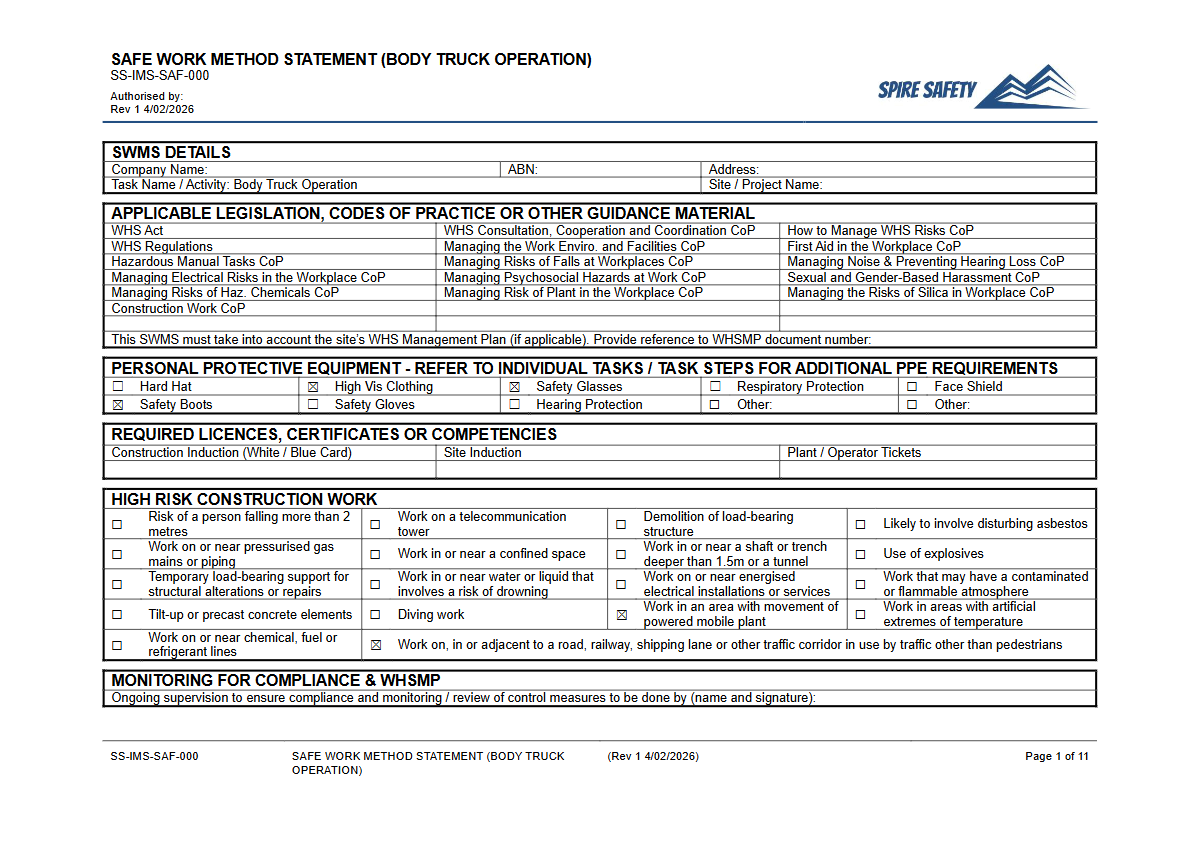
Download our free Safe Work Method Statement (Body Truck Operation) Template. A structured starting point for managing body truck risks. Get your copy today!
Safe Work Method Statement (Body Truck Operation) Template
DOCX • 159 KB + PDF
Updated Oct 2026
No signup required
Purpose of the Safe Work Method Statement (Body Truck Operation) Template
This free WHS resource provides a structured Safe Work Method Statement (SWMS) template specifically for body truck operation. It is designed to assist persons conducting a business or undertaking (PCBUs) in meeting their WHS obligations by systematically identifying hazards, assessing risks, and implementing control measures associated with operating a body truck.
The template helps ensure that critical safety steps are considered and documented before work commences, promoting a proactive approach to workplace health and safety.
Using a comprehensive Safe Work Method Statement (Body Truck Operation) Template facilitates clear communication of safe work procedures to all workers involved. This helps to minimise the risk of incidents and injuries during tasks such as loading, unloading, transporting materials, and operating the truck in various environments.
It also supports due diligence by providing a record of the risk management process undertaken for this common high-risk activity.
Video walkthrough
How to use the Safe Work Method Statement (Body Truck Operation) Template
Our Safe Work Method Statement (Body Truck Operation) Template is provided in an editable DOCX format, making it easy to customise for your specific workplace conditions and tasks. While it offers a solid foundation based on the model WHS framework, it is crucial that this template is adapted to your unique operational environment. This involves:
- Reviewing all pre-filled sections for relevance to your specific body truck model and operating context.
- Identifying any additional hazards unique to your site or specific tasks.
- Evaluating the effectiveness of suggested control measures and adding or modifying them as necessary to reflect your actual risk management strategies.
- Ensuring all workers involved in body truck operations are consulted during the customisation process and understand the finalised SWMS.
- Implementing and regularly reviewing the document as part of your overall WHS management systems.
Remember, a template is only a starting point; its effectiveness depends on thorough customisation and diligent implementation within your organisation.
When to use it
This Safe Work Method Statement template should be used whenever body truck operation is identified as a high-risk construction work activity, or any other work activity where specific risks necessitate a formal SWMS. This includes tasks such as:
- Transporting heavy materials on construction sites.
- Loading and unloading operations with excavators, loaders, or other plant.
- Operating in confined spaces or areas with limited visibility.
- Working near overhead power lines or other obstructions.
- Performing tipping operations.
It acts as a primary planning tool before commencing such work.
Who should use it
This resource is invaluable for a range of individuals and organisations, including:
- Construction companies and contractors utilising body trucks.
- Site managers and supervisors responsible for overseeing truck operations.
- Health and safety officers developing and implementing WHS documentation.
- Small businesses operating body trucks who need a structured approach to risk management.
- Anyone involved in WHS consulting or auditing for operations involving heavy vehicles.
It provides a clear framework for anyone needing to document safe work practices for body truck operation.
Common mistakes
Common mistakes to avoid
- Not customising the template to specific site conditions or truck models.
- Failing to consult with workers who will be performing the tasks covered by the SWMS.
- Treating the SWMS as a 'tick and flick' document rather than a living safety plan.
- Not reviewing or updating the SWMS when work conditions change or incidents occur.
Legal references
Legal considerations
The following legal requirements may be relevant to this type of work.
- Work Health and Safety Act (Harmonised) — Provides the primary duties for protecting workers and other people from work health and safety risks.
- Work Health and Safety Regulations (Harmonised) — Sets out requirements supporting the management of workplace hazards and risks.
The following codes may be relevant to this type of work.
- Managing WHS Risks Code of Practice — Provides practical guidance on identifying hazards, assessing risks and applying effective controls.
- Work Health and Safety Consultation, Cooperation and Coordination Code of Practice — Provides practical guidance on consulting workers and coordinating with other duty holders.
- Managing the Work Environment and Facilities Code of Practice — Provides practical guidance on safe work environments, workplace facilities and related controls.
Did you know
Australia's WHS Framework
Australia's WHS laws are based on a model WHS Act, Regulations, and Codes of Practice, which have been implemented in most Australian states and territories, creating a largely harmonised legal framework.
Road Incidents Data
Heavy vehicle incidents are a significant concern; in 2022, heavy vehicle involvement accounted for 18% of all road fatalities in Australia, highlighting the inherent risks associated with truck operations.
FAQ
Frequently asked questions
01What is a Safe Work Method Statement (SWMS)?
02Is a SWMS legally required for all work?
03How often should a SWMS be reviewed?
04Can I use this template for other types of trucks?
Share this resource
Safe Work Method Statement (Body Truck Operation) Template
Browse Categories
How To Use It
- 1Download and open in Word or PDF.
- 2Replace the placeholders with your business details.
- 3Get it reviewed by a WHS specialist before rollout.
Need it customised?
Our WHS consultants can adapt this template to your site, run a gap analysis, or audit what you already have in place.
Book a Free Consultation WHS consulting servicesor call 1300 156 382
Related templates
- Safe Work Method Statement (Bulldozer Operation) Template
- Safe Work Method Statement (Concrete Truck Operation) Template
- Safe Work Method Statement (Elevated Work Platform Operation) Template
- Safe Work Method Statement (Excavator Operation) Template
- Safe Work Method Statement (Float or Low Loader Operation) Template
- Safe Work Method Statement (Fuel Truck Operation) Template