
Safe Work Method Statement (Bulldozer Operation) Template
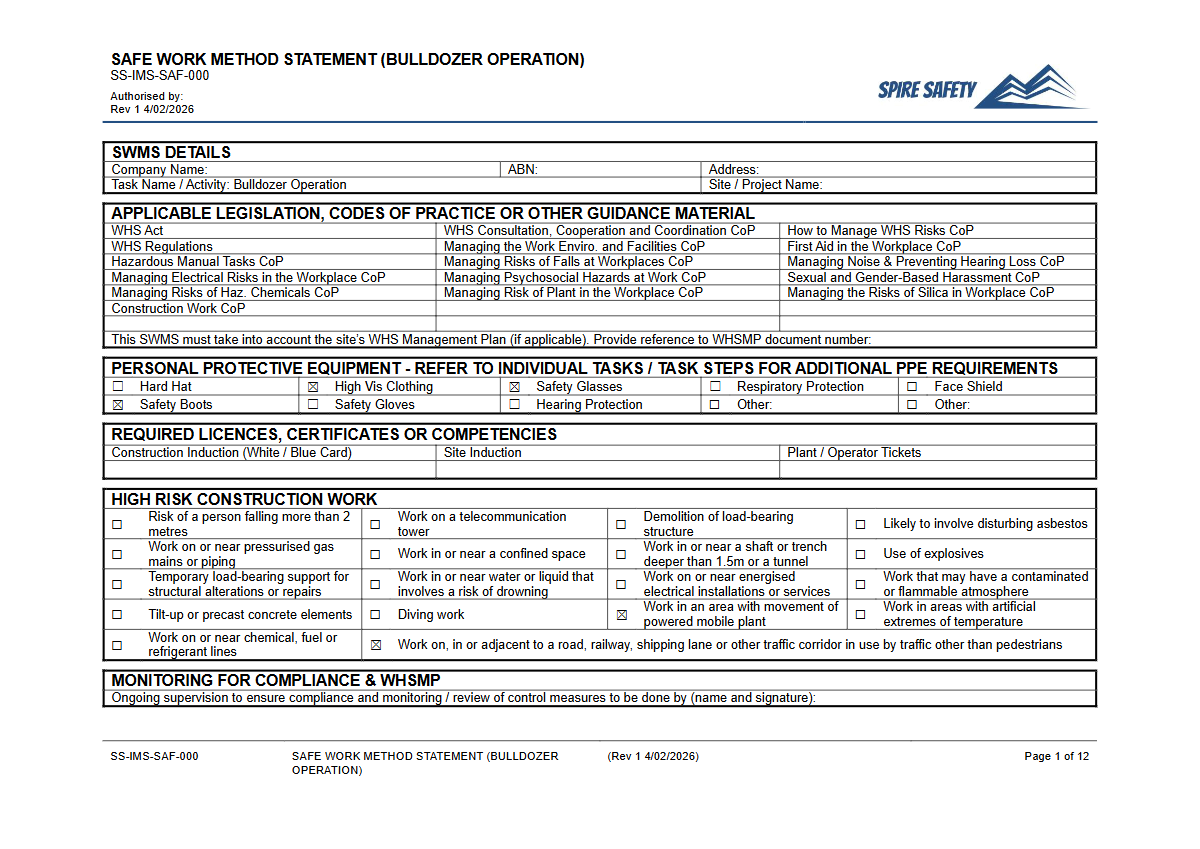
Download our free Safe Work Method Statement (Bulldozer Operation) template. A structured starting point for managing bulldozer risks in your workplace.
Safe Work Method Statement (Bulldozer Operation) Template
DOCX • 160 KB + PDF
Updated Oct 2026
No signup required
Purpose of the Safe Work Method Statement (Bulldozer Operation) Template
This Safe Work Method Statement (Bulldozer Operation) template provides a structured starting point for organisations to identify and control hazards associated with bulldozer operations. Bulldozers are powerful pieces of plant commonly used in construction, mining, and earthmoving, presenting significant risks from crushing, rollovers, falls from height, and collision with other plant or personnel.
This template helps you systematically document the work steps, potential hazards, and the control measures required to manage these risks effectively, aligning with Australian WHS practice.
By utilising this template, businesses can demonstrate their commitment to providing a safe working environment and proactively manage the risks inherent in operating heavy earthmoving equipment. It is designed to facilitate a thorough risk assessment process, ensuring that all aspects of bulldozer use are considered before work commences.
Video walkthrough
How to use the Safe Work Method Statement (Bulldozer Operation) Template
Our free Safe Work Method Statement (Bulldozer Operation) template is delivered as an editable DOCX file, making it easy to customise for your specific workplace and task requirements. While it provides a comprehensive framework, it must be customised to your workplace, specific bulldozer model, and the unique conditions of the work site.
- Download the DOCX or PDF file by clicking the buttons above.
- Review each section of the template and update it with details relevant to your organisation, specific job, and site conditions.
- Conduct a thorough site-specific risk assessment, involving all workers who will be performing or supervising the bulldozer operation.
- Clearly define the scope of work, plant to be used, roles and responsibilities, and specific control measures for identified hazards.
- Ensure all workers involved are trained and understand the SWMS before commencing work.
- Regularly review and update the SWMS as conditions change or new risks emerge.
When to use it
A Safe Work Method Statement (SWMS) for bulldozer operation should be developed and implemented whenever bulldozer work is classified as 'high risk construction work' or involves other high-risk activities as defined by WHS regulations. This includes, but is not limited to, excavation work, work near trenches, demolition, and work in areas with live services.
It's crucial to have a completed and communicated SWMS before any bulldozer work begins, and to review it whenever there are changes to the work environment, equipment, or personnel. This proactive approach helps prevent incidents and supports your compliance efforts with WHS duties.
Who should use it
This template is invaluable for WHS managers, site supervisors, project managers, and business owners responsible for ensuring the safe operation of bulldozers. It is also a critical tool for operators and workers, providing clear instructions on how to perform tasks safely.
Companies that need to demonstrate their commitment to WHS compliance, especially those engaged in civil construction, earthmoving, mining, or landscaping, will find this a practical resource. Engaging in robust risk management is a cornerstone of effective WHS management systems.
What is a Safe Work Method Statement?
A Safe Work Method Statement (SWMS) is a document that sets out the high-risk construction work activities to be carried out, the hazards arising from these activities, and the measures to be put in place to control the risks. It serves as a plan for how to do the job safely and describes the specific control measures to be implemented.
SWMS are required for 'high-risk construction work' in Australia and are a key tool for managing WHS risks on a project site. They are developed through consultation with workers and must be readily available to workers and others who need to see them.
Additional resources for WHS management
Spire Safety offers a range of free WHS resources library to support Australian businesses in managing their safety obligations. From other plant-specific SWMS to general WHS checklists, our resources are designed to help you build a safer workplace.
For more tailored support, consider leveraging our WHS consulting services.
Common mistakes
Common mistakes to avoid
- Using a generic SWMS without customising it for site-specific conditions and equipment.
- Failing to involve workers in the development and review of the SWMS.
- Not adequately training operators and other personnel on the SWMS content.
- Neglecting to review and update the SWMS when conditions, equipment, or tasks change.
Legal references
Legal considerations
The following legal requirements may be relevant to this type of work.
- Work Health and Safety Act (Harmonised) — Provides the primary duties for protecting workers and other people from work health and safety risks.
- Work Health and Safety Regulations (Harmonised) — Sets out requirements supporting the management of workplace hazards and risks.
The following codes may be relevant to this type of work.
- Managing WHS Risks Code of Practice — Provides practical guidance on identifying hazards, assessing risks and applying effective controls.
- Work Health and Safety Consultation, Cooperation and Coordination Code of Practice — Provides practical guidance on consulting workers and coordinating with other duty holders.
- Managing the Work Environment and Facilities Code of Practice — Provides practical guidance on safe work environments, workplace facilities and related controls.
Did you know
Bulldozer History
The first bulldozers were adaptations of farm tractors, fitted with a heavy metal plate (blade) at the front to remove soil, sand, and rubble, significantly revolutionising earthmoving in the early 20th century.
Safety Standards
Modern bulldozers incorporate advanced safety features such as Roll-Over Protective Structures (ROPS) and Falling Object Protective Structures (FOPS), along with sophisticated control systems to enhance operator safety.
FAQ
Frequently asked questions
01Is this bulldozer SWMS template compliant with Australian WHS laws?
02What details should I customise in the template?
03Who needs to approve the completed SWMS?
04Can I use this template for other heavy machinery?
Share this resource
Safe Work Method Statement (Bulldozer Operation) Template
Browse Categories
How To Use It
- 1Download and open in Word or PDF.
- 2Replace the placeholders with your business details.
- 3Get it reviewed by a WHS specialist before rollout.
Need it customised?
Our WHS consultants can adapt this template to your site, run a gap analysis, or audit what you already have in place.
Book a Free Consultation WHS consulting servicesor call 1300 156 382
Related templates
- Safe Work Method Statement (Concrete Truck Operation) Template
- Safe Work Method Statement (Elevated Work Platform Operation) Template
- Safe Work Method Statement (Excavator Operation) Template
- Safe Work Method Statement (Float or Low Loader Operation) Template
- Safe Work Method Statement (Fuel Truck Operation) Template
- Safe Work Method Statement (Light Vehicle Operation) Template